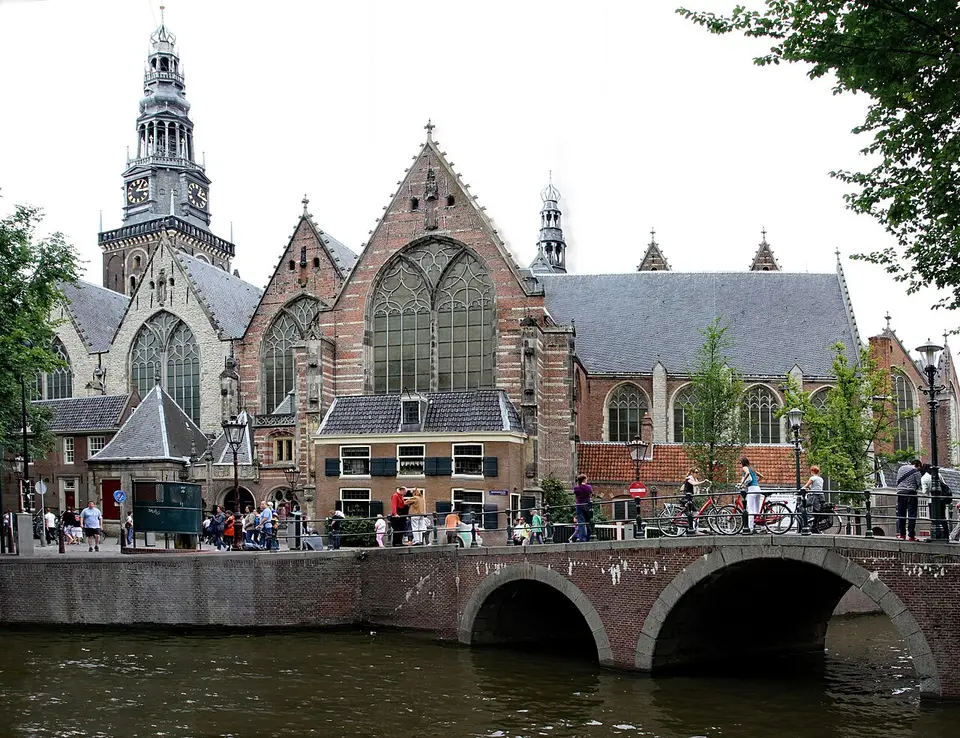
Amsterdam
Amsterdam began as a dam across the river Amstel in the 13th century. Most of what a visitor walks through today was laid out in two bursts: the medieval town around the Dam and the Oude Kerk, and the ring of canals dug in the 17th century, when this was the trading capital of Europe.
It was built by merchants, not by kings, and its centre was never bombed flat or replanned wholesale. So the old city is unusually intact, and unusually easy to read once you know what you are looking at.
In Amsterdam now? Point your phone at something and Lookstory tells you its story.
Open LookstoryWalks
- A walk through medieval Amsterdam, from Centraal Station to the DamA self-guided loop through the oldest part of Amsterdam.
- Along the Amstel: a walk from the Mint Tower to CarréA self-guided walk down the Amstel, the river that gave Amsterdam its name.
- From the Begijnhof to the Skinny Bridge: a walk on the old edgeA self-guided walk along what was the southern edge of medieval Amsterdam, from the hidden courtyard of the Begijnhof past the Munttoren and the Tuschinski cinema to the Magere Brug on the river Amstel.
- Rembrandt and the Jewish Quarter: a walk from the NieuwmarktA self-guided walk from the Waag on the Nieuwmarkt through the streets where Rembrandt lived to the old Jewish Quarter and its memorials.
- The western canal ring: a walk from the Dam to the NoorderkerkA short self-guided walk from Dam Square out through the 17th-century canal ring to the edge of the Jordaan.
Understanding Amsterdam
- Amsterdam in the Dutch Golden AgeIn the 17th century Amsterdam grew from a middling port into the richest trading city in Europe.
- Amsterdam in the Second World WarGermany occupied Amsterdam from May 1940 to May 1945.
- Amsterdam’s Jewish Quarter: what it was and what remainsThe Jodenbuurt, just east of the old centre, was the heart of Jewish life in Amsterdam for more than three centuries.
- Dam Square: the dam that gave Amsterdam its nameDam Square is the site of the dam built across the river Amstel in the 13th century, the one the city is named after.
- De Wallen: Amsterdam’s red-light district and how it beganDe Wallen is the medieval core of Amsterdam, the district around the Oude Kerk between the Damrak and the Nieuwmarkt.
- Hendrick de Keyser, the man who gave Amsterdam its skylineHendrick de Keyser (1565–1621) was Amsterdam’s city sculptor and architect during its fastest growth.
- How did Amsterdam get its name, and how old is it?Amsterdam is named after a dam in the river Amstel, built in the 13th century where Dam Square is now.
- Leidseplein: the square of the theatre and the caféThe Leidseplein is the square at the edge of old Amsterdam where the city theatre has stood since the 18th century.
- Medieval Amsterdam: what is left of itAmsterdam began in the 13th century as a settlement at a dam in the river Amstel.
- Pierre Cuypers: the architect of the Rijksmuseum and Centraal StationPierre Cuypers (1827–1921) designed the two buildings that frame the centre of Amsterdam: the Rijksmuseum, opened in 1885, and Centraal Station, opened in 1889.
- Rembrandt in Amsterdam: where he lived, worked and is buriedRembrandt van Rijn moved from Leiden to Amsterdam in 1631 and stayed until he died in 1669.
- The Amsterdam School of architectureThe Amsterdam School is a style of expressive brick architecture that flourished in Amsterdam from about 1910 to 1930.
- The Amsterdam canal ring: how and why it was builtThe canal ring, or Grachtengordel, is the belt of three main canals, the Herengracht, Keizersgracht and Prinsengracht, dug around the medieval city from 1613.
- The Jordaan: from working quarter to Amsterdam’s most wanted addressThe Jordaan is the district west of the Prinsengracht, laid out from 1612 for the craftsmen and labourers the grand canals had no room for.
- What do the three crosses (XXX) of Amsterdam mean?The three crosses on Amsterdam’s flag and coat of arms are Saint Andrew’s crosses.
- Where is Rembrandt buried?Rembrandt is buried in the Westerkerk in Amsterdam, but nobody knows exactly where.
- Why are Amsterdam’s houses so narrow?Amsterdam’s canal houses are narrow because land along the water was scarce and expensive, and it was sold in narrow strips.
- Why do Amsterdam’s houses lean?Amsterdam’s houses lean for two different reasons.
- Why does Amsterdam have hidden churches?After Amsterdam became Protestant in 1578, Catholics were forbidden to worship in public but were quietly allowed to do so indoors, as long as the building did not look like a church from the street.
- Why is Amsterdam built on piles?Amsterdam stands on waterlogged peat and clay that cannot carry a building.
Old Centre
- Amsterdam CentraalAmsterdam Centraal is the city’s main railway station, opened in 1889 and designed by Pierre Cuypers, the architect of the Rijksmuseum.
- Basilica of Saint NicholasThe Basilica of Saint Nicholas is Amsterdam’s principal Catholic church, built from 1884 to 1887 opposite Centraal Station to a design by Adrianus Bleijs.
- BegijnhofThe Begijnhof is an enclosed courtyard of houses in the centre of Amsterdam, founded in the 14th century for the beguines, a community of unmarried Catholic women.
- BurgerweeshuisThe Burgerweeshuis was Amsterdam’s city orphanage from about 1580 to 1960, in a former convent between the Kalverstraat and the Nieuwezijds Voorburgwal.
- MunttorenThe Munttoren is a tower on the Muntplein that began as part of the Regulierspoort, a medieval gate in Amsterdam’s city wall.
- Oost-Indisch HuisThe Oost-Indisch Huis is the former Amsterdam headquarters of the Dutch East India Company, the VOC, built in 1606.
- Ronde Lutherse KerkThe Ronde Lutherse Kerk, the Round Lutheran Church, is a domed former church on the Singel, built in 1668–1671 to a design by Adriaan Dortsman.
- ScheepvaarthuisThe Scheepvaarthuis, or Shipping House, was built from 1913 to 1916 as the shared headquarters of six Amsterdam shipping companies.
- SchreierstorenThe Schreierstoren is a defensive tower from the 1480s, the only defensive tower of Amsterdam’s medieval city wall still standing.
- Tuschinski TheatreThe Tuschinski is a cinema on the Reguliersbreestraat, opened in 1921 by Abraham Tuschinski.
Canal Belt
- AmstelhofThe Amstelhof is a very long brick building on the Amstel, built in the early 1680s as a home for old women and used to house the elderly until 2007.
- Anne Frank HouseThe Anne Frank House is the canal house at Prinsengracht 263 where Anne Frank, her family and four others hid from 1942 to 1944 in rooms at the back of her father’s business.
- HomomonumentThe Homomonument is a memorial of three pink granite triangles beside the Westerkerk, designed by Karin Daan and unveiled in 1987.
- Huis met de HoofdenThe Huis met de Hoofden, the House with the Heads, is a large canal house of 1622 on the Keizersgracht, named after the six carved heads of Roman gods on its front.
- Magere BrugThe Magere Brug, or Skinny Bridge, is a white wooden drawbridge across the river Amstel.
- Rembrandt MonumentThe Rembrandt Monument is a cast-iron statue of the painter by Louis Royer, unveiled in 1852 on what was then the butter market.
- Theater CarréTheater Carré is a theatre on the Amstel that opened in December 1887 as a permanent circus building for the circus director Oscar Carré.
- WesterkerkThe Westerkerk is a Protestant church on the Prinsengracht, built from 1620 to 1631 to a design by Hendrick de Keyser.
Jodenbuurt
- BlauwbrugThe Blauwbrug, the Blue Bridge, is a richly decorated bridge of 1883 over the Amstel, between the Amstelstraat and the Waterlooplein.
- De DokwerkerDe Dokwerker is a bronze statue by Mari Andriessen, unveiled in 1952, that commemorates the February Strike of 1941, when workers in Amsterdam went on strike against the persecution of the city’s Jews.
- Mozes en AäronkerkThe Mozes en Aäronkerk is a Roman Catholic church of 1837–1841 on the Waterlooplein, designed by Tieleman Franciscus Suys and officially dedicated to Saint Anthony of Padua.
- Portuguese SynagogueThe Portuguese Synagogue, or Esnoga, was built from 1671 to 1675 for Amsterdam’s Sephardic Jewish community, to a design by Elias Bouman.
- Rembrandt HouseThe Rembrandt House is the house on the Jodenbreestraat where Rembrandt van Rijn lived and worked from 1639 to 1658.
Dam
- Magna PlazaMagna Plaza is a shopping centre in Amsterdam’s former Main Post Office, built in 1895–1899 behind the Royal Palace to a design by the government architect Cornelis Peters.
- National MonumentThe National Monument is the Netherlands’ principal memorial to the Second World War: a 22-metre travertine pillar on Dam Square, unveiled in 1956.
- Nieuwe KerkThe Nieuwe Kerk is a 15th-century Gothic church on Dam Square, next to the Royal Palace.
- Royal PalaceThe Royal Palace on Dam Square was built between 1648 and 1665 as Amsterdam’s town hall, designed by Jacob van Campen.
Nieuwmarkt
- De WaagDe Waag on the Nieuwmarkt was built in 1488 as Saint Anthony’s Gate, one of the main gates in Amsterdam’s medieval city wall.
- TrippenhuisThe Trippenhuis is a double canal mansion on the Kloveniersburgwal, built from 1660 to 1662 for the brothers Louis and Hendrick Trip, who were arms dealers.
- ZuiderkerkThe Zuiderkerk is the first church built in Amsterdam for Protestant worship, designed by Hendrick de Keyser and completed in 1611, with its tower finished in 1614.
De Wallen
Leidseplein
Museum Quarter
Elsewhere in Amsterdam
- Beurs van BerlageThe Beurs van Berlage is the former Amsterdam commodity exchange on the Damrak, built from 1898 to 1903 to a design by Hendrik Petrus Berlage.
- Het ScheepvaartmuseumHet Scheepvaartmuseum, the Dutch national maritime museum, occupies ’s Lands Zeemagazijn, the storehouse built in 1656 for the navy of the Admiralty of Amsterdam.
- Hollandsche SchouwburgThe Hollandsche Schouwburg is a former theatre, opened in 1892, that the German occupiers used in 1942 and 1943 as the assembly point from which Amsterdam’s Jews were deported.
- MontelbaanstorenThe Montelbaanstoren is a tower on the Oudeschans canal, built in 1516 to defend Amsterdam’s shipyards.
- NoorderkerkThe Noorderkerk is a Protestant church on the Noordermarkt, built from 1620 to 1623 for the working people of the new Jordaan district.
- West-Indisch HuisThe West-Indisch Huis was the headquarters of the Dutch West India Company from 1623 to 1647.