Amsterdam’s Jewish Quarter: what it was and what remains
The Jodenbuurt, just east of the old centre, was the heart of Jewish life in Amsterdam for more than three centuries. Most of the people who lived there were murdered in the Second World War and most of its streets were later demolished. Its synagogues, a few houses and its memorials remain.
Who came, and why here
The first Jews to settle in Amsterdam, around 1600, were Sephardim: families from Portugal and Spain who had been forced to convert and could live openly as Jews here. In the decades that followed they were joined by Ashkenazi Jews fleeing war and persecution in Germany and Poland, who were poorer and soon far more numerous.
Before the German occupation they were never confined to a ghetto. They settled in this district because it was new, cheap land on the edge of the city, and they stayed because the community was here. Most guilds were closed to them, so they worked in the trades that were not: diamonds, printing, tobacco and street selling. The philosopher Spinoza was born in the quarter in 1632, and Rembrandt lived on its main street.
Two synagogues facing each other
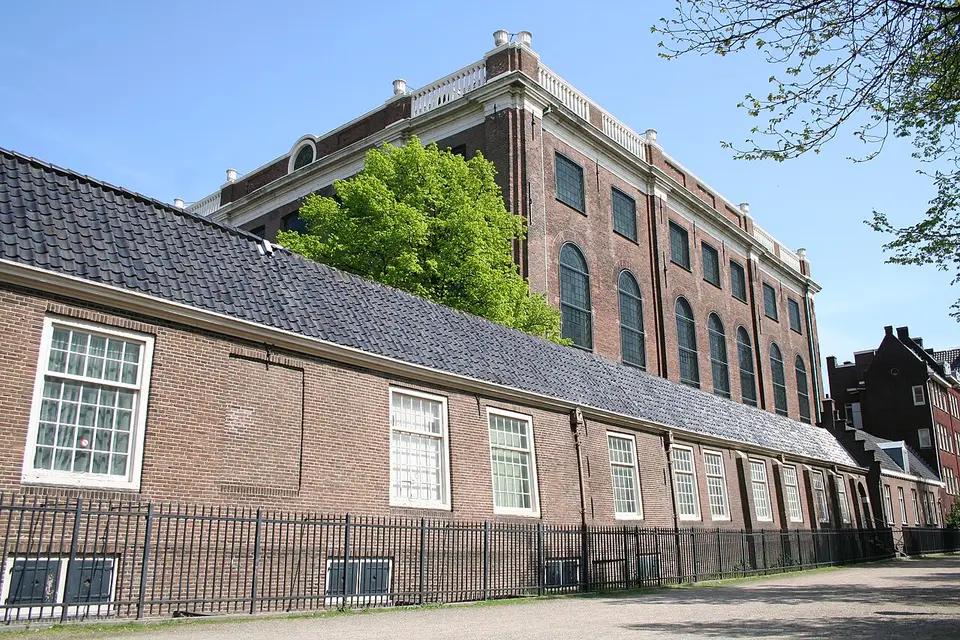
By the 1670s both communities were confident enough to build in the open. The Ashkenazi Great Synagogue opened in 1671 and the far larger Portuguese Synagogue in 1675, on opposite sides of the same square. At a time when Catholics in the city had to hide their churches, that says a good deal about how Amsterdam treated those who were useful to it.
The Great Synagogue and three later ones beside it now house the Jewish Museum. The Portuguese Synagogue is still used for services.
What happened to it
In 1941 the occupiers declared the quarter a Jewish ghetto. That February, German police sealed it off and seized more than four hundred men on the square between the synagogues, which set off the February Strike. From July 1942 its people were deported. By the end of the war the district was empty, and during the famine of the last winter its abandoned houses were pulled apart for firewood.
What was left was cleared in the decades that followed, for a wide road and then for the metro, against fierce protest. The city hall and opera house that stand on the Waterlooplein today were built on the site of the oldest part of the quarter. The statue of the dock worker marks the square where the round-up took place.
Where to see it
- Portuguese Synagogue The Portuguese Synagogue, or Esnoga, was built from 1671 to 1675 for Amsterdam’s Sephardic Jewish community, to a design by Elias Bouman.
- De Dokwerker De Dokwerker is a bronze statue by Mari Andriessen, unveiled in 1952, that commemorates the February Strike of 1941, when workers in Amsterdam went on strike against the persecution of the city’s Jews.
- Rembrandt House The Rembrandt House is the house on the Jodenbreestraat where Rembrandt van Rijn lived and worked from 1639 to 1658.
- Zuiderkerk The Zuiderkerk is the first church built in Amsterdam for Protestant worship, designed by Hendrick de Keyser and completed in 1611, with its tower finished in 1614.
- Mozes en Aäronkerk The Mozes en Aäronkerk is a Roman Catholic church of 1837–1841 on the Waterlooplein, designed by Tieleman Franciscus Suys and officially dedicated to Saint Anthony of Padua.
- Blauwbrug The Blauwbrug, the Blue Bridge, is a richly decorated bridge of 1883 over the Amstel, between the Amstelstraat and the Waterlooplein.
- Hollandsche Schouwburg The Hollandsche Schouwburg is a former theatre, opened in 1892, that the German occupiers used in 1942 and 1943 as the assembly point from which Amsterdam’s Jews were deported.
Walking through Amsterdam? Lookstory tells you the story of whatever you’re standing in front of. Point your phone at it.
Open Lookstory