Amsterdam in the Second World War
Germany occupied Amsterdam from May 1940 to May 1945. About 80,000 Jews lived in the city when the occupation began, and most of them were deported and murdered. The memorials to those years stand within walking distance of each other in the centre.
Occupation
The German army invaded the Netherlands on 10 May 1940, and the country surrendered within a week, after the bombing of Rotterdam. Amsterdam itself was taken without a fight. At first daily life went on. Then, step by step, Jewish residents were dismissed from their jobs, banned from parks, trams and cinemas, and made to register.
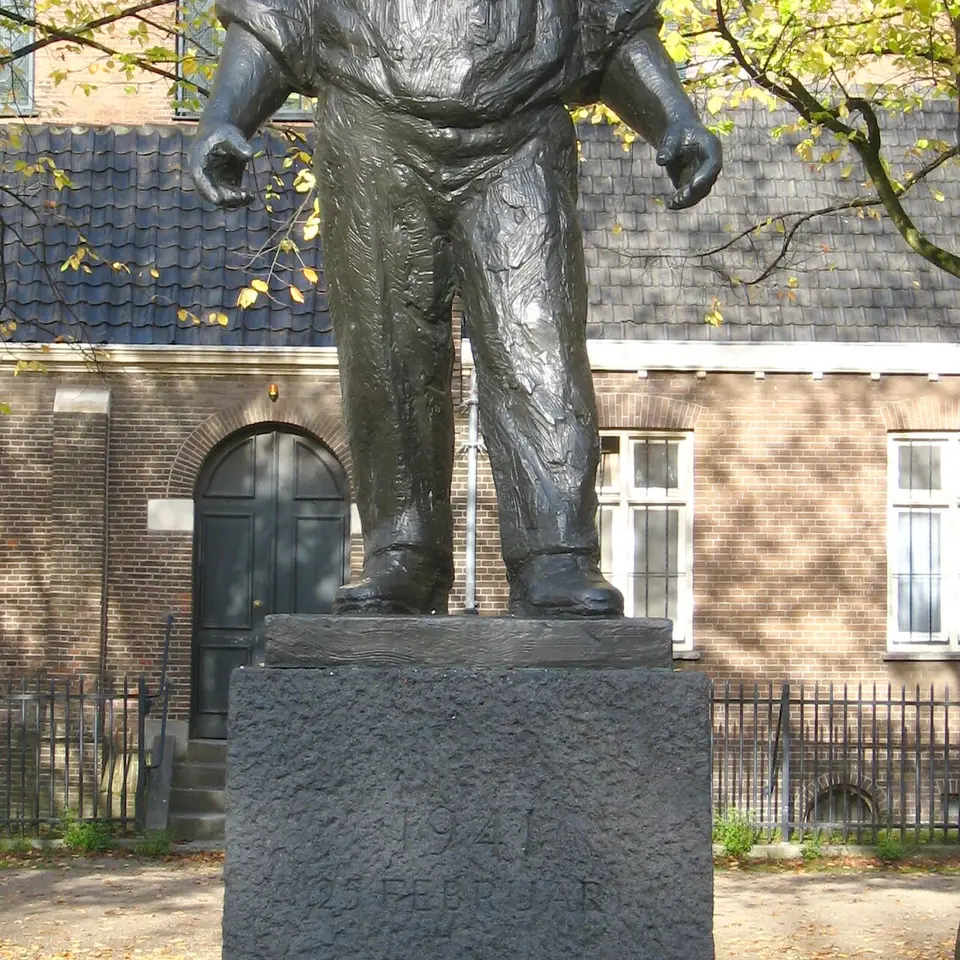
In February 1941, after German police rounded up more than four hundred Jewish men on the Jonas Daniël Meijerplein, the city went on strike. Trams stopped, docks and factories emptied. It was put down within two days, and it remains one of the few mass protests against the persecution of the Jews anywhere in occupied Europe.
Deportation and hiding
Deportations began in July 1942. People were ordered to report, or were taken from their homes at night, held in a theatre in the east of the centre and sent by train to the transit camp at Westerbork, and from there to Auschwitz and Sobibor. Of about 140,000 Jews in the Netherlands, more than 100,000 were killed, a higher share than in any other country in western Europe.
Some went into hiding. The best known are the eight people in the back rooms of Prinsengracht 263, among them Anne Frank, who were found in August 1944.
The last winter, and after
The south of the Netherlands was freed in the autumn of 1944. Amsterdam was not. Through the winter that followed, food and fuel stopped reaching the west of the country, and around 20,000 people died of hunger and cold. In Amsterdam the empty houses of the Jewish quarter were stripped of their timber for firewood.
Germany surrendered in the Netherlands on 5 May 1945. Two days later, German sailors fired on the crowd celebrating on Dam Square. The National Monument now stands on that square, and every year on the evening of 4 May the country keeps two minutes of silence there.
Where to see it
- De Dokwerker De Dokwerker is a bronze statue by Mari Andriessen, unveiled in 1952, that commemorates the February Strike of 1941, when workers in Amsterdam went on strike against the persecution of the city’s Jews.
- Anne Frank House The Anne Frank House is the canal house at Prinsengracht 263 where Anne Frank, her family and four others hid from 1942 to 1944 in rooms at the back of her father’s business.
- Portuguese Synagogue The Portuguese Synagogue, or Esnoga, was built from 1671 to 1675 for Amsterdam’s Sephardic Jewish community, to a design by Elias Bouman.
- National Monument The National Monument is the Netherlands’ principal memorial to the Second World War: a 22-metre travertine pillar on Dam Square, unveiled in 1956.
- Homomonument The Homomonument is a memorial of three pink granite triangles beside the Westerkerk, designed by Karin Daan and unveiled in 1987.
- Zuiderkerk The Zuiderkerk is the first church built in Amsterdam for Protestant worship, designed by Hendrick de Keyser and completed in 1611, with its tower finished in 1614.
- Hollandsche Schouwburg The Hollandsche Schouwburg is a former theatre, opened in 1892, that the German occupiers used in 1942 and 1943 as the assembly point from which Amsterdam’s Jews were deported.
- Tuschinski Theatre The Tuschinski is a cinema on the Reguliersbreestraat, opened in 1921 by Abraham Tuschinski.
Walking through Amsterdam? Lookstory tells you the story of whatever you’re standing in front of. Point your phone at it.
Open Lookstory