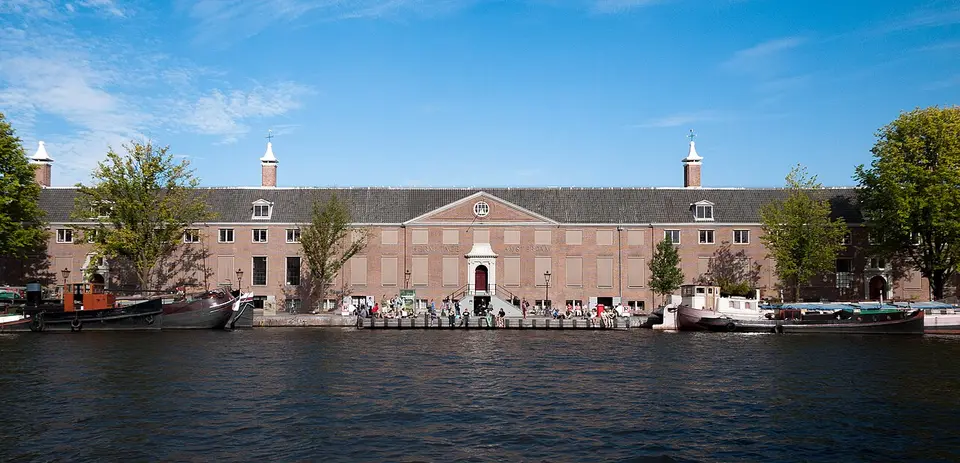
Amstelhof
The Amstelhof is a very long brick building on the Amstel, built in the early 1680s as a home for old women and used to house the elderly until 2007. Since 2009 it has been a museum, first as Hermitage Amsterdam and from September 2023 as the H’ART Museum.
For more than three hundred years old people lived behind this very long wall. The last of them moved out in 2007.
It began with a will. Barent Helleman, a rich merchant, died in 1680 and left about 90,000 guilders to the Reformed Church. The city gave the land. With that the church’s deacons, who looked after its poor, built a home for old women here in the early 1680s. The design was by the city carpenter, Hans Petersom.
The stone tablet over the door still carries its first name and a year: Diaconie Oude Vrouwen Huys, 1681. Amsterdam had a shorter name for it, the Besjeshuis, the old women’s house.
The grand doorway is not quite what it seems. The story is that the burgomasters thought a building of this standing needed an entrance with steps. But the church hall lies directly behind the door, so it could never be the way in.
At first only women lived here. Men were admitted later. The name Amstelhof is much younger than the building: it dates from 1953.
By the 1990s the place no longer suited nursing care. The last residents left in 2007, and in June 2009 it opened as Hermitage Amsterdam, a branch of the museum in Saint Petersburg. Queen Beatrix and the Russian president, Dmitry Medvedev, performed the opening. In March 2022, after Russia invaded Ukraine, the museum cut that tie. Since 1 September 2023 it has been the H’ART Museum, and it now works with the British Museum, the Centre Pompidou and the Smithsonian American Art Museum.
What to look for
The tablet over the door
At the top of the steps, above the door, a stone tablet carries the building’s first name: Diaconie Oude Vrouwen Huys, the deacons’ home for old women, with the year 1681.
How long it is
Walk from one end to the other, or look from across the river. The front is 102 metres long, and was the longest in Amsterdam when it was built.
One ornament
Above the door the roofline breaks into a low triangle with a single round window. Apart from the doorways, it is almost the only decoration on the whole front.
Key facts
- Built
- Early 1680s, as a home for old women
- Designed by
- Hans Petersom, city carpenter
- Named Amstelhof
- 1953
- Last residents left
- 2007
- Museum
- Hermitage Amsterdam from 2009; H’ART Museum since September 2023
- Address
- Amstel 51, Amsterdam Directions
Close by
The bigger picture
In Amsterdam? Lookstory tells you the story of whatever you’re standing in front of. Point your phone at it.
Open LookstorySources
The dates, names and figures on this page were checked against published references. These are the records for this place. The story is Lookstory’s own telling of them. Last updated October 2026.