Het Scheepvaartmuseum
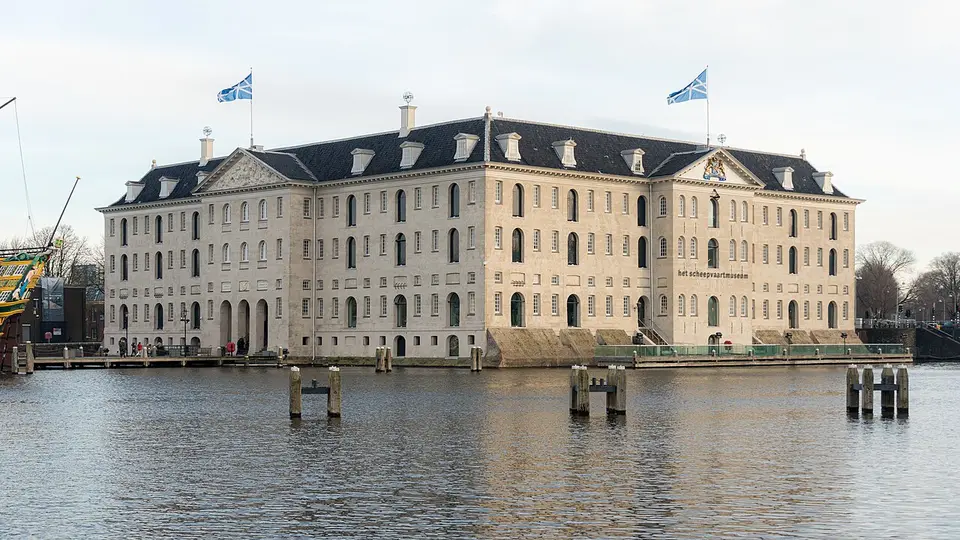
Het Scheepvaartmuseum, the Dutch national maritime museum, occupies ’s Lands Zeemagazijn, the storehouse built in 1656 for the navy of the Admiralty of Amsterdam. A full-size replica of an 18th-century East India Company ship is moored beside it.
It looks like a palace of pale stone. It is a brick warehouse with a coat of plaster, and it was built in nine months to keep a navy at sea.
In the 1650s the Dutch Republic had just fought England at sea, and expected to do so again. Amsterdam’s admiralty needed somewhere to keep everything a fleet uses: sails, rope, cannon, anchors, flags. The city laid out new islands in the harbour for shipbuilding and put this storehouse at the head of them.
Daniël Stalpaert, the city architect, designed it, and an unusually large crew of carpenters and bricklayers had it ready in about nine months. It stands in the water on some 2,300 wooden piles: four wings around a square courtyard, each side almost the same as the next. Under the courtyard were vaulted cisterns that held about forty thousand litres of rainwater, to fill the casks of ships about to sail.
On a July night in 1791 the whole building burned. Only the walls were left standing. They were repaired rather than replaced, and then plastered and painted the colour of sandstone, with joints drawn in to look like great blocks. That disguise is what you are looking at. Underneath it is brick.
The navy went on using the building as a store until the 20th century. It has been the national maritime museum since 1973.
The ship at the jetty is a copy of the Amsterdam, which belonged to the Dutch East India Company. The original left for Asia in January 1749 and was wrecked on the English coast, near Hastings, less than three weeks later. Volunteers built this one between 1985 and 1990.
What to look for
The stone that is not stone
Look closely at the walls. The blocks are lines drawn in plaster over brick, added when the building was repaired after the fire of 1791.
The pediments
Each side has a triangular pediment filled with carved figures. They are thought to have been designed by Artus Quellinus, the sculptor of the town hall on the Dam, and carved by his pupils.
The ship
The Amsterdam shows the size of ship that sailed to Asia and back: three masts, and room for several hundred people on a voyage of many months.
Key facts
- Built
- 1655–1656, for the Admiralty of Amsterdam
- Architect
- Daniël Stalpaert, the city architect
- Foundations
- About 2,300 wooden piles
- Fire
- Night of 5–6 July 1791; only the walls were left
- Museum since
- 1973
- Address
- Kattenburgerplein 1, Amsterdam Directions
Close by
The bigger picture
In Amsterdam? Lookstory tells you the story of whatever you’re standing in front of. Point your phone at it.
Open LookstorySources
The dates, names and figures on this page were checked against published references. These are the records for this place. The story is Lookstory’s own telling of them. Last updated October 2026.