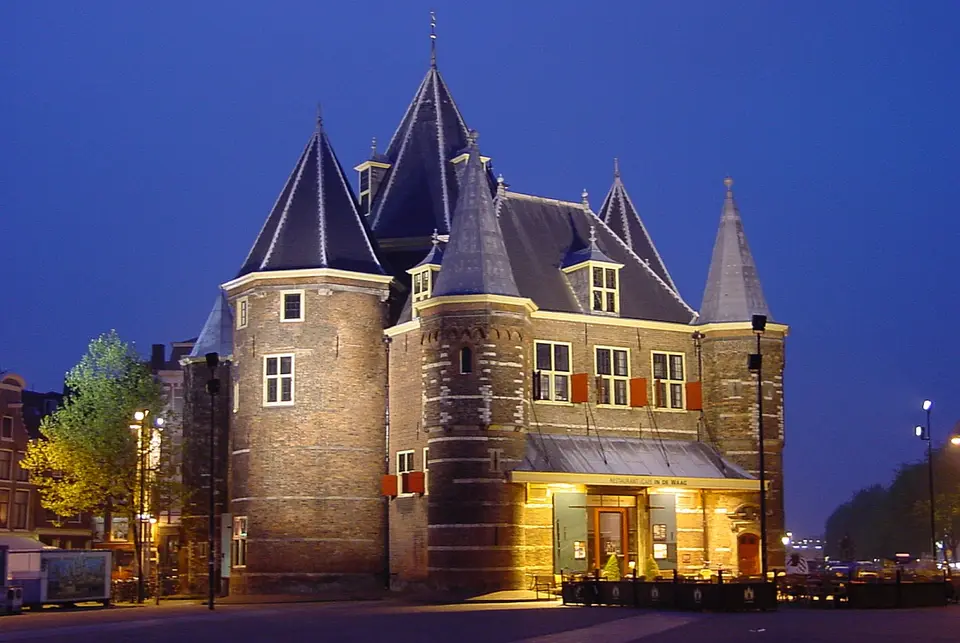
De Waag
De Waag on the Nieuwmarkt was built in 1488 as Saint Anthony’s Gate, one of the main gates in Amsterdam’s medieval city wall. In 1617 it became a weigh house, with guild rooms upstairs, and it is the oldest surviving non-religious building in the city.
This is a city gate with no wall. You are standing where the edge of Amsterdam used to be, and the square around you was a moat.
In 1488 this was the way in from the east. Travellers crossed a bridge over the moat and passed between the towers, and the wall ran off to either side. A stone in one of the towers still records the day the first stone was laid.
A century later Amsterdam had outgrown its walls. The city pushed its defences further out, pulled the old wall down and filled in the moat, which is how the Nieuwmarkt came to exist. The gate was left standing in the middle of a new market square with nothing to guard. It also sits strangely low: the ground was raised around it when the water was filled in.
So the city found it a job. In 1617 the courtyard between the towers was roofed over and it became a weigh house, where goods were weighed on official scales before they could be sold. The rooms upstairs went to the guilds: the smiths, the painters, the masons and the surgeons, each with its own front door.
The surgeons held public dissections here, of executed criminals, in winter when the cold kept the body. In 1632 they commissioned a group portrait from a 25-year-old painter who had recently moved to the city. Rembrandt’s Anatomy Lesson of Dr Nicolaes Tulp was painted for the surgeons’ room in this building, and it made his name.
What to look for
A door for each guild
Walk round the outside and count the entrances. Each guild had its own, with its emblem above. The masons’ door is the one framed in showy brickwork: it was their advertisement.
The central turret
The eight-sided tower in the middle was added in 1691 for the surgeons’ anatomical theatre. The domed room under it is still there.
How low it sits
Compare the doorways with the level of the square. The building looks as though it has sunk; in fact the square was raised.
Key facts
- Built
- 1488, as a city gate
- Weigh house from
- 1617
- Guilds housed
- Masons, painters, smiths and surgeons
- Anatomical theatre added
- 1691
- Address
- Nieuwmarkt 4, Amsterdam Directions
Close by
The bigger picture
In Amsterdam? Lookstory tells you the story of whatever you’re standing in front of. Point your phone at it.
Open LookstorySources
The dates, names and figures on this page were checked against published references. These are the records for this place. The story is Lookstory’s own telling of them. Last updated October 2026.