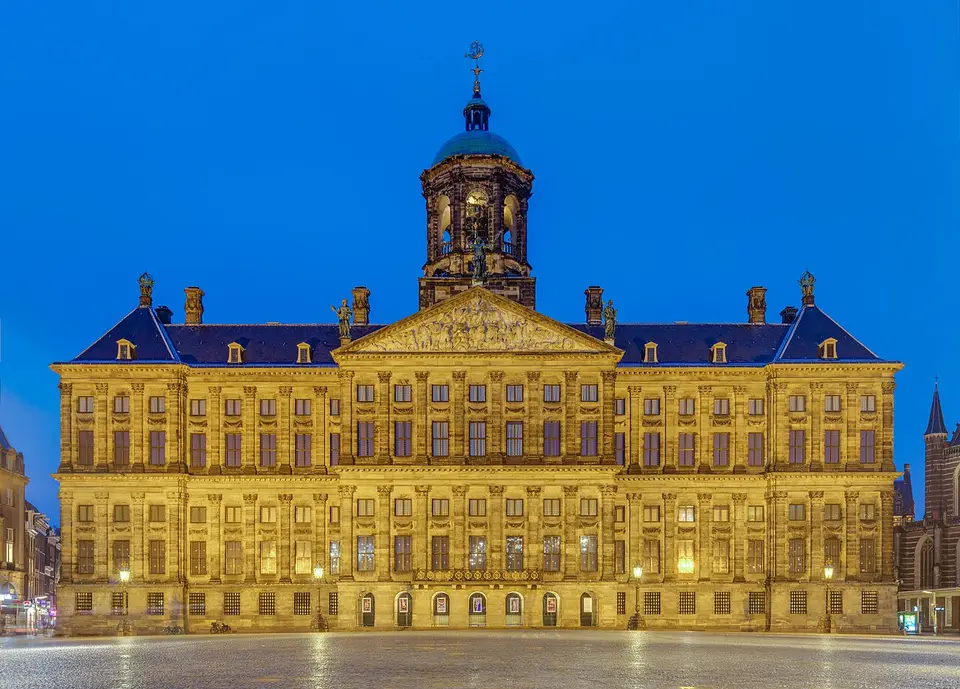
Dam Square: the dam that gave Amsterdam its name
Dam Square is the site of the dam built across the river Amstel in the 13th century, the one the city is named after. It has been Amsterdam’s market, its seat of government and its place of ceremony ever since, and the Royal Palace, the Nieuwe Kerk and the National Monument all stand on it.
A dam in the Amstel
Amsterdam means what it says: the dam in the Amstel. Some time in the 13th century the people living on either bank of the river mouth joined their dikes with a dam, to keep the sea out of the land behind. The first document to mention the place, a toll privilege granted by the count of Holland in 1275, calls its people those living “at the dam in the Amstel”.
The dam had a sluice in it, to let the river out and ships through. On the seaward side was the harbour, the Damrak. On the landward side was the Rokin. Both are streets now, and the square between them is still, underneath, the dam.
A market before it was a square
For centuries this was two spaces rather than one. The dam itself, the Middeldam, held the fish market, where boats tied up and unloaded. Beside it to the west was an open place simply called the Plaetse, with the old town hall on it. The city’s weigh house stood here from the 14th century, because goods sold by weight had to be weighed in public.
In the 17th century Amsterdam replaced its medieval town hall with the enormous building that still fills the west side, in use from 1655. The Nieuwe Kerk beside it was already more than two hundred years old.
How the square was cleared
The town hall became a palace in 1808, when Napoleon’s brother Louis Bonaparte was made king of Holland and moved in. He found a weigh house blocking his view and had it pulled down the same year.
The fish market lasted until the 1840s, when a stock exchange was built over it. That exchange came down in turn after the traders moved to Berlage’s new building on the Damrak in 1903, and a department store has stood on the spot since 1914.
7 May 1945
Two days after the German surrender, thousands of people came to the Dam to welcome the Allied troops. German marines were still in a building on the corner of the Kalverstraat, and they opened fire on the crowd. More than thirty people were killed.
It is one reason the country’s memorial to the war stands here. The National Monument, the white pillar on the east side, was unveiled in 1956, and every year on 4 May the dead are remembered in front of it.
Where to see it
- Royal Palace The Royal Palace on Dam Square was built between 1648 and 1665 as Amsterdam’s town hall, designed by Jacob van Campen.
- Nieuwe Kerk The Nieuwe Kerk is a 15th-century Gothic church on Dam Square, next to the Royal Palace.
- National Monument The National Monument is the Netherlands’ principal memorial to the Second World War: a 22-metre travertine pillar on Dam Square, unveiled in 1956.
- Beurs van Berlage The Beurs van Berlage is the former Amsterdam commodity exchange on the Damrak, built from 1898 to 1903 to a design by Hendrik Petrus Berlage.
Walking through Amsterdam? Lookstory tells you the story of whatever you’re standing in front of. Point your phone at it.
Open Lookstory