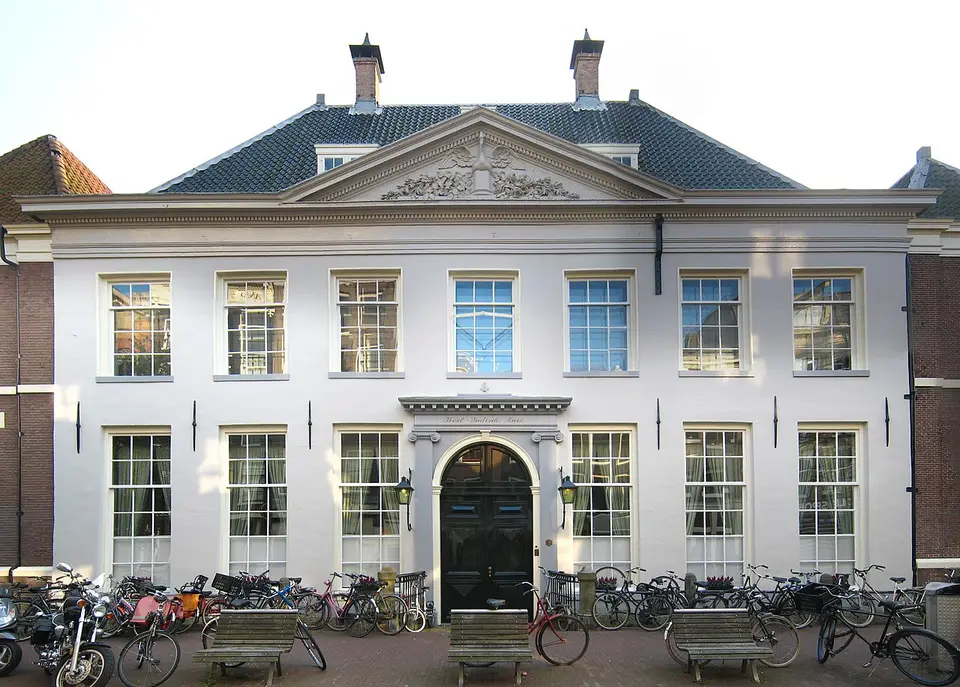
West-Indisch Huis
The West-Indisch Huis was the headquarters of the Dutch West India Company from 1623 to 1647. It was built in 1617 as a meat hall with a guardroom for the civic militia above, and it is where the company’s governors gave the order in 1625 to build a fort on Manhattan.
In 1625 the men who met in this building gave the order to build a fort on an island called Manhattan. That fort was the beginning of New York.
The building was not made for them. In 1617 it was a meat hall, with a guardroom for the civic militia on the floor above. Six years later the Dutch West India Company, founded in 1621, rented it as its headquarters.
The company’s governors, the Heren XIX or Nineteen Gentlemen, met here until 1647. In those years they added two wings round a courtyard, which made the building three times the size.
Two moments from that time are still remembered. In 1625 the governors ordered a fort on Manhattan. And in 1628 Piet Hein captured the Silver Fleet. When he came home the loot was stored in the cellars here, and his crew, who wanted to be paid, stormed the building.
The money did not last. After the loss of Dutch Brazil the company was in financial trouble, and in 1647 it moved out to one of its own warehouses. This building became an inn, and from 1825 a home for orphans and old people. In those years the tall front steps were taken away and the front was plastered, which is the pale wall you see now.
In December 1975 a fire destroyed most of it. A stray firework rocket was the probable cause: a textile wholesaler had the building by then, and the attics were full of cloth. It was restored between 1978 and 1981. Today it holds offices and rooms for weddings and conferences, and the John Adams Institute, which brings American writers and speakers to Amsterdam.
What to look for
The name over the door
Look above the arched door, on the band under the small cornice. The words “West Indisch Huis” are lettered there.
Plaster and brick
The pale middle part is the oldest, the meat hall of 1617, under a coat of 19th-century plaster. The brick fronts to left and right were built later.
Stuyvesant
If the courtyard is open, look for the fountain. The bronze figure on it is Peter Stuyvesant, governor of New Netherland, made by the sculptor Hans Bayens.
Key facts
- Built
- 1617, as a meat hall with a militia guardroom above
- West India Company
- Headquarters from 1623 to 1647
- New York
- The fort on Manhattan was ordered here in 1625
- Fire and restoration
- Burned in December 1975; restored 1978–1981
- Today
- Offices, events and the John Adams Institute
- Address
- Herenmarkt 99, Amsterdam Directions
Close by
The bigger picture
In Amsterdam? Lookstory tells you the story of whatever you’re standing in front of. Point your phone at it.
Open LookstorySources
The dates, names and figures on this page were checked against published references. These are the records for this place. The story is Lookstory’s own telling of them. Last updated October 2026.