How did Amsterdam get its name, and how old is it?
Amsterdam is named after a dam in the river Amstel, built in the 13th century where Dam Square is now. The place is first mentioned in a document of 1275, which is the date the city counts its age from.
The dam in the Amstel
The name says what the place was. Some time in the 13th century the people living on either bank of the river mouth joined their dikes with a dam across the Amstel. Amstel plus dam is Amsterdam.
The dam had a sluice in it, to let the river out and ships through. On the seaward side was the harbour, the Damrak. On the landward side was the Rokin. Both are streets today, and the square between them, Dam Square, is still the dam underneath.
The document of 1275
The first time the place appears in writing is in a toll privilege granted by the count of Holland in 1275. It speaks of the people living “at the dam in the Amstel”. That phrase is the name, before it had been worn down into one word.
That year is the one Amsterdam uses as its birthday. By it, the city is a little over 750 years old.
What is left from the beginning
Nothing above ground survives from 1275. The oldest building in the city is the Oude Kerk, consecrated in 1306, a generation later. The river itself is still there: the Amstel flows into the centre under the Magere Brug and the Blauwbrug.
Where to see it
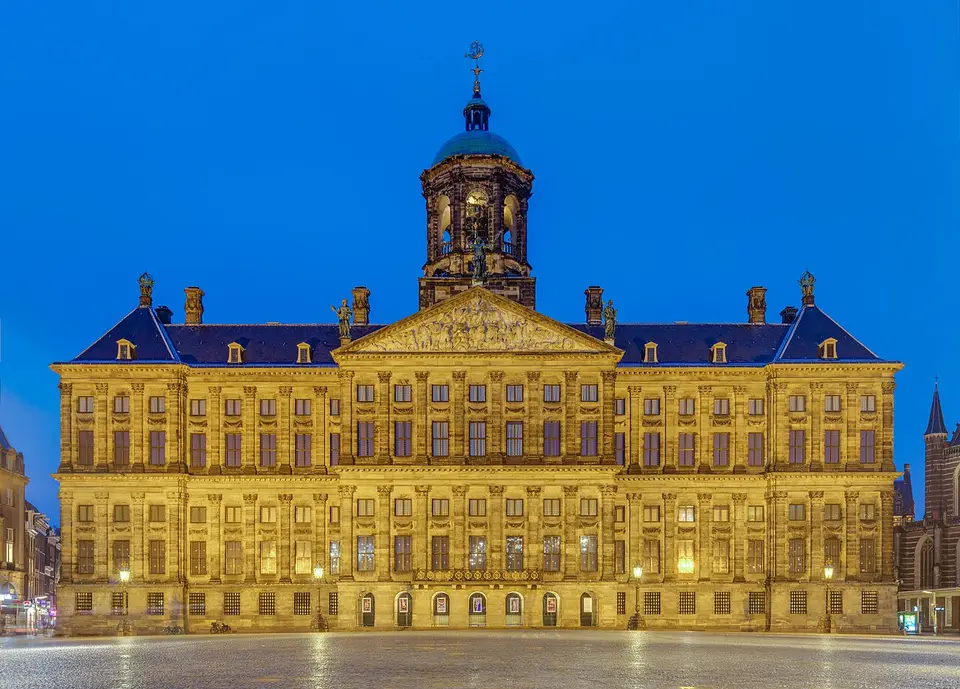
- Royal Palace The Royal Palace on Dam Square was built between 1648 and 1665 as Amsterdam’s town hall, designed by Jacob van Campen.
- Oude Kerk The Oude Kerk is the oldest building in Amsterdam: a parish church consecrated in 1306 and enlarged for the next 250 years.
- Magere Brug The Magere Brug, or Skinny Bridge, is a white wooden drawbridge across the river Amstel.
- National Monument The National Monument is the Netherlands’ principal memorial to the Second World War: a 22-metre travertine pillar on Dam Square, unveiled in 1956.
Walking through Amsterdam? Lookstory tells you the story of whatever you’re standing in front of. Point your phone at it.
Open Lookstory