Mozes en Aäronkerk
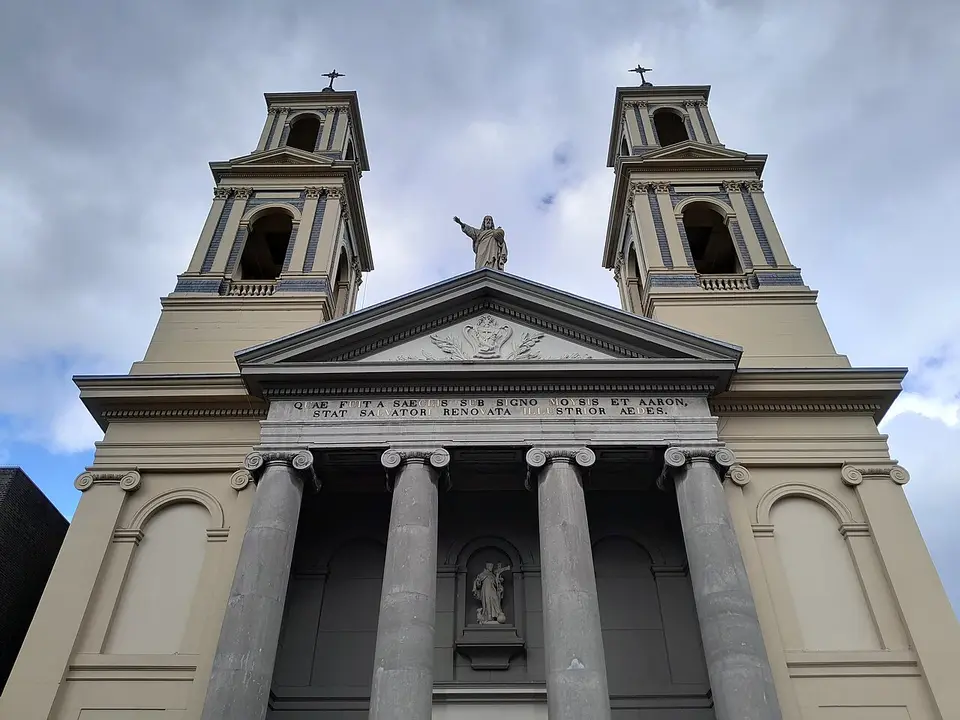
The Mozes en Aäronkerk is a Roman Catholic church of 1837–1841 on the Waterlooplein, designed by Tieleman Franciscus Suys and officially dedicated to Saint Anthony of Padua. Its everyday name comes from two houses, Moses and Aaron, in which it began as a hidden church in the 17th century.
A Catholic church named after two Old Testament brothers. The names belonged to two houses, Moses and Aaron, behind whose gables Catholics worshipped out of sight.
After the Reformation, Catholics in Amsterdam could not worship in public. In 1641 Franciscan priests opened a church inside a house called Moyses, on the Jodenbreestraat, behind where this building stands. In 1682 the house next door, Aäron, was bought as well. The church was dedicated to Saint Anthony of Padua, and officially it still is. But the city knew it by the names of the two houses.
When the restrictions were lifted, the congregation built in the open, and built large. Between 1837 and 1841 the hidden church was replaced by this one, designed by Tieleman Franciscus Suys. He drew on an earlier, unbuilt plan for a cathedral on the Nieuwmarkt, which is why this temple front has two towers.
It is grander to look at than it is solid. The four columns are of Bentheim sandstone, but the two towers are made of wood.
When it was new the church stood on the water. One canal ran in front of it and another along its side. Both were filled in in 1882, and that made the Waterlooplein.
For a long time this was a Catholic church in the middle of the Jewish quarter. From 1980 it was not used as a church at all, and held cultural gatherings instead. Services began again on 28 September 2014, led by the Community of Sant’Egidio.
What to look for
A date hidden in the Latin
Read the two lines under the pediment. They say that what stood for ages under the sign of Moses and Aaron stands renewed for the Saviour. Some of the letters are gilded. Read as Roman numerals and added together, they make 1839.
Christ alone
The statue on top of the pediment is Christ giving a blessing. Two more figures once stood beside him and others on the towers. They are gone.
Liszt was here
On the wall facing the Waterlooplein, look for a relief of the composer Franz Liszt in profile. It recalls his visit to the church in 1866.
Key facts
- Built
- 1837–1841
- Architect
- Tieleman Franciscus Suys
- Dedicated to
- Saint Anthony of Padua
- Began as
- A hidden church in the house Moyses, from 1641
- In use again since
- 2014, by the Community of Sant’Egidio
- Address
- Waterlooplein 207, Amsterdam Directions
Close by
The bigger picture
In Amsterdam? Lookstory tells you the story of whatever you’re standing in front of. Point your phone at it.
Open LookstorySources
The dates, names and figures on this page were checked against published references. These are the records for this place. The story is Lookstory’s own telling of them. Last updated October 2026.