The Amsterdam canal ring: how and why it was built
The canal ring, or Grachtengordel, is the belt of three main canals, the Herengracht, Keizersgracht and Prinsengracht, dug around the medieval city from 1613. It was a planned extension for a fast-growing trading city, and it has been a UNESCO World Heritage Site since 2010.
A city that had run out of room
By 1600 Amsterdam was crammed inside its medieval walls and its population was doubling every generation. The city council decided to build an entirely new town around the old one. Work began in 1613 on the western half, from the Brouwersgracht round to the Leidsegracht, and was finished in about twelve years. The southern and eastern sections, as far as the river Amstel, followed from the 1660s.
The three main canals were named in order of rank. The Herengracht was for the gentlemen who governed the city, the Keizersgracht was named after the emperor Maximilian, and the Prinsengracht after the Prince of Orange.
How it was meant to work
The canals were streets for boats. Goods came to the door by water, and the same water drained the land and carried away the city’s waste. The plots along the main canals were sold for houses and warehouses, with rules about what could be built: no noisy or foul-smelling trades. Those went to the Jordaan, the district laid out to the west for workers and workshops, along the lines of the old drainage ditches.
The grandest stretch is the bend in the Herengracht known as the Golden Bend, where the richest families bought two plots side by side and built double-width mansions.
What to see on it
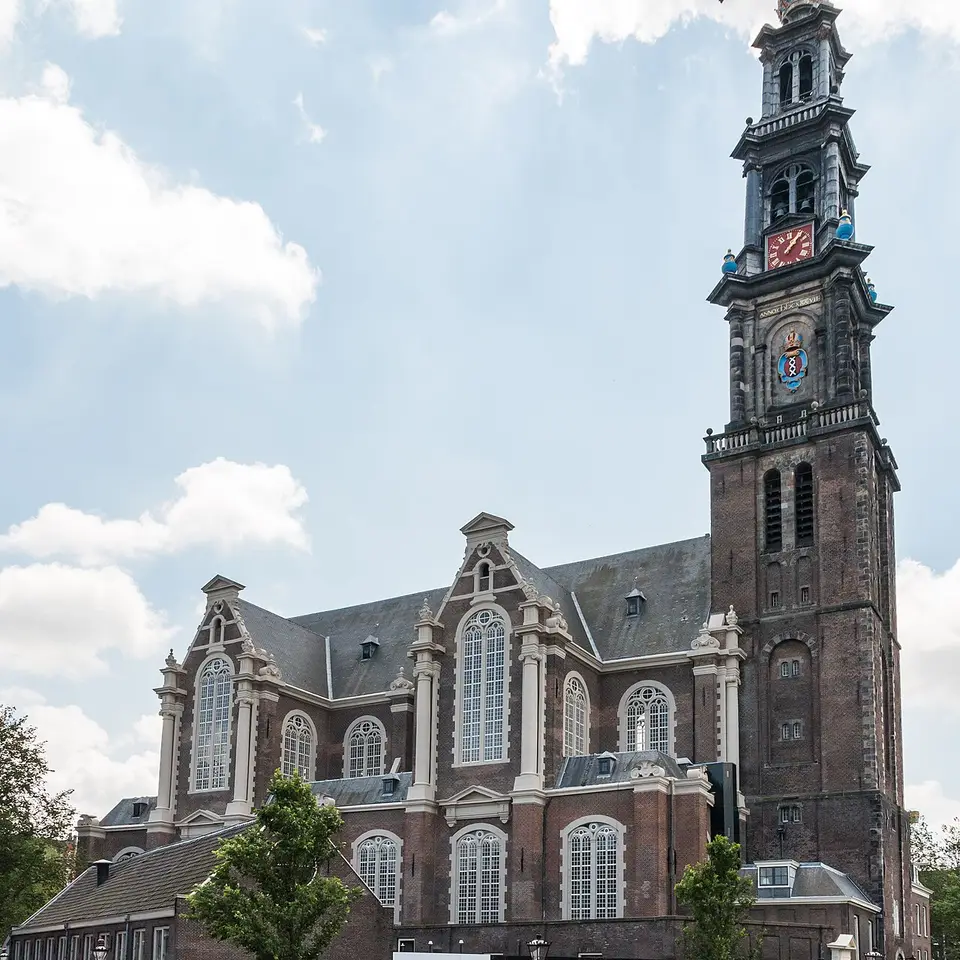
The Westerkerk was the principal church of the new district, and its tower is still the tallest church tower in the city. A few doors up the Prinsengracht is the house where Anne Frank hid, an ordinary merchant’s building of 1635 with a second house behind it. On the square beside the church is the Homomonument.
At its eastern end the ring meets the Amstel, crossed by the wooden Magere Brug. At the inner edge, where the Singel reaches the river, the Munttoren marks the line of the medieval wall the canal ring replaced.
Where to see it
- Westerkerk The Westerkerk is a Protestant church on the Prinsengracht, built from 1620 to 1631 to a design by Hendrick de Keyser.
- Anne Frank House The Anne Frank House is the canal house at Prinsengracht 263 where Anne Frank, her family and four others hid from 1942 to 1944 in rooms at the back of her father’s business.
- Homomonument The Homomonument is a memorial of three pink granite triangles beside the Westerkerk, designed by Karin Daan and unveiled in 1987.
- Magere Brug The Magere Brug, or Skinny Bridge, is a white wooden drawbridge across the river Amstel.
- Munttoren The Munttoren is a tower on the Muntplein that began as part of the Regulierspoort, a medieval gate in Amsterdam’s city wall.
- Huis met de Hoofden The Huis met de Hoofden, the House with the Heads, is a large canal house of 1622 on the Keizersgracht, named after the six carved heads of Roman gods on its front.
- Ronde Lutherse Kerk The Ronde Lutherse Kerk, the Round Lutheran Church, is a domed former church on the Singel, built in 1668–1671 to a design by Adriaan Dortsman.
Walking through Amsterdam? Lookstory tells you the story of whatever you’re standing in front of. Point your phone at it.
Open Lookstory