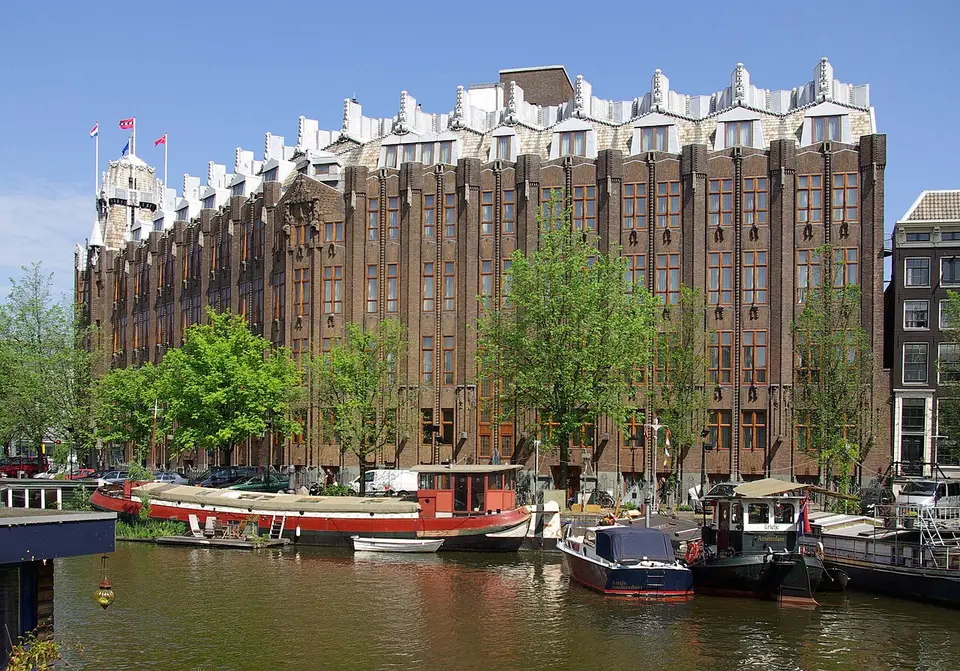
The Amsterdam School of architecture
The Amsterdam School is a style of expressive brick architecture that flourished in Amsterdam from about 1910 to 1930. Its architects, led by Michel de Klerk, Piet Kramer and Johan van der Mey, treated brick as a material to be modelled, and used it above all for workers’ housing.
Where it came from
Around 1900 the leading Dutch architect was Hendrik Petrus Berlage, whose stock exchange on the Damrak stripped a building down to honest brick walls. The next generation admired the honesty and found the result too sober. Three of them, De Klerk, Kramer and Van der Mey, had worked together in the same office, and when Van der Mey won the commission for the Scheepvaarthuis in 1912 he brought the other two in.
That building, finished in 1916, is where the style begins: a modern frame, wrapped in brick that folds, curves and ripples, with ironwork and sculpture worked into every surface.
Palaces for workers
The style found its real purpose in housing. The Housing Act of 1901 let cooperative associations build decent homes with public money, and Amsterdam, run for years by socialist aldermen, built on a large scale. The Amsterdam School architects gave those blocks rounded corners, towers that held nothing, windows in odd shapes and brick laid in patterns, on the argument that working people deserved beauty as much as anyone.
The best known is Het Schip, “the ship”, designed by De Klerk and completed in 1921 in the west of the city. It is now a museum of the movement.
How to recognise it
Look for brick used decoratively: laid upright, at angles or in waves. Look for walls that bulge or curve, small-paned windows grouped in horizontal bands, heavy wooden doors and wrought iron shaped by hand. Sculpture is built into the walls instead of standing in front of them.
The movement faded after De Klerk died in 1923, aged 39, and money for ornament ran out in the 1930s. Kramer went on to design bridges for the city for decades, including the present Magere Brug.
Where to see it
- Scheepvaarthuis The Scheepvaarthuis, or Shipping House, was built from 1913 to 1916 as the shared headquarters of six Amsterdam shipping companies.
- Beurs van Berlage The Beurs van Berlage is the former Amsterdam commodity exchange on the Damrak, built from 1898 to 1903 to a design by Hendrik Petrus Berlage.
- Magere Brug The Magere Brug, or Skinny Bridge, is a white wooden drawbridge across the river Amstel.
Walking through Amsterdam? Lookstory tells you the story of whatever you’re standing in front of. Point your phone at it.
Open Lookstory