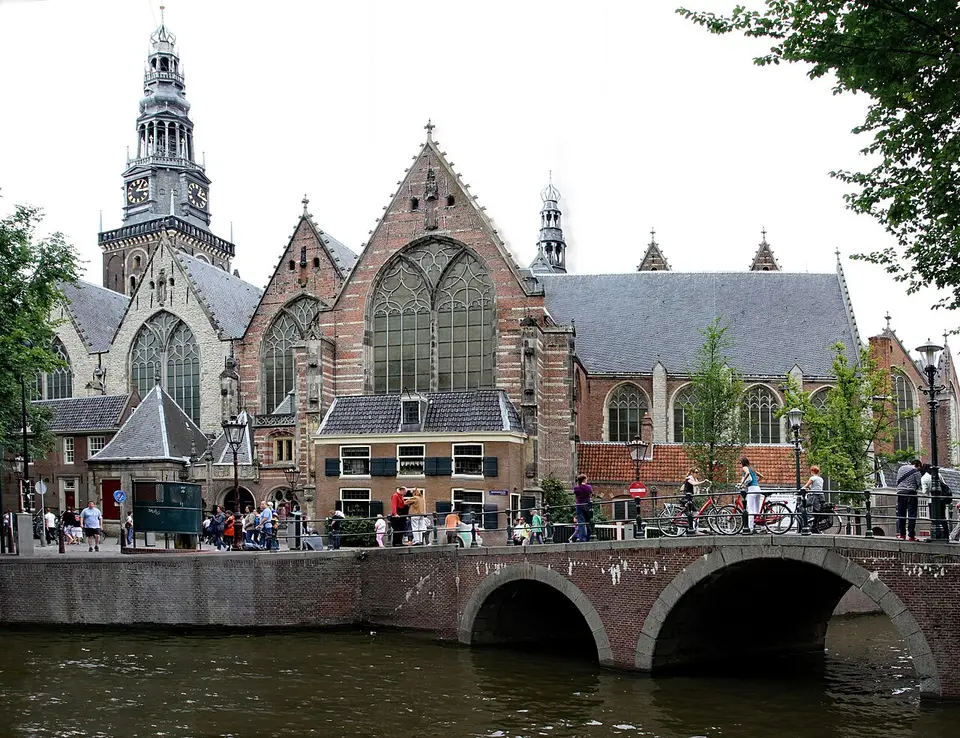
De Wallen: Amsterdam’s red-light district and how it began
De Wallen is the medieval core of Amsterdam, the district around the Oude Kerk between the Damrak and the Nieuwmarkt. It is best known as the red-light district, but it is also where the city began, and it holds its oldest church, its oldest gate and a church hidden in an attic.
What the name means
“Wallen” means ramparts. The two canals that run through the district, the Oudezijds Voorburgwal and the Oudezijds Achterburgwal, began as the moats and earth banks that defended the medieval town on its eastern side. When the city grew past them, the banks became quays and the name stayed.
This was the harbour side of the town. The Zeedijk, the sea dike, ran along its northern edge, and ships anchored in the open water just beyond. The Oude Kerk, consecrated in 1306, was the sailors’ church.
Why the red-light district is here
Where sailors came ashore there were taverns, lodging houses and prostitution, and they have been here since the Middle Ages. The city alternated for centuries between banning it and tolerating it. The windows the district is known for are a 20th-century development, and brothels were made legal in the Netherlands in 2000.
People live here, and the women in the windows are at work. Photographing them is not allowed, and the city has spent years trying to reduce the crowds that come only to stare.
What to look for instead
The district has more medieval fabric than anywhere else in Amsterdam. The Oude Kerk stands in the middle of it. A few doors along the canal, an ordinary-looking house holds a complete Catholic church in its attic. At the northern end the Schreierstoren marks the corner of the old city wall, and at the eastern edge the Waag, once a city gate, sits in the middle of the Nieuwmarkt.
At Zeedijk 1 is one of only two wooden house fronts left in the city centre. The streets around it are Amsterdam’s Chinatown.
Where to see it
- Oude Kerk The Oude Kerk is the oldest building in Amsterdam: a parish church consecrated in 1306 and enlarged for the next 250 years.
- Our Lord in the Attic Our Lord in the Attic is a 17th-century canal house with a complete Catholic church hidden in its top floors.
- De Waag De Waag on the Nieuwmarkt was built in 1488 as Saint Anthony’s Gate, one of the main gates in Amsterdam’s medieval city wall.
- Schreierstoren The Schreierstoren is a defensive tower from the 1480s, the only defensive tower of Amsterdam’s medieval city wall still standing.
- Oost-Indisch Huis The Oost-Indisch Huis is the former Amsterdam headquarters of the Dutch East India Company, the VOC, built in 1606.
Walking through Amsterdam? Lookstory tells you the story of whatever you’re standing in front of. Point your phone at it.
Open Lookstory