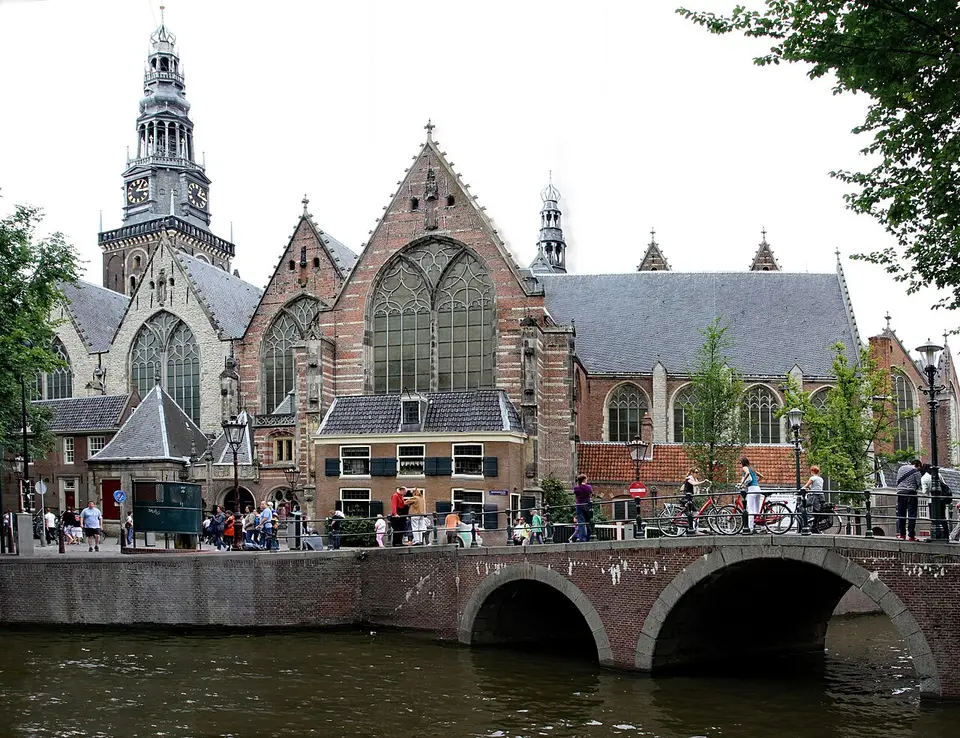
Medieval Amsterdam: what is left of it
Amsterdam began in the 13th century as a settlement at a dam in the river Amstel. Two great fires, in 1421 and 1452, destroyed most of the wooden town, so little survives from before 1500: two churches, a city gate, a tower, a wooden house and the plan of the streets.
A dam in a river
In the 13th century the people living at the mouth of the Amstel built a dam across it to keep the sea out. The name of the place records it: Amstelredam, the dam on the Amstel. The oldest document to mention the town is dated 1275, when the Count of Holland excused its people from paying tolls on his waterways.
The dam is still there, under Dam Square. The river was channelled along what is now the Rokin and the Damrak, and the dikes that protected the town on either side are still streets: Warmoesstraat and the Zeedijk on the old side, Nieuwendijk on the new.
Why so little is left
The medieval town was built of timber and thatch, and it burned. A fire in 1421 destroyed a large part of it, and a worse one in 1452 took about three quarters of what had been rebuilt. After that the city required brick walls and tiled roofs, and later banned wooden houses outright. Only two wooden house fronts remain in the centre, one of them in the Begijnhof.
What survived was stone: the Oude Kerk, consecrated in 1306, and the Nieuwe Kerk, begun a century later. The city wall came late, in the 1480s. When Amsterdam outgrew it a hundred years on, the wall was pulled down, but one gate, one tower and the stump of another gate were kept and given new uses.
Reading the medieval city today
The clearest trace is the map. The old centre is long and narrow, running north to south along the former river, with the Dam in the middle. The innermost canals, the Oudezijds and Nieuwezijds Voorburgwal, were the town’s first moats. The Singel, further out, was the last medieval moat, and the wall of the 1480s ran along it.
In 1578 the Catholic city government was deposed and Amsterdam joined the Protestant revolt. That year is usually taken as the end of its Middle Ages.
Where to see it
- Oude Kerk The Oude Kerk is the oldest building in Amsterdam: a parish church consecrated in 1306 and enlarged for the next 250 years.
- Nieuwe Kerk The Nieuwe Kerk is a 15th-century Gothic church on Dam Square, next to the Royal Palace.
- De Waag De Waag on the Nieuwmarkt was built in 1488 as Saint Anthony’s Gate, one of the main gates in Amsterdam’s medieval city wall.
- Schreierstoren The Schreierstoren is a defensive tower from the 1480s, the only defensive tower of Amsterdam’s medieval city wall still standing.
- Begijnhof The Begijnhof is an enclosed courtyard of houses in the centre of Amsterdam, founded in the 14th century for the beguines, a community of unmarried Catholic women.
- Munttoren The Munttoren is a tower on the Muntplein that began as part of the Regulierspoort, a medieval gate in Amsterdam’s city wall.
Walking through Amsterdam? Lookstory tells you the story of whatever you’re standing in front of. Point your phone at it.
Open Lookstory