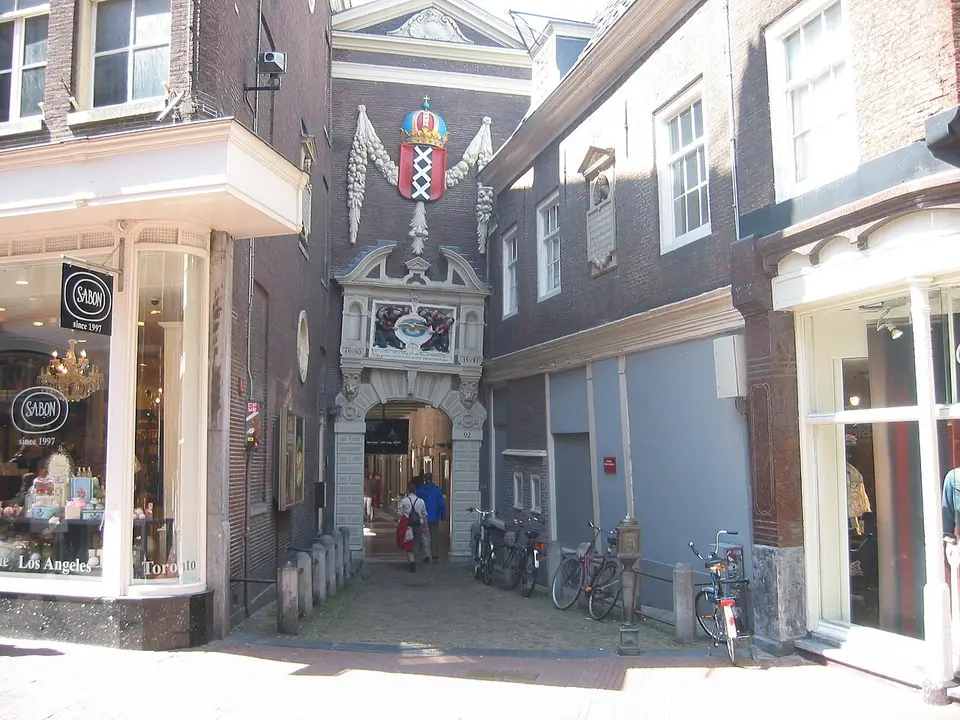
Burgerweeshuis
The Burgerweeshuis was Amsterdam’s city orphanage from about 1580 to 1960, in a former convent between the Kalverstraat and the Nieuwezijds Voorburgwal. The Amsterdam Museum has been housed here since 1975. The building is closed for renovation, and the museum plans to reopen it in 2030.
The children carved above this gate are asking you for money. The verse beneath them says: do not walk on through this gate without helping to carry a little.
This was the way into the Burgerweeshuis, the city orphanage. Around 1580 the orphans moved into what had been the convent of Saint Lucy, and the orphanage was given the convent’s land and property. That income kept it going for centuries.
To show the Kalverstraat what lay behind, a gate was made in 1581 by the sculptor Joost Jansz. Bilhamer. He carved the relief over the arch. The verse under it is attributed to the poet Vondel and was probably added in 1634. It speaks for the children: we keep growing in number and in cost.
Not every orphan got in. The Burgerweeshuis took only the children of poorters, people who held the citizenship of Amsterdam. Foundlings and the children of the poor were not admitted. Even so, the plague filled it. In the 1620s the number of children nearly doubled.
You could pick them out in the street. Their clothes were bright red on the left side and black on the right, probably after the colours of the city’s arms, though nobody is certain. The uniform lasted until 1919.
The orphanage left in 1960, and in 1975 the Amsterdam Museum moved in. The museum itself is older: it opened in 1926 in the Waag on the Nieuwmarkt. The buildings here have been closed to visitors since 2022. Building work began in September 2026, and the museum plans to reopen in 2030. Until then it shows its collection at other places in the city.
What to look for
Red and black
Look at the carved children above the arch. They wear red and black, the colours of the orphans’ uniform.
The year
ANNO on the left and 1581 on the right give the year of the gate. The verse between them is thought to be about half a century younger.
The city’s shield
Higher up the wall hangs the shield of Amsterdam, red with a black band and three white crosses, under a crown. This was the city’s own orphanage.
Key facts
- City orphanage
- From about 1580 to 1960
- Kalverstraat gate
- 1581, by the sculptor Joost Jansz. Bilhamer
- Before that
- The convent of Saint Lucy
- Museum
- Amsterdam Museum, housed here since 1975
- Now
- Closed for renovation; reopening planned for 2030
- Address
- Kalverstraat 92, Amsterdam Directions
Close by
The bigger picture
In Amsterdam? Lookstory tells you the story of whatever you’re standing in front of. Point your phone at it.
Open LookstorySources
The dates, names and figures on this page were checked against published references. These are the records for this place. The story is Lookstory’s own telling of them. Last updated October 2026.
- Rijksmonumentenregister, monument 5467
- Amsterdam Museum
- Amsterdam Museum: building work for the renovation begins (3 September 2026)
- Wikidata Q1909968
- Wikipedia: Amsterdam Museum
- Wikipedia (Dutch): Burgerweeshuis (Amsterdam, Kalverstraat)
- Wikipedia (Dutch): Amsterdam Museum
- Wikipedia: Coat of arms of Amsterdam
- Photograph: BloemenV, CC BY 4.0