The Jordaan: from working quarter to Amsterdam’s most wanted address
The Jordaan is the district west of the Prinsengracht, laid out from 1612 for the craftsmen and labourers the grand canals had no room for. For three centuries it was the city’s poorest and most crowded quarter. Today it is one of the most expensive places to live in the Netherlands.
Built for everyone else
When Amsterdam built its ring of canals in the 17th century, it built two things at once. Inside the Prinsengracht went the mansions and warehouses of the merchants. Outside it, from 1612, went a district first called simply the New Work, for the people who did the city’s manual labour: craftsmen, small workshops, and trades too smelly or noisy for the canals.
You can see the difference on a map. The canal ring was drawn fresh, in clean curves. The Jordaan was not: its streets were laid along the ditches of the farmland that was already there. That is why they run at a slant to the Prinsengracht, and why they do not line up with the bridges across it.
Where the name comes from
Nobody is sure. The best-known theory is that it comes from the French jardin, garden, perhaps by way of the French-speaking refugees who settled here. It fits the street names, most of which are flowers and trees: Rozengracht, Lindengracht, Bloemgracht, Egelantiersgracht. Another theory derives it from an old word for the land outside the city’s jurisdiction. Neither has been proved.
Canals that became streets
The Jordaan once had eleven canals of its own. Most of them were filled in during the 19th century to make streets. The Rozengracht was filled in 1889 and is now the main street through the district. The Lindengracht and the Westerstraat, both markets today, were canals too. A street with “gracht” in its name and no water in it is one of these.
It was on the Rozengracht that Rembrandt spent his last years, after his debts cost him the big house across town. He is buried in the Westerkerk, on the Jordaan’s edge.
Poor, crowded and quick to riot
By the 19th century the Jordaan was badly overcrowded. Houses were built in the yards behind houses, reached by alleys too narrow for daylight, and many of them declined into slums. The district had a reputation for standing up for itself, and serious riots broke out here in 1835, 1886, 1917 and 1934. The last began on 4 July 1934, after the government cut the dole in the middle of the Depression.
In February 1941 the open-air meetings that launched the strike against the persecution of the city’s Jews were held on the Noordermarkt, in the north of the district.
What happened next
In the 1950s the city drew up plans to demolish large parts of the Jordaan and start again. They were not carried through, and the old street plan was kept. But from the 1960s many of the families who had lived here for generations moved out to new towns, and young people, students and later the well-off moved in. About twenty thousand people live here now.
What is left of the old Jordaan is its shape: the narrow streets, the small houses, and the hofjes, courtyards of almshouses hidden behind street doors. There were nineteen of them at the last count.
Where to see it
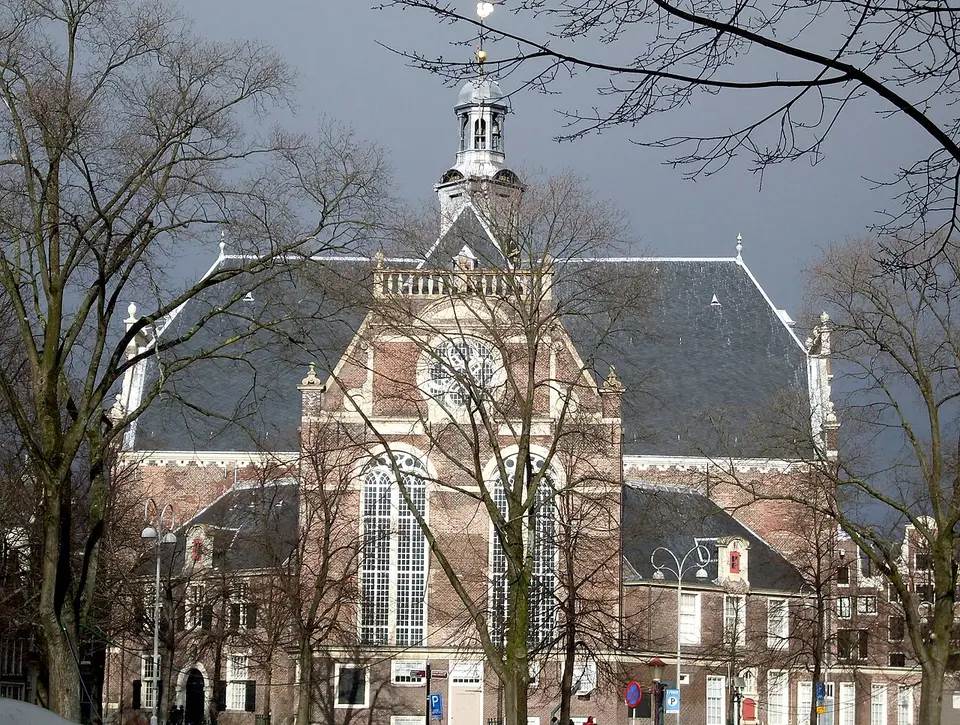
- Noorderkerk The Noorderkerk is a Protestant church on the Noordermarkt, built from 1620 to 1623 for the working people of the new Jordaan district.
- Westerkerk The Westerkerk is a Protestant church on the Prinsengracht, built from 1620 to 1631 to a design by Hendrick de Keyser.
- Anne Frank House The Anne Frank House is the canal house at Prinsengracht 263 where Anne Frank, her family and four others hid from 1942 to 1944 in rooms at the back of her father’s business.
- Homomonument The Homomonument is a memorial of three pink granite triangles beside the Westerkerk, designed by Karin Daan and unveiled in 1987.
Walking through Amsterdam? Lookstory tells you the story of whatever you’re standing in front of. Point your phone at it.
Open Lookstory