Why is Amsterdam built on piles?
Amsterdam stands on waterlogged peat and clay that cannot carry a building. Every structure rests on piles driven down to a layer of firm sand about twelve metres below the surface: wooden piles under the old city, concrete ones today. It is also why so many old houses lean.
The ground under the city
The land here was a bog. Under the streets lie several metres of soft peat and clay, soaked with water, and anything heavy set on top of it slowly sinks. The first solid layer is sand, roughly twelve metres down.
So builders went down to it. For every house, a row of tree trunks was driven through the soft ground until their tips stood in the sand, beams were laid across their heads, and the walls went up on top. The scholar Erasmus is said to have joked that the people of Amsterdam lived on the tops of trees, like rooks.
How many, and how long they last
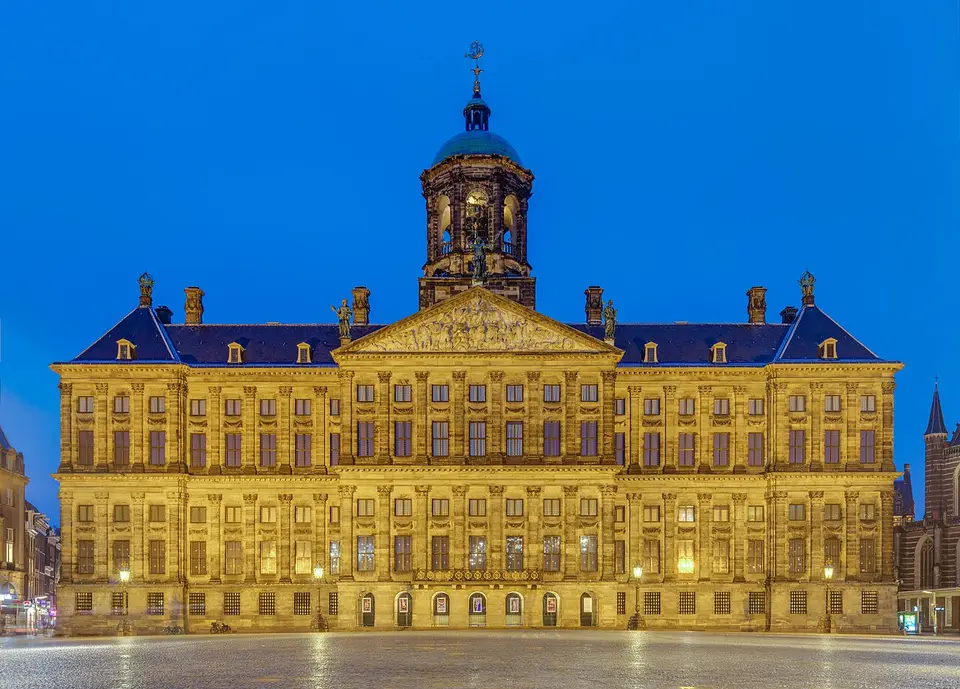
A canal house needed a few dozen piles. Large buildings needed thousands. The town hall on the Dam, now the Royal Palace, stands on 13,659 of them, and Centraal Station, built in open water in the 1880s, on 8,687. More than six thousand were driven for a tower at the Nieuwe Kerk that was never built.
Wood does not rot as long as it stays under water, where there is no air, and many of the old piles are still sound after four hundred years. The danger comes when the water level in the ground drops. The tops of the piles dry out, fungus gets in, and the building above begins to settle.
Why the houses lean
There are two kinds of lean. Many house fronts tip forward towards the street on purpose, so that goods hoisted to the attic on a rope would swing clear of the wall. Houses that lean sideways, or against their neighbours, are standing on piles that have sunk or rotted unevenly.
It has been happening for a long time. The Montelbaanstoren began to tilt in 1610, a few years after it was given a heavy new top, and had to be pulled upright. The weight problem also explains the ceilings of the old churches: the vaults of the Oude Kerk are made of wood, and the usual explanation is that the ground would not carry stone.
Where to see it
- Royal Palace The Royal Palace on Dam Square was built between 1648 and 1665 as Amsterdam’s town hall, designed by Jacob van Campen.
- Amsterdam Centraal Amsterdam Centraal is the city’s main railway station, opened in 1889 and designed by Pierre Cuypers, the architect of the Rijksmuseum.
- Nieuwe Kerk The Nieuwe Kerk is a 15th-century Gothic church on Dam Square, next to the Royal Palace.
- Montelbaanstoren The Montelbaanstoren is a tower on the Oudeschans canal, built in 1516 to defend Amsterdam’s shipyards.
- Oude Kerk The Oude Kerk is the oldest building in Amsterdam: a parish church consecrated in 1306 and enlarged for the next 250 years.
- Concertgebouw The Concertgebouw is Amsterdam’s concert hall, opened on 11 April 1888 and designed by Adolf Leonard van Gendt.
- Het Scheepvaartmuseum Het Scheepvaartmuseum, the Dutch national maritime museum, occupies ’s Lands Zeemagazijn, the storehouse built in 1656 for the navy of the Admiralty of Amsterdam.
- Magna Plaza Magna Plaza is a shopping centre in Amsterdam’s former Main Post Office, built in 1895–1899 behind the Royal Palace to a design by the government architect Cornelis Peters.
Walking through Amsterdam? Lookstory tells you the story of whatever you’re standing in front of. Point your phone at it.
Open Lookstory