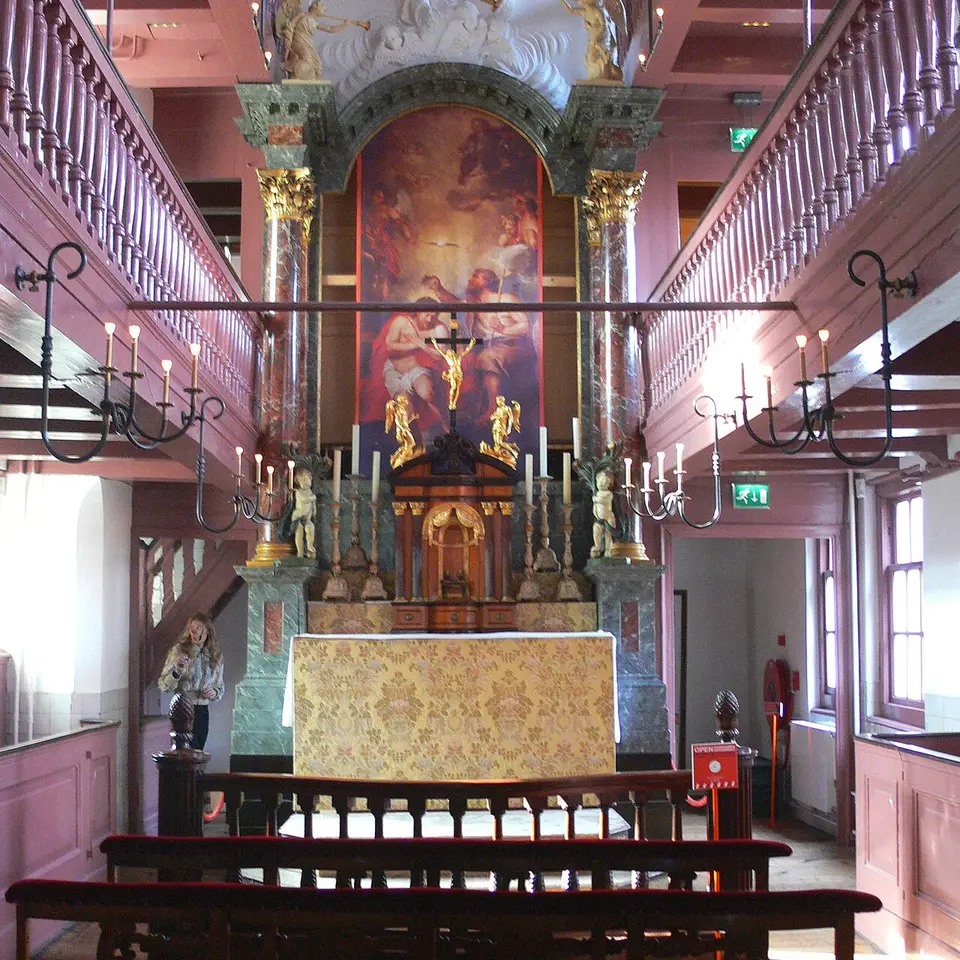
Why does Amsterdam have hidden churches?
After Amsterdam became Protestant in 1578, Catholics were forbidden to worship in public but were quietly allowed to do so indoors, as long as the building did not look like a church from the street. The result was the schuilkerk: a complete church hidden inside an ordinary house.
An arrangement, not a law
In 1578 the Catholic city government was removed and the churches were handed to the Reformed faith. The new Dutch Republic promised that nobody would be punished for what they believed. It did not promise that they could worship as they pleased. Catholic services were officially banned.
In practice Amsterdam looked away. A city that lived on trade had no interest in driving out a large part of its merchants and craftsmen. So long as a Catholic church had no tower, no bells and no church front, and often so long as the right officials were paid, it was left alone. The Dutch have a word for this kind of thing, gedogen: to tolerate what you have forbidden.
What a hidden church looked like
From the street, nothing. Inside, as much as the owner could afford. The best preserved is the one a merchant built in the 1660s across the attics of three houses on the Oudezijds Voorburgwal, with galleries, an altar and room for about 150 people. It is now the museum Our Lord in the Attic.
The beguines of the Begijnhof did the same after their chapel was given to English Protestants: they joined two of their houses and built a chapel behind the fronts, directly opposite the church they had lost. It is still in use.
How the hiding ended
Equal rights for all religions came in the 1790s, when the old Republic fell, and in the 19th century Catholics were again free to build openly. They did so with enthusiasm. The Basilica of Saint Nicholas, opposite Centraal Station, was finished in 1887 for the congregation that had worshipped in the attic, and it was placed where every visitor to the city would see it.
The contrast is the Portuguese Synagogue of 1675. Amsterdam’s Jews were allowed to build one of the largest synagogues in the world in full view, in the same years that Catholics were hiding theirs. Catholics had been the old rulers of the city, and the new ones did not want to be reminded of it.
Where to see it
- Our Lord in the Attic Our Lord in the Attic is a 17th-century canal house with a complete Catholic church hidden in its top floors.
- Begijnhof The Begijnhof is an enclosed courtyard of houses in the centre of Amsterdam, founded in the 14th century for the beguines, a community of unmarried Catholic women.
- Basilica of Saint Nicholas The Basilica of Saint Nicholas is Amsterdam’s principal Catholic church, built from 1884 to 1887 opposite Centraal Station to a design by Adrianus Bleijs.
- Oude Kerk The Oude Kerk is the oldest building in Amsterdam: a parish church consecrated in 1306 and enlarged for the next 250 years.
- Portuguese Synagogue The Portuguese Synagogue, or Esnoga, was built from 1671 to 1675 for Amsterdam’s Sephardic Jewish community, to a design by Elias Bouman.
- Mozes en Aäronkerk The Mozes en Aäronkerk is a Roman Catholic church of 1837–1841 on the Waterlooplein, designed by Tieleman Franciscus Suys and officially dedicated to Saint Anthony of Padua.
Walking through Amsterdam? Lookstory tells you the story of whatever you’re standing in front of. Point your phone at it.
Open Lookstory