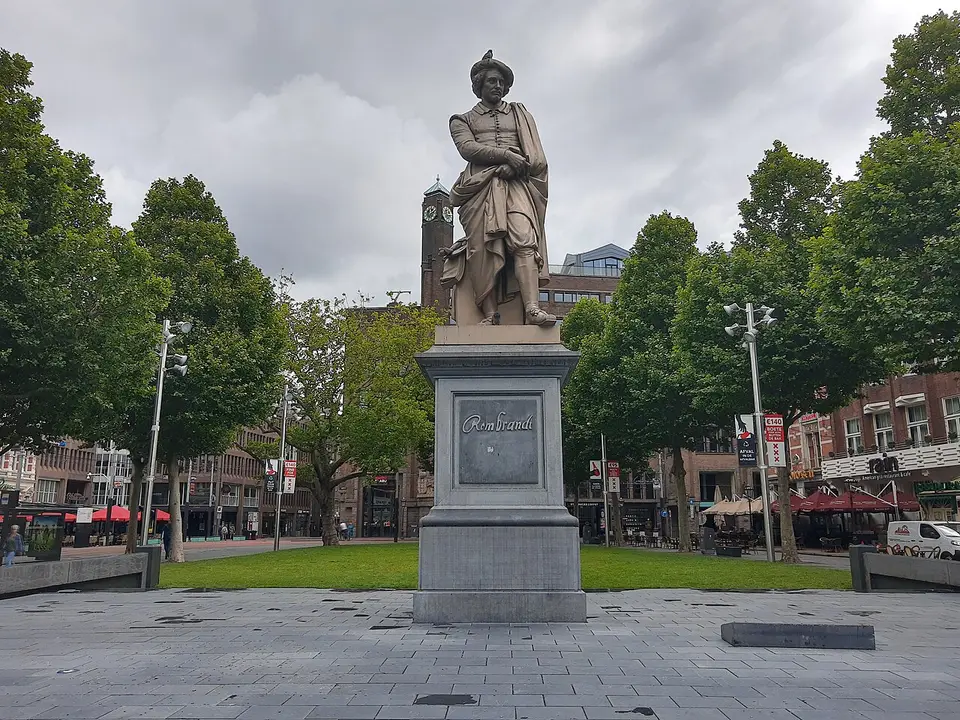
Rembrandt Monument
The Rembrandt Monument is a cast-iron statue of the painter by Louis Royer, unveiled in 1852 on what was then the butter market. It is the oldest statue in a public space in Amsterdam, and the square around it was later named Rembrandtplein after it.
Rembrandt died poor in 1669 and was buried in a grave nobody marked. It took Amsterdam almost two hundred years to put up a statue of him, and this is it.
For a long time after his death, Rembrandt was out of fashion. His reputation came back in the 19th century, and with it a campaign to give him a monument. The spur seems to have come from Antwerp, which put up a statue of Rubens in 1840. A subscription was opened so that the public could pay for one here.
The sculptor was Louis Royer, a Fleming from Mechelen who had settled in Amsterdam and made many of the country’s public statues in those years. His first idea was a seated Rembrandt, sketching. What he made in the end is the man you see: standing, wrapped in a cloak, in the soft beret he wears in his self-portraits.
It is not stone, and it is not bronze. The statue was cast in iron, by a foundry in The Hague, and painted. It was hoisted onto its plinth in May 1852 and unveiled three weeks later in front of the king.
It was the first statue in the Netherlands put up to an artist, and it is now the oldest statue in any public space in Amsterdam.
The square was not his yet. This was the Botermarkt, where farmers sold butter, cheese and poultry, and the statue stood at its edge. In 1876 it was moved to the middle and the square was renamed after it. It has been shifted and turned more than once since. In 1924 it was given a new plinth and turned to face the Amstelstraat.
Rembrandt’s own house is a ten-minute walk from here.
What to look for
The beret and cloak
Royer dressed him as Rembrandt painted himself: a wide soft beret and a heavy pleated cloak, the costume of a 17th-century artist.
Iron, not stone
It looks carved, but the surface is paint over cast iron. The plinth below it, with his signature, is real stone and dates from 1924.
The square
Imagine the café terraces gone and market stalls in their place. Until 1876 this was the butter market.
Key facts
- Unveiled
- 27 May 1852, with King William III present
- Sculptor
- Louis Royer
- Material
- Painted cast iron
- Square renamed
- From Botermarkt to Rembrandtplein in 1876
- Address
- Rembrandtplein, Amsterdam Directions
Close by
The bigger picture
In Amsterdam? Lookstory tells you the story of whatever you’re standing in front of. Point your phone at it.
Open LookstorySources
The dates, names and figures on this page were checked against published references. These are the records for this place. The story is Lookstory’s own telling of them. Last updated October 2026.