Huis met de Hoofden
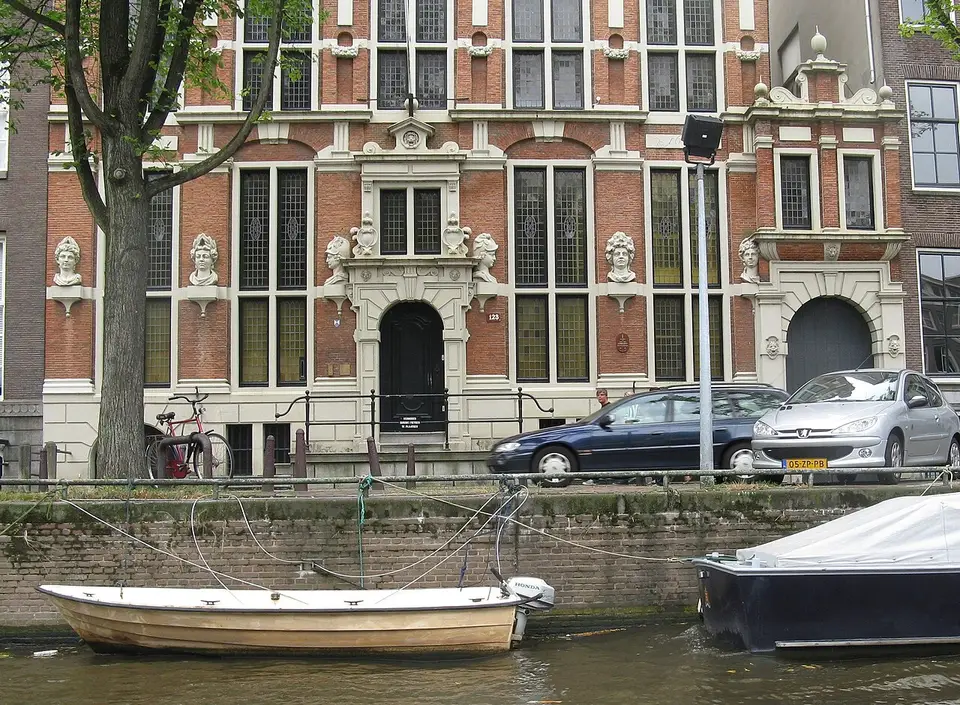
The Huis met de Hoofden, the House with the Heads, is a large canal house of 1622 on the Keizersgracht, named after the six carved heads of Roman gods on its front. The design is attributed to Hendrick de Keyser.
The story goes that a maid, alone in the house, cut off the heads of six burglars as they climbed in one by one. The six heads on the front are something else entirely.
Count them: six heads, three on each side of the door. Amsterdam has told the story of the maid and the burglars for a very long time, and it is a good story. But look at what the heads are wearing. Five of them carry a clue. One has a laurel wreath, one has ears of ripe corn in her hair, one a winged helmet, one bunches of grapes, one a crescent moon.
They are gods. Apollo for the arts, Ceres for the harvest, Mercury for trade, Minerva for wisdom, Bacchus for wine and Diana for the hunt. It is the kind of thing a rich and well-read merchant put on his house in 1622 to tell the street who lived there.
That merchant was Nicolaas Sohier, who dealt in hosiery and loved art. The front is in the style of Hendrick de Keyser, the city’s great architect, and has always been attributed to him. But De Keyser died in 1621, so it was probably his son Pieter who saw it built.
Sohier did not enjoy it for long. In 1634 he sold the house to Louis de Geer, who had made a fortune in iron and weapons, and De Geer’s family kept it for four generations. One of their guests here was the Czech thinker Comenius, who had been driven out of his own country for his beliefs.
That history suits the present owners. Since 2017 the house has been a museum and library of books on philosophy, mysticism and free thought.
What to look for
Who is who
Find Mercury by the wings on his helmet and Diana by the crescent moon. Bacchus is the one with grapes, Ceres the one with corn.
The gable
The stepped gable, with its vases, scrolls and bands of pale stone on red brick, is the Amsterdam style of the early 17th century at its richest.
The width
Compare the house with its neighbours. Sohier bought two extra-wide plots, and built a main house with a side house beside it, the part with the arched gate. Only three houses of this early kind survive in Amsterdam.
Key facts
- Built
- 1622, for the merchant Nicolaas Sohier
- Design
- Attributed to Hendrick de Keyser, finished by his son Pieter
- The heads
- Apollo, Ceres, Mercury, Minerva, Bacchus and Diana
- Today
- Embassy of the Free Mind, a museum and library, since 2017
- Address
- Keizersgracht 123, Amsterdam Directions
Close by
The bigger picture
In Amsterdam? Lookstory tells you the story of whatever you’re standing in front of. Point your phone at it.
Open LookstorySources
The dates, names and figures on this page were checked against published references. These are the records for this place. The story is Lookstory’s own telling of them. Last updated October 2026.