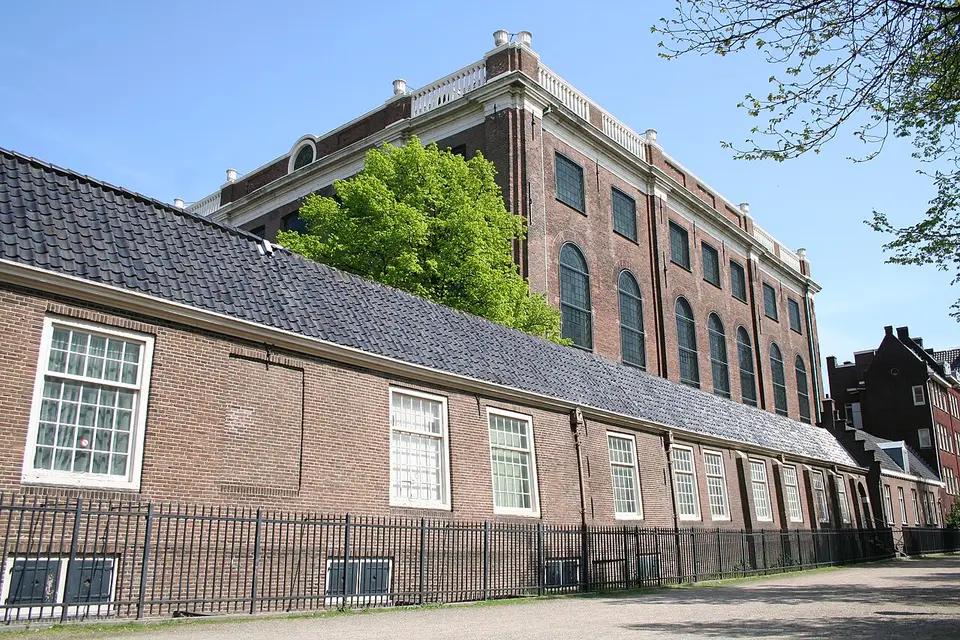
Portuguese Synagogue
The Portuguese Synagogue, or Esnoga, was built from 1671 to 1675 for Amsterdam’s Sephardic Jewish community, to a design by Elias Bouman. It is still in use, almost unaltered, and is lit only by candles.
Catholics in 17th-century Amsterdam had to hide their churches in attics. The city’s Jews were allowed to build this.
The people who built it had been hiding for generations. They were descended from Jews in Spain and Portugal who had been forced to convert, and who went on practising their religion in secret under the eye of the Inquisition. From about 1600 they began arriving in Amsterdam, where nobody asked what they believed, and they became Jews openly again.
Many were merchants with connections across the Atlantic world, and the community grew rich. In 1670 it bought this ground and commissioned one of the largest synagogues in the world. When it opened in 1675 the celebrations lasted eight days.
It is big on purpose. The building stands in full view, taller than the houses around it, and no attempt was made to disguise what it was. Visitors came from across Europe to look at it, and synagogues in London and the Americas were modelled on it.
Inside, almost nothing has changed in three and a half centuries. There is no electric light and no heating. Services are lit by around a thousand candles in brass chandeliers, and the floor is strewn with fine sand, which soaks up damp and softens the sound of footsteps. The building came through the German occupation undamaged. Most of its congregation did not.
What to look for
The courtyard buildings
The low buildings around the synagogue hold the offices, a winter synagogue and Ets Haim, a library founded in the 17th century that is still in use.
The windows
Count them. There are seventy-two, large and clear. With no other source of daylight, the building was designed to be read in.
The scale
Compare its height with the old houses nearby. In 1675 only churches were this tall.
Key facts
- Built
- 1671–1675
- Architect
- Elias Bouman
- Community
- Sephardic Jews of Spanish and Portuguese descent
- Lighting
- Candles only; the building has no electric light
- Address
- Mr. Visserplein 3, Amsterdam Directions
Close by
The bigger picture
In Amsterdam? Lookstory tells you the story of whatever you’re standing in front of. Point your phone at it.
Open LookstorySources
The dates, names and figures on this page were checked against published references. These are the records for this place. The story is Lookstory’s own telling of them. Last updated October 2026.