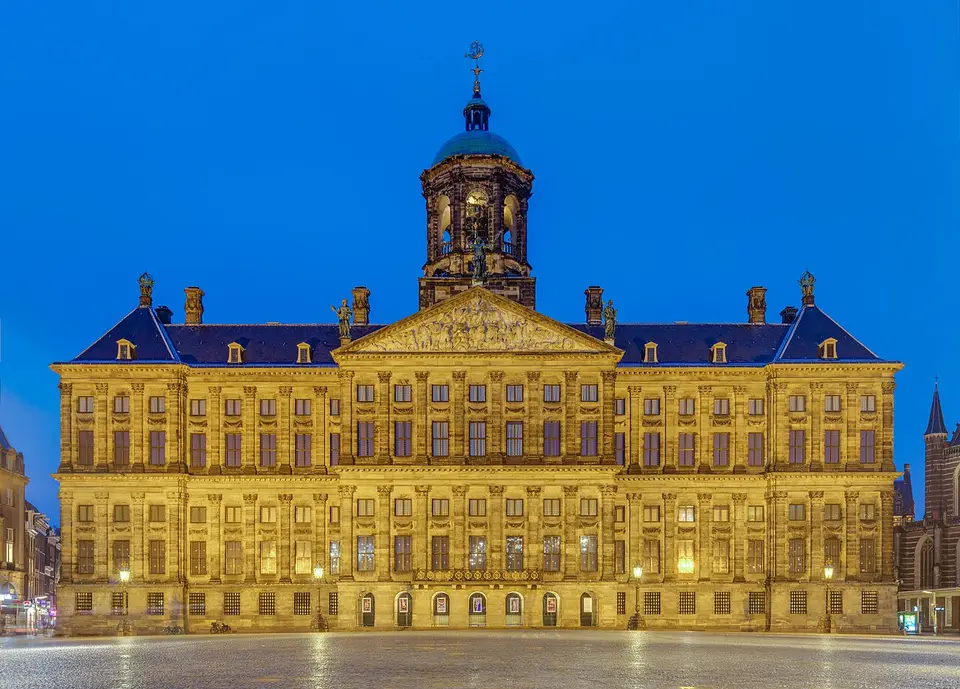
Royal Palace
The Royal Palace on Dam Square was built between 1648 and 1665 as Amsterdam’s town hall, designed by Jacob van Campen. It became a palace in 1808 under Louis Bonaparte and is still used by the Dutch king for state occasions.
This was not built for a king. It was built by a city of merchants who had no king, and wanted everyone to know they did not need one.
In 1648 the Dutch Republic signed the peace that ended eighty years of war with Spain. That same year Amsterdam started work on a new town hall, and it was meant as a statement. The city was the richest in Europe, and it was run by men who traded grain, timber and spices.
The ground here is peat and wet sand, so the building stands on 13,659 wooden piles driven down to firmer soil. Dutch schoolchildren used to learn the number by a trick: the days of the year, with a one in front and a nine behind.
The architect, Jacob van Campen, borrowed the language of ancient Rome because Amsterdam’s rulers saw themselves as a new republic of that kind. Look at what is carved in the pediment. There is no monarch and no saint. A woman representing Amsterdam sits while the oceans bring her their goods. On the back, Atlas carries the heavens. The message is that the world revolves around this square.
Then the Republic fell. In 1808 Napoleon’s brother Louis, installed as King of Holland, decided he needed a palace and took the town hall. He stayed barely two years, and left behind one of the best collections of Empire furniture anywhere. The city was handed its building back in 1813, then offered it to the new Dutch king. It has been a palace since.
What to look for
No front door
A building this grand has seven small arches where you would expect a great entrance. They are often said to stand for the seven provinces of the Republic, though nothing from the time confirms it. Small doors were also easier to defend if a crowd turned hostile.
The weathervane
On top of the cupola is a gilded ship, a cog, the medieval trading vessel from the city’s seal.
The balcony
The balcony over the arches is not original. Louis Bonaparte added it so he could be seen by his subjects, and the royal family has used it since.
Key facts
- Built
- 1648–1665, opened 1655
- Architect
- Jacob van Campen
- Built as
- Town hall of Amsterdam
- Palace since
- 1808
- Foundations
- 13,659 wooden piles
- Address
- Dam, Amsterdam Directions
Close by
The bigger picture
- A walk through medieval Amsterdam, from Centraal Station to the Dam
- Amsterdam in the Dutch Golden Age
- Dam Square: the dam that gave Amsterdam its name
- How did Amsterdam get its name, and how old is it?
- Rembrandt in Amsterdam: where he lived, worked and is buried
- The western canal ring: a walk from the Dam to the Noorderkerk
- Why do Amsterdam’s houses lean?
- Why is Amsterdam built on piles?
In Amsterdam? Lookstory tells you the story of whatever you’re standing in front of. Point your phone at it.
Open LookstorySources
The dates, names and figures on this page were checked against published references. These are the records for this place. The story is Lookstory’s own telling of them. Last updated October 2026.