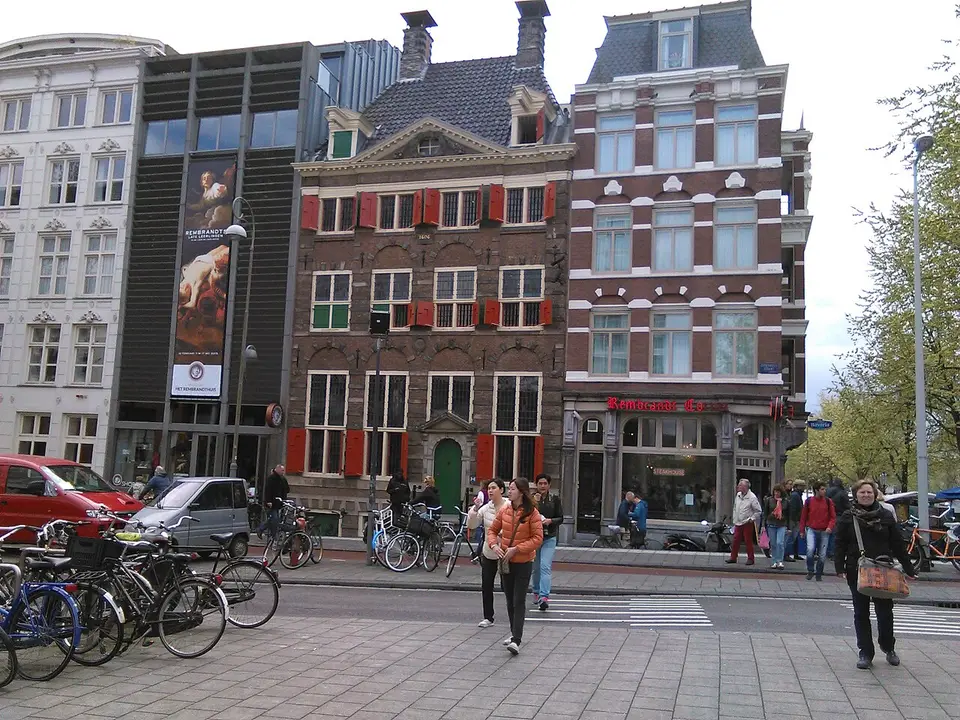
Rembrandt in Amsterdam: where he lived, worked and is buried
Rembrandt van Rijn moved from Leiden to Amsterdam in 1631 and stayed until he died in 1669. The house he bought, the guild room he painted for, the churches where his family were buried and the mansion where The Night Watch later hung are all within a twenty-minute walk of each other.
A young painter arrives
Rembrandt was 25 when he came to Amsterdam. He lodged with an art dealer, Hendrick van Uylenburgh, on the street that would later be called the Jodenbreestraat, and within a year he had the commission that made him famous: a group portrait of the surgeons’ guild, to hang in their room in the Waag on the Nieuwmarkt. The Anatomy Lesson of Dr Nicolaes Tulp was finished in 1632.
In 1634 he married his landlord’s cousin, Saskia van Uylenburgh. They registered their intention to marry at the Oude Kerk, and married in Friesland, where her family lived.
The house, and what it cost him
In 1639, at the height of his success, he bought a large house on the Jodenbreestraat for 13,000 guilders, to be paid in instalments. He lived and taught there for almost twenty years, and there he painted The Night Watch, completed in 1642.
That year Saskia died and was buried in the Oude Kerk. Three of their four children had already died as infants and were buried in the Zuiderkerk, round the corner. Rembrandt kept spending and stopped paying. In 1656 he was declared insolvent, his collection was auctioned, and in 1658 the house was sold.
The last years
He moved to a rented house on the Rozengracht, in the Jordaan, and went on painting. His partner Hendrickje Stoffels died in 1663 and his son Titus in 1668. Both were buried in the Westerkerk. Rembrandt followed them in October 1669, into a rented grave in the same church. Its place is not known.
The Night Watch outlasted its first home. In 1715 it was moved to the town hall on the Dam, now the Royal Palace, and cut down on all four sides to fit its new wall. For most of the 19th century it hung in the Trippenhuis, until the Rijksmuseum opened in 1885.
Where to see it
- Rembrandt House The Rembrandt House is the house on the Jodenbreestraat where Rembrandt van Rijn lived and worked from 1639 to 1658.
- De Waag De Waag on the Nieuwmarkt was built in 1488 as Saint Anthony’s Gate, one of the main gates in Amsterdam’s medieval city wall.
- Oude Kerk The Oude Kerk is the oldest building in Amsterdam: a parish church consecrated in 1306 and enlarged for the next 250 years.
- Zuiderkerk The Zuiderkerk is the first church built in Amsterdam for Protestant worship, designed by Hendrick de Keyser and completed in 1611, with its tower finished in 1614.
- Westerkerk The Westerkerk is a Protestant church on the Prinsengracht, built from 1620 to 1631 to a design by Hendrick de Keyser.
- Trippenhuis The Trippenhuis is a double canal mansion on the Kloveniersburgwal, built from 1660 to 1662 for the brothers Louis and Hendrick Trip, who were arms dealers.
- Royal Palace The Royal Palace on Dam Square was built between 1648 and 1665 as Amsterdam’s town hall, designed by Jacob van Campen.
- Montelbaanstoren The Montelbaanstoren is a tower on the Oudeschans canal, built in 1516 to defend Amsterdam’s shipyards.
- Rembrandt Monument The Rembrandt Monument is a cast-iron statue of the painter by Louis Royer, unveiled in 1852 on what was then the butter market.
Walking through Amsterdam? Lookstory tells you the story of whatever you’re standing in front of. Point your phone at it.
Open Lookstory