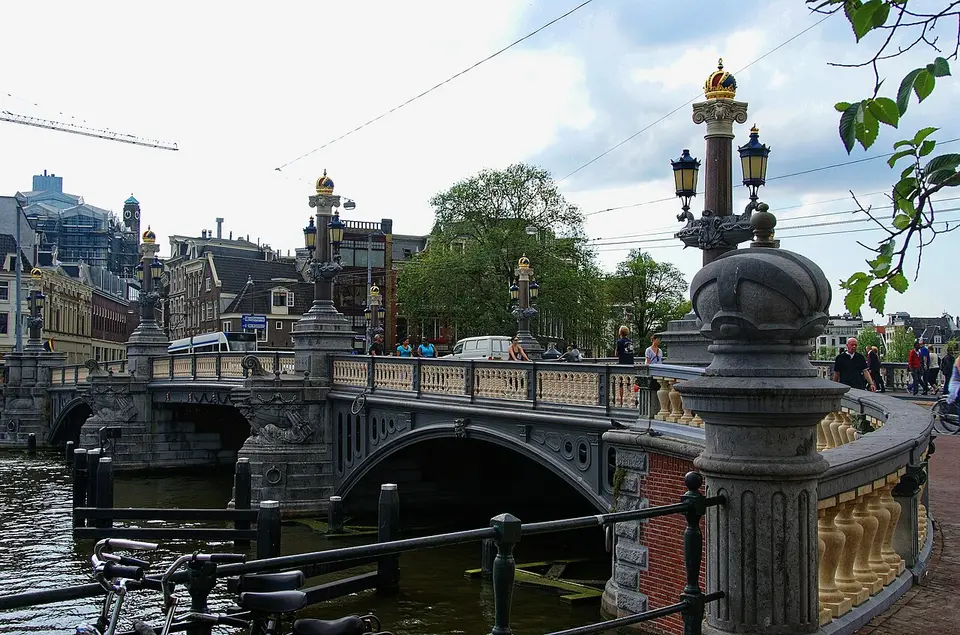
Blauwbrug
The Blauwbrug, the Blue Bridge, is a richly decorated bridge of 1883 over the Amstel, between the Amstelstraat and the Waterlooplein. It was designed by the city architects Bastiaan de Greef and Willem Springer, and takes its name from an older wooden bridge on the same spot.
The name is older than the bridge. A wooden bridge painted blue stood here first, and when this one replaced it in 1883 people went on calling it the Blue Bridge.
Before 1883 a wooden drawbridge crossed the river here, of the same kind as the Magere Brug a little further along the Amstel. Its woodwork was painted blue. It led from the city to the island of Vlooienburg and was one of the ways into the Jewish quarter. In Yiddish it was the Bloubrik.
Then Amsterdam decided to show off. In 1883 the city held the International Colonial Exhibition. It wanted a bridge here that could carry a tram, and one with some grandeur. The city architects Bastiaan de Greef and Willem Springer looked to the bridges over the Seine in Paris. Half the cost was paid by the Amsterdam Omnibus Company.
What they built is a bridge about ships and about Amsterdam. The piers are carved as ships’ bows. On them stand eight columns of polished red Swedish granite, and each column carries a pair of lanterns, sixteen in all. Each is topped with the imperial crown, the same crown that sits on the city’s coat of arms.
Not everyone liked it. When the bridge opened, the criticism broke loose: it was thought too pompous for Amsterdam.
It has one more date. On 30 April 1980, the day Beatrix became queen, squatters and riot police fought here. The writer A.F.Th. van der Heijden built a novel on that day and named it after the bridge: De Slag om de Blauwbrug, the battle for the Blue Bridge.
What to look for
The crowns
Look at the top of each red column. The gilded and coloured crown is the imperial crown from Amsterdam’s coat of arms.
Ships in stone
Look at the piers from the quay. They are carved as the bows of ships, and there is a small ship’s shape halfway up each column as well.
Count the lanterns
Two hang from each column, held out by carved animals. There should be sixteen.
Key facts
- Opened
- 1883
- Designers
- Bastiaan de Greef and Willem Springer, city architects
- Name
- From an earlier wooden bridge painted blue
- Lanterns
- Sixteen, on eight columns of red Swedish granite
- National monument since
- 2002
- Address
- Amstel, between Amstelstraat and Waterlooplein, Amsterdam Directions
Close by
The bigger picture
In Amsterdam? Lookstory tells you the story of whatever you’re standing in front of. Point your phone at it.
Open LookstorySources
The dates, names and figures on this page were checked against published references. These are the records for this place. The story is Lookstory’s own telling of them. Last updated October 2026.