Rembrandt and the Jewish Quarter: a walk from the Nieuwmarkt
7 stops, about 1.7 km, around 40 minutes with the stories
A self-guided walk from the Waag on the Nieuwmarkt through the streets where Rembrandt lived to the old Jewish Quarter and its memorials. It takes in the painter’s house, the Portuguese Synagogue, the statue of the dock worker and the theatre from which the city’s Jews were deported.
What this walk shows you
The first half belongs to the 17th century. You begin at the building Rembrandt’s first famous painting was made for, pass the mansion where The Night Watch later hung and the church where his children were buried, and reach the house he bought and lost.
His street was the main street of the Jewish Quarter, and the second half of the walk follows what became of it: the great synagogue of 1675, the square where the round-ups of February 1941 took place, and the theatre that was turned into a deportation centre.
Before you set out
Much of the old quarter was demolished after the war, so there are wide roads and modern buildings between the stops. The last stop is a memorial, and the stop before it marks the place where people were taken from their neighbours. Allow time to stand still.
The route
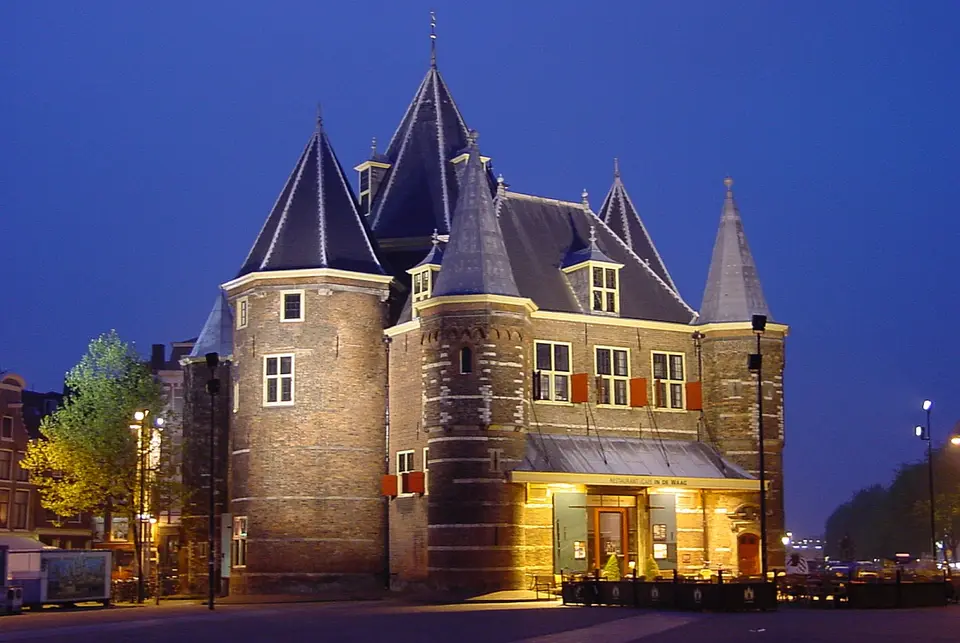
- 1 De Waag De Waag on the Nieuwmarkt was built in 1488 as Saint Anthony’s Gate, one of the main gates in Amsterdam’s medieval city wall.
240 m to the next stop
- 2 Trippenhuis The Trippenhuis is a double canal mansion on the Kloveniersburgwal, built from 1660 to 1662 for the brothers Louis and Hendrick Trip, who were arms dealers.
180 m to the next stop
- 3 Zuiderkerk The Zuiderkerk is the first church built in Amsterdam for Protestant worship, designed by Hendrick de Keyser and completed in 1611, with its tower finished in 1614.
170 m to the next stop
- 4 Rembrandt House The Rembrandt House is the house on the Jodenbreestraat where Rembrandt van Rijn lived and worked from 1639 to 1658.
440 m to the next stop
- 5 Portuguese Synagogue The Portuguese Synagogue, or Esnoga, was built from 1671 to 1675 for Amsterdam’s Sephardic Jewish community, to a design by Elias Bouman.
80 m to the next stop
- 6 De Dokwerker De Dokwerker is a bronze statue by Mari Andriessen, unveiled in 1952, that commemorates the February Strike of 1941, when workers in Amsterdam went on strike against the persecution of the city’s Jews.
540 m to the next stop
- 7 Hollandsche Schouwburg The Hollandsche Schouwburg is a former theatre, opened in 1892, that the German occupiers used in 1942 and 1943 as the assembly point from which Amsterdam’s Jews were deported.
Take Lookstory with you. At each stop it tells the story aloud, and points you to the next one.
Open Lookstory