Amsterdam in the Dutch Golden Age
In the 17th century Amsterdam grew from a middling port into the richest trading city in Europe. Most of what a visitor sees in the centre today, the canal ring, the palace on the Dam, the big Protestant churches and the merchants’ houses, was built in those hundred years.
How a small port became the centre of world trade
In 1585 Spanish troops took Antwerp, then the great port of the Low Countries, and its merchants, printers and craftsmen fled north. Many came to Amsterdam, which had joined the revolt against Spain a few years earlier. They brought money, skills and trading contacts.
The city’s population went from about 30,000 in the 1570s to around 200,000 a century later. In 1602 the Dutch East India Company was founded, and its shares were traded in Amsterdam. A municipal exchange bank followed in 1609. Grain from the Baltic, spices from Asia and sugar from the Americas all passed through its warehouses.
What it built
To house everyone, the city council planned one of the largest city extensions of its time: three concentric canals dug from 1613 onwards, lined with plots for merchants’ houses. The canal ring has been a World Heritage Site since 2010.
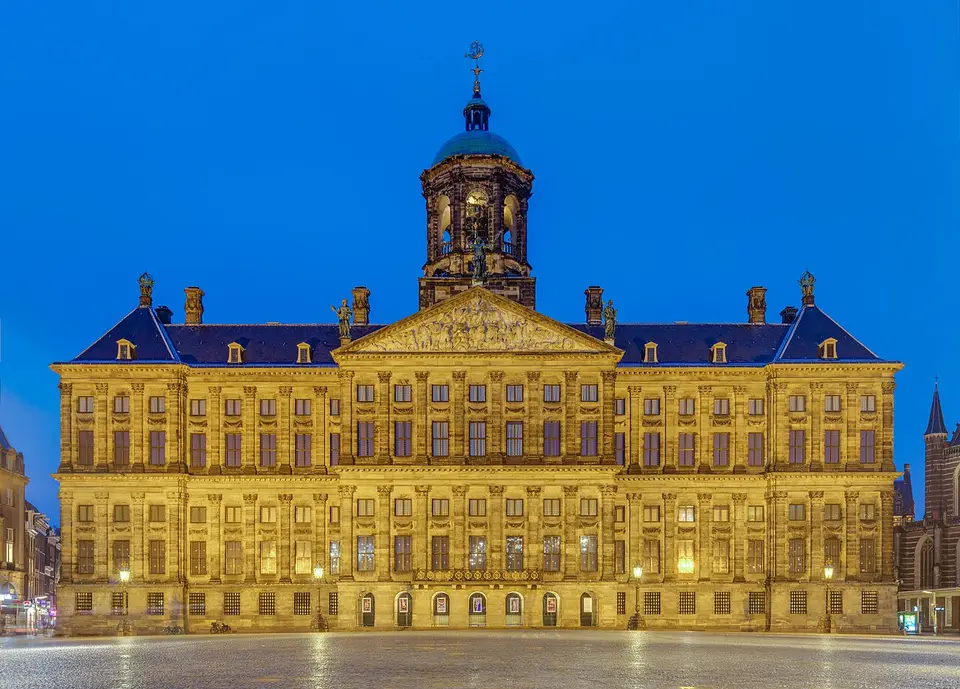
The great buildings followed the money. The Westerkerk rose in the new district. The directors of the East India Company met in the Oost-Indisch Huis. In 1648 the city began a town hall so grand that it later became a royal palace. Rembrandt arrived in 1631 and found more customers for portraits than any painter could serve.
Who paid for it
Amsterdam was unusually tolerant for its time, mostly because tolerance was good for business. Jews expelled from Spain and Portugal built their synagogue here in the open, and Catholics were left alone as long as their churches stayed out of sight.
The wealth had another side. The trading companies took territory by force in Asia, and the Dutch West India Company, founded in 1621, shipped enslaved Africans across the Atlantic. For that reason some Dutch museums no longer use the name “Golden Age” at all. The boom ended with the wars of 1672, though the city stayed rich for a long time after.
Where to see it
- Royal Palace The Royal Palace on Dam Square was built between 1648 and 1665 as Amsterdam’s town hall, designed by Jacob van Campen.
- Oost-Indisch Huis The Oost-Indisch Huis is the former Amsterdam headquarters of the Dutch East India Company, the VOC, built in 1606.
- Westerkerk The Westerkerk is a Protestant church on the Prinsengracht, built from 1620 to 1631 to a design by Hendrick de Keyser.
- Trippenhuis The Trippenhuis is a double canal mansion on the Kloveniersburgwal, built from 1660 to 1662 for the brothers Louis and Hendrick Trip, who were arms dealers.
- Rembrandt House The Rembrandt House is the house on the Jodenbreestraat where Rembrandt van Rijn lived and worked from 1639 to 1658.
- Portuguese Synagogue The Portuguese Synagogue, or Esnoga, was built from 1671 to 1675 for Amsterdam’s Sephardic Jewish community, to a design by Elias Bouman.
- Our Lord in the Attic Our Lord in the Attic is a 17th-century canal house with a complete Catholic church hidden in its top floors.
- Het Scheepvaartmuseum Het Scheepvaartmuseum, the Dutch national maritime museum, occupies ’s Lands Zeemagazijn, the storehouse built in 1656 for the navy of the Admiralty of Amsterdam.
- Huis met de Hoofden The Huis met de Hoofden, the House with the Heads, is a large canal house of 1622 on the Keizersgracht, named after the six carved heads of Roman gods on its front.
- West-Indisch Huis The West-Indisch Huis was the headquarters of the Dutch West India Company from 1623 to 1647.
- Amstelhof The Amstelhof is a very long brick building on the Amstel, built in the early 1680s as a home for old women and used to house the elderly until 2007.
- Burgerweeshuis The Burgerweeshuis was Amsterdam’s city orphanage from about 1580 to 1960, in a former convent between the Kalverstraat and the Nieuwezijds Voorburgwal.
Walking through Amsterdam? Lookstory tells you the story of whatever you’re standing in front of. Point your phone at it.
Open Lookstory