Pierre Cuypers: the architect of the Rijksmuseum and Centraal Station
Pierre Cuypers (1827–1921) designed the two buildings that frame the centre of Amsterdam: the Rijksmuseum, opened in 1885, and Centraal Station, opened in 1889. He was the leading church architect in the Netherlands and a Catholic, and both buildings were attacked for looking like it.
A church builder from the south
Cuypers was born in 1827 in Roermond, in the Catholic south of the country, and he died there in 1921 at the age of 93. In between he designed something like a hundred churches.
He had good timing. For more than two centuries Dutch Catholics had been forbidden to worship in public. In 1853 their church was allowed to organise itself again, and it needed buildings. Cuypers gave it tall brick churches in the Gothic style, modelled on the French cathedrals of the 13th century and on the ideas of the French architect Viollet-le-Duc.
He moved to Amsterdam in 1865 and laid out a street of his own, the Vondelstraat beside the Vondelpark, with houses and a church to his design.
The Rijksmuseum
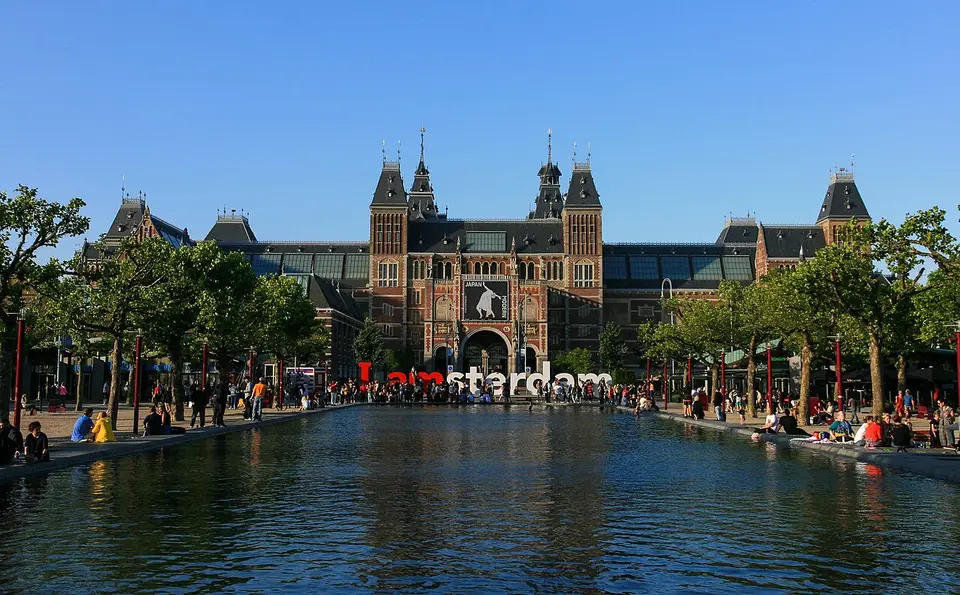
In 1876 Cuypers won the commission for the new national museum, and building began that October. What he designed mixes Gothic and Renaissance, with towers, steep roofs, stained glass and walls covered in tiles and carving.
To many Protestants this was the wrong building for the country’s treasures. Critics said he was dragging the Netherlands back to the dark Middle Ages, and when the museum opened in 1885 King William III stayed away, calling it a monastery.
Centraal Station
He was already at work on the next one. Centraal Station was built between 1881 and 1889 on three artificial islands in the harbour, on 8,687 wooden piles, and Cuypers designed the station building with the engineer A.L. van Gendt. It is why the museum and the station look like sisters: the same red brick and pale stone, the same pair of towers, the same wealth of ornament.
Van Gendt had a third building under way in the same years. He was the architect of the Concertgebouw.
What he left
Cuypers was also the country’s most active restorer of old buildings, and a controversial one. Like Viollet-le-Duc, he was willing to rebuild a monument as he thought it should have been, rather than keep it as he found it. His largest work of that kind is the castle of De Haar near Utrecht, rebuilt from a ruin between 1892 and 1912.
In the 20th century his buildings went badly out of fashion. In this century both the museum and the station have been restored at great expense, with his decoration put back.
Where to see it
- Rijksmuseum The Rijksmuseum is the national museum of the Netherlands, home of Rembrandt’s Night Watch.
- Amsterdam Centraal Amsterdam Centraal is the city’s main railway station, opened in 1889 and designed by Pierre Cuypers, the architect of the Rijksmuseum.
- Concertgebouw The Concertgebouw is Amsterdam’s concert hall, opened on 11 April 1888 and designed by Adolf Leonard van Gendt.
Walking through Amsterdam? Lookstory tells you the story of whatever you’re standing in front of. Point your phone at it.
Open Lookstory