The short answer
They are gable stones, gevelstenen in Dutch: carved and painted tablets set into the front of a house. Before Amsterdam numbered its houses in 1796, the stone was the address. It showed the owner’s trade, name or home town, and people said they lived in “the Lamb”, or opposite it. About 730 from the 16th, 17th and 18th centuries are still on the street.
An address before house numbers
Until the end of the 18th century an Amsterdam house had no number. You found it by its sign. The city archive gives an example: a house in the alley called Gebed zonder End was described as the place “where the Crowned Starch Pot hangs out”, after its signboard. A gable stone did the same job in stone. The society that looks after them, the Vereniging Vrienden van Amsterdamse Gevelstenen, gives house names such as De Meeremin, the mermaid, and Int Lam, in the lamb. People said they lived in such a house, opposite it or beside it.
Gable stones came into use in the second half of the 16th century. Amsterdam got its first real house numbers in 1796, painted on the fronts, and after that nobody needed a stone to find a door.
What the pictures say
Most stones pair a picture with a few words, and some carry only a year. Many show the trade of the first owner: a cooper might have a butter barrel carved, a writer a quill. Others play on the builder’s name or point to the place the owner came from. They worked as shop signs too. A neighbour in the same trade who wanted to stand out took the same picture and added something, often a crown, which is why the Netherlands has stones of a crowned calf and a crowned boot.
They were made to be seen in colour. The stones were painted from the start, and many names carry a colour: the Red Lion, the White Elephant, the Black Horse. A gable stone is not a gable, though. The gable is the shaped top of the house front. The stone is a tablet set lower in the wall, usually about four metres above the street.
How many are left
It depends on who counts, and what. The society of friends, founded in 1991, speaks of about 730 stones from the 16th, 17th and 18th centuries along the public street. Other published counts give around 850 for Amsterdam, and more than 1,600. The craft is alive as well. The society says it has had more than 400 stones restored and put back in colour, has advised on about a hundred modern ones, and knows of three hundred more put up by others.
Three to look for
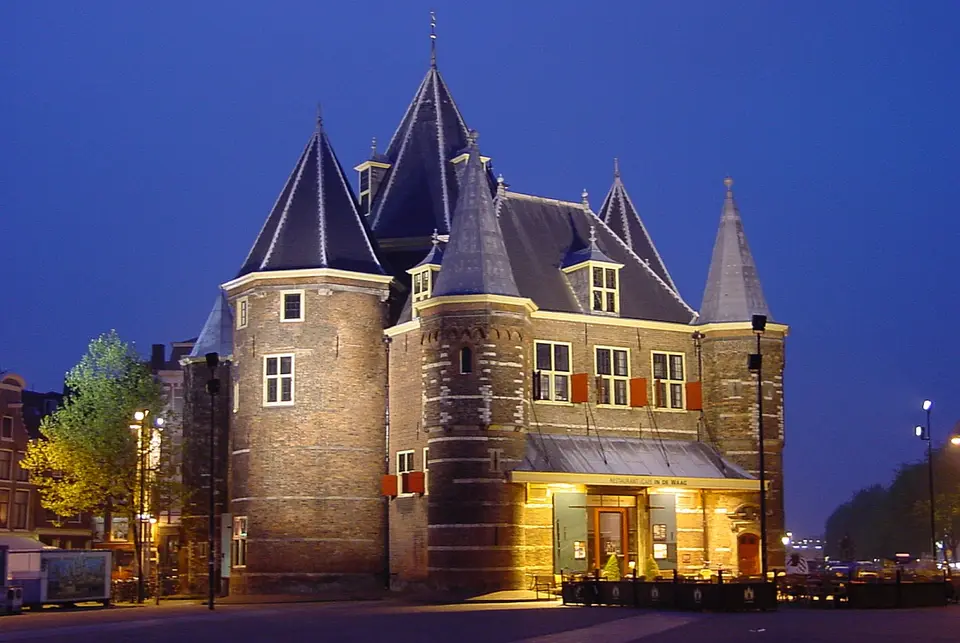
The oldest gable stone in the city is on De Waag, the old gate on the Nieuwmarkt. It sits beside the tower at the corner where the Zeedijk meets the Geldersekade, and says in Gothic letters that the first stone of the gate was laid on 28 April 1488. The men who carved such stones were mostly stonemasons, members of the masons’ guild, and that guild had its own door into this building, on the Zeedijk side.
On the Schreierstoren, to the right of the entrance, is a relief dated 1569: a woman with one hand before her face, pointing with the other at a ship sailing away, under the words SCRAYER HOVCK. The Begijnhof has a great many stones, a good number of them plainly Catholic in subject. Its old gate of 1574 carries one of Saint Ursula, patron saint of the beguines of Amsterdam. For a longer hunt, a walk devoted to gable stones has been laid out through the northern Jordaan.
Where to see it
- De Waag De Waag on the Nieuwmarkt was built as Saint Anthony’s Gate, one of the main gates in Amsterdam’s medieval city wall; a stone on it gives the year 1488.
- Schreierstoren The Schreierstoren is a defensive tower from the 1480s, the only defensive tower of Amsterdam’s medieval city wall still standing.
- Begijnhof The Begijnhof is an enclosed courtyard of houses in the centre of Amsterdam, founded in the 14th century for the beguines, a community of unmarried Catholic women.
Walking through Amsterdam? Point your phone at whatever you’re standing in front of, and I’ll tell you its story.
Open LookstorySee how it worksKeep reading
Sources
- Vereniging Vrienden van Amsterdamse Gevelstenen (VVAG)
- Vereniging Vrienden van Amsterdamse Gevelstenen: Historie VVAG
- Vereniging Vrienden van Amsterdamse Gevelstenen: Tekststeen eerste steenlegging in 1488
- Vereniging Vrienden van Amsterdamse Gevelstenen: Gevelsteen SCRAYERS HOVCK
- Stadsarchief Amsterdam: Huisnummers in Amsterdam
- Wikipedia: Gable stone
- Wikipedia (Dutch): Gevelsteen
- Wikipedia: Begijnhof, Amsterdam
- Wikipedia: Waag, Amsterdam