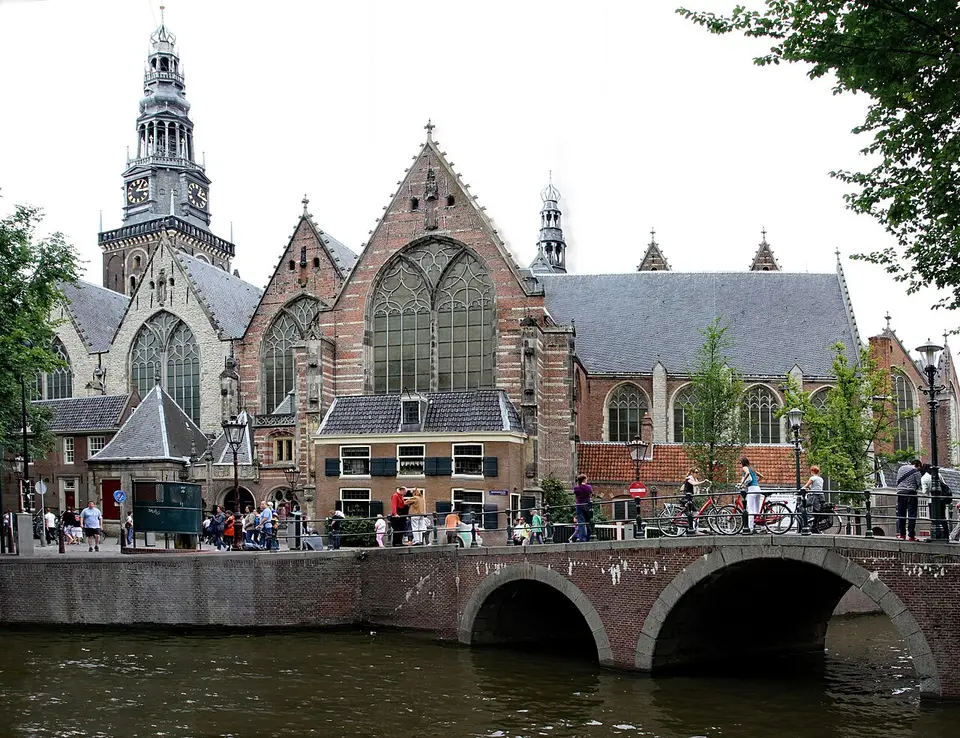
The short answer
The oldest building in Amsterdam is the Oude Kerk, a church consecrated in 1306 and enlarged until about 1570. De Waag, a city gate with a stone dated 1488, is usually named as the oldest building that is not a church. The oldest house found so far is Warmoesstraat 90, with a timber frame of about 1485. The wooden house in the Begijnhof, long called the oldest, dates from about 1530.
The Oude Kerk, since 1306
The Oude Kerk, in De Wallen, calls itself Amsterdam’s oldest building, and the other sources agree. In the 13th century the first people of the town put up a small wooden chapel here, on a bank of clay left by the river, with a graveyard around it. A stone church took its place, and on 17 September 1306 the bishop of Utrecht consecrated it to Saint Nicholas, the patron saint of sailors.
Oldest does not mean that what you see is from 1306. The church went on growing until about 1570. The two chapels that give it the shape of a cross were built between 1380 and 1460, the Lady Chapel was added in the 1550s, and the tower was made much taller between 1563 and 1565. So 1306 is the date of the church, not of the wall in front of you. What stands here was built in stages, each added to the last.
Not a church: three buildings of the 1480s
De Waag, the turreted brick building on the Nieuwmarkt, is usually named as the oldest building in Amsterdam that is not a church. It began as Saint Anthony’s Gate, in the city wall built between 1481 and 1494. A stone by one of its towers says the first stone of the gate was laid on 28 April 1488. There are signs that the stone marks only a later addition, and that the main gate is decades older.
The Schreierstoren, on the Prins Hendrikkade, is the only defensive tower left from the same wall, and was built about 1487. One house, described below, belongs to the same years. The three dates lie so close together that it is fairer to say Amsterdam’s oldest buildings other than churches come from the 1480s than to crown one of them.
The oldest house is not the famous one
For years the answer was Het Houten Huys, the house with the wooden front at number 34 in the Begijnhof. It was said to have gone up straight after the great fire of 1452. Then its timbers were dated by their growth rings. The result, known since 2010, was that the wood had been felled in 1528, so the house was built about 1530.
In 2012 an older house was announced. After a fire at Warmoesstraat 90, a building inspector noticed beams that looked far too old for the plain front, which is centuries younger. Samples from the timber frame were examined in Berlin and came from trees felled in 1472, 1483 and 1485. The house is dated to about 1485, almost half a century before the one in the Begijnhof. The people who reported it added that many old houses have never been tested, so the record may not stand.
Where to stand
Walk round the Oude Kerk first. The tall side chapels, each with a gable of its own, are the building campaigns standing side by side. Then step into the Warmoesstraat. Number 90 is on the Damrak side, directly opposite the church tower. From the street it is an ordinary front, which is the point: the frame of the 1480s is inside.
Go on to De Waag and find the stone of 1488 beside the tower at the corner where the Zeedijk meets the Geldersekade. The Nieuwe Kerk on the Dam, consecrated in 1409, was the town’s second parish church, though a fire in 1645 left it a ruin and it had to be rebuilt. End at number 34 in the Begijnhof, the wooden house that held the title for so long.
Where to see it
- Oude Kerk The Oude Kerk is the oldest building in Amsterdam: a parish church consecrated in 1306 and enlarged for the next 250 years.
- De Waag De Waag on the Nieuwmarkt was built as Saint Anthony’s Gate, one of the main gates in Amsterdam’s medieval city wall; a stone on it gives the year 1488.
- Begijnhof The Begijnhof is an enclosed courtyard of houses in the centre of Amsterdam, founded in the 14th century for the beguines, a community of unmarried Catholic women.
- Nieuwe Kerk The Nieuwe Kerk is a 15th-century Gothic church on Dam Square, next to the Royal Palace.
- Schreierstoren The Schreierstoren is a defensive tower from the 1480s, the only defensive tower of Amsterdam’s medieval city wall still standing.
Walking through Amsterdam? Point your phone at whatever you’re standing in front of, and I’ll tell you its story.
Open LookstorySee how it worksKeep reading
Sources
- Oude Kerk Amsterdam: About the Oude Kerk
- Rijksmonumentenregister, monument 3990 (Oude Kerk)
- Vrienden van de Amsterdamse Binnenstad: Houten Huis op het Begijnhof niet langer het oudste huis (2012, archived)
- NOS: Oudste huis van Amsterdam ontdekt (16 June 2012)
- Vereniging Vrienden van Amsterdamse Gevelstenen: Tekststeen eerste steenlegging in 1488
- De Nieuwe Kerk Amsterdam: History
- Wikipedia (Dutch): Oude Kerk (Amsterdam)
- Wikipedia: Waag, Amsterdam
- Wikipedia (Dutch): Schreierstoren
- Wikipedia: Nieuwe Kerk, Amsterdam
- Rijksmonumentenregister, monument 371 (Het Houten Huys)
- Wikipedia: Oude Kerk, Amsterdam
- Wikipedia (Dutch): Waag (Amsterdam)
- Wikipedia (Dutch): Begijnhof (Amsterdam)
- Wikipedia (Dutch): Warmoesstraat (Amsterdam)