The short answer
Rembrandt’s Night Watch hangs in the Rijksmuseum in Amsterdam, in the Night Watch Gallery at the far end of the Gallery of Honour. Painted in 1642, it shows a company of the city’s civic guard setting out. It is not a night scene. The name dates from the end of the 18th century, after the varnish had darkened.
In the Rijksmuseum, at the end of the long gallery
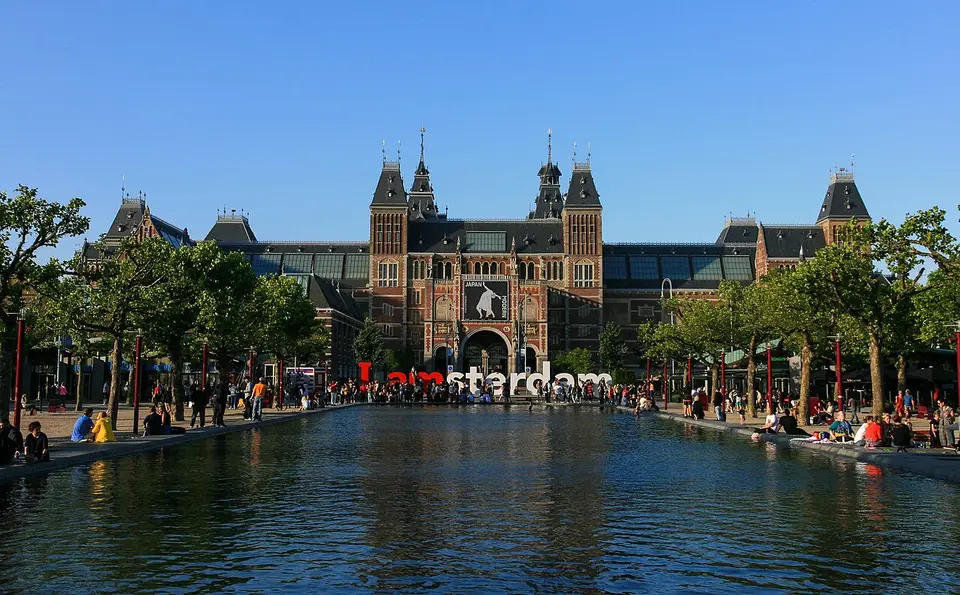
The Night Watch hangs in the Rijksmuseum, in a room named after it: the Night Watch Gallery. When the building opened the painting was given a room built for it at the far end of the Gallery of Honour. The museum likens that gallery to the nave of a church, and the place where the painting hangs to the high altar.
The canvas is about 3.8 metres high and 4.5 metres wide, and with its frame it weighs 337 kilograms. It is not the museum’s property. It belongs to the City of Amsterdam, which has lent it since 1808. For the time being you see it through glass. Since 2019 the museum has been studying and restoring it where it hangs, inside a glass chamber, and since the end of 2024 the restorers have been removing the old varnish. Parts of the surface look matt and dull while they work.
What it shows, and its real name
It is a group portrait of a company of Amsterdam’s civic guard, the citizens’ militia. The museum’s title for it is Militia Company of District II under the Command of Captain Frans Banninck Cocq. The captain is the man in black, telling his lieutenant, Willem van Ruytenburch, to start the company marching while the guardsmen get into formation. The Rijksmuseum calls Rembrandt the first to paint the figures in a group portrait actually doing something. One man loads his gun, another fires, a third cleans his.
Why “night” is a mistake
At first the painting had no title at all. The name Night Watch is first found in a document of 1797, a century and a half after it was finished. Rembrandt had kept the scene fairly dark so that the light would fall where he wanted it. Over the years the varnish discoloured and made it far darker, and people came to believe they were looking at a scene at night. They were not. The name stayed anyway.
Where it has been since 1642
The painting was made for the great hall of the Kloveniersdoelen, the guard’s headquarters, which stood where the Doelen Hotel is now. Rembrandt was then living on the Jodenbreestraat, in what is now the Rembrandt House. In 1715 the painting went to the town hall on the Dam, today the Royal Palace. To fit between two doors there it was cut down on all four sides, most of all on the left. The pieces have never been found. A copy made in Rembrandt’s lifetime shows what was lost, including two guardsmen and a child on a bridge.
For most of the 19th century it hung in the Trippenhuis on the Kloveniersburgwal, until the Rijksmuseum opened in 1885. In September 1939 it was taken out of the museum for safety. It was hidden in bunkers near the coast and, from 1942, in a cave in the Sint-Pietersberg at Maastricht.
Three attacks, and one thing to look for
The painting has been attacked three times: with a knife in 1911, with a knife again on 14 September 1975, when a man made twelve cuts in the canvas, and with acid in 1990, when a guard acted so quickly that only the varnish was damaged.
When you stand in front of it, find the captain’s gesturing hand, then its shadow on the lieutenant’s coat. Between the thumb and fingers of that shadow is the coat of arms of Amsterdam. The museum reads it as Rembrandt’s way of saying that the city is safe in the militia’s hands.
Where to see it
- Rijksmuseum The Rijksmuseum is the national museum of the Netherlands, home of Rembrandt’s Night Watch.
- Rembrandt House The Rembrandt House is the house on the Jodenbreestraat where Rembrandt van Rijn lived and worked from 1639 to 1658.
- Trippenhuis The Trippenhuis is a double canal mansion on the Kloveniersburgwal, built from 1660 to 1662 for the brothers Louis and Hendrick Trip, who were arms dealers.
- Royal Palace The Royal Palace on Dam Square was built between 1648 and 1665 as Amsterdam’s town hall, designed by Jacob van Campen.
Walking through Amsterdam? Point your phone at whatever you’re standing in front of, and I’ll tell you its story.
Open LookstorySee how it worksKeep reading
Sources
- Rijksmuseum: The Night Watch (SK-C-5)
- Rijksmuseum: 10 things about Rembrandt’s Night Watch
- Rijksmuseum: 10 things about the Great Hall, Gallery of Honour, and Night Watch Gallery
- Rijksmuseum: Operation Night Watch
- Rijksmuseum: For the first time in 300 years The Night Watch is complete again
- Rijksmuseum: Brittle varnish
- Wikipedia (Dutch): De Nachtwacht
- Wikipedia: The Night Watch
- Wikipedia (Dutch): Kloveniersdoelen (Amsterdam)
- Wikipedia: Trippenhuis
- Wikipedia: Rembrandt House Museum