Museumplein: Amsterdam’s museum square and how it came to be
The Museumplein is the great open lawn in the south of Amsterdam with the Rijksmuseum at one end, the Concertgebouw at the other, and the Van Gogh Museum and the Stedelijk Museum along one side. Until the 1870s it was wet meadow with windmills outside the city. It was meant to be built over with villas, and has had its present form since 1999.
What stands on it
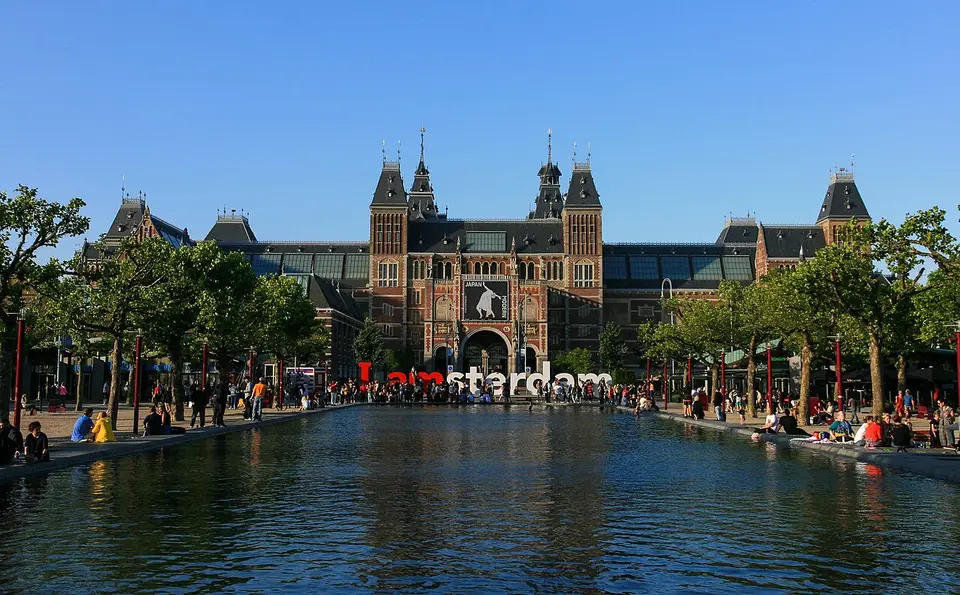
Four institutions share the square. The Rijksmuseum came first: Pierre Cuypers’ building opened in 1885 and closes off one end like a gatehouse. The Concertgebouw, facing it from the far end, gave its first concert in 1888. The Stedelijk Museum, the city’s museum of modern art, opened in 1895 in a red-brick building by Adriaan Willem Weissman. The Van Gogh Museum followed in 1973.
The Stedelijk and the Van Gogh Museum long had their main entrances on the street behind, the Paulus Potterstraat. Both have since turned round to face the grass. The Stedelijk reopened in 2012 with a new wing that Amsterdammers call the bathtub, and the Van Gogh Museum opened its glass entrance hall in 2015.
Meadow, windmills and an exhibition
From the 17th century a ditch and a path ran here through the meadows, with seven windmills along them, mostly sawmills and corn mills. The last of the mills were pulled down in 1878 to make room for the Rijksmuseum.
The empty ground behind the new museum was put to use at once. In 1883 it held the International Colonial and Export Exhibition, the same exhibition for which the city built the Blauwbrug. From 1887 it served in winter as the city’s ice rink, and in 1893 the first official world championship in speed skating was held on it. The Dutch skater Jaap Eden won.
It was still the edge of town. When the Concertgebouw was finished, late in 1886, it stood in a field with no paved road to it.
Why it was never built on
The city’s plan was to cover the ground with villas, with the Rijksmuseum as the gateway to the new streets. Cuypers, the museum’s architect, argued against it before the city council in December 1891. In 1902 the council decided to leave most of the ground open and to allow villas on only part of it. The name Museumplein was fixed the following year.
The shortest motorway in the country
During the German occupation bunkers were built on the square. They were demolished in 1946 and 1953. In 1953 a wide brick road was laid across the square, in line with the passage under the Rijksmuseum. It was meant to connect with the motorway from The Hague and bring cars into the centre. Local residents protested, the rest of the plan was dropped, and the stub that remained was nicknamed the shortest motorway in the Netherlands. Tour coaches parked on it for years.
The road was closed in 1997, after a car park had been built under the square. In 1999 the square was laid out afresh by the landscape architect Sven-Ingvar Andersson, as a field that is half square and half park, with a pond behind the Rijksmuseum. At the Van Baerlestraat side a piece of the lawn slopes up off the ground. It is called the ezelsoor, the dog-ear, and under it are the entrances to the car park and to a supermarket.
The pond was taken out in 2024 because it leaked badly, to be replaced by a new one.
A place for crowds
The lawn is where Amsterdam gathers in large numbers. On 21 November 1981 an estimated 420,000 people came here to protest against new nuclear weapons in Europe, one of the largest demonstrations in Dutch history. When Ajax win a major prize, the team is often honoured here.
Visitors still come looking for the giant red and white letters that spelled I amsterdam. They stood by the pond from 2005 and were removed in December 2018, after the city council decided they should go as a gesture against mass tourism.
Where to see it
- Rijksmuseum The Rijksmuseum is the national museum of the Netherlands, home of Rembrandt’s Night Watch.
- Van Gogh Museum The Van Gogh Museum holds the largest collection of Vincent van Gogh’s paintings in the world.
- Concertgebouw The Concertgebouw is Amsterdam’s concert hall, opened on 11 April 1888 and designed by Adolf Leonard van Gendt.
- Vondelpark The Vondelpark is Amsterdam’s best-known park: 47 hectares of lawns, ponds and winding paths, opened in 1865 and laid out by the garden architects Jan David Zocher and his son Louis Paul.
Walking through Amsterdam? Lookstory tells you the story of whatever you’re standing in front of. Point your phone at it.
Open Lookstory