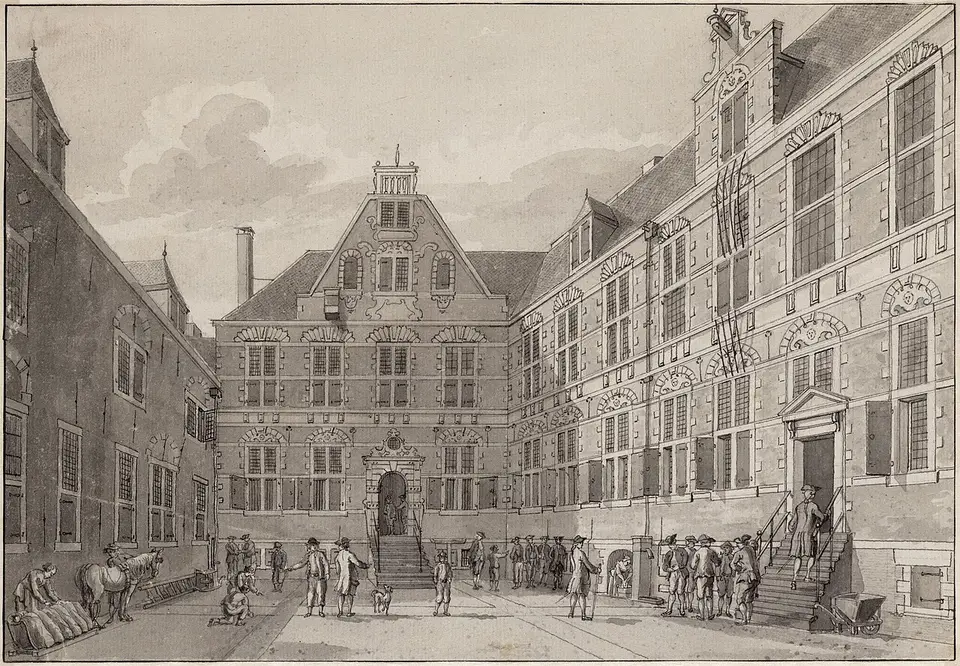
The VOC, the Dutch East India Company, was founded in 1602 and run largely from Amsterdam. It held the Dutch monopoly on trade with Asia, enforced it by war and conquest, and bought, sold and used enslaved people. Its Amsterdam headquarters, the Oost-Indisch Huis, still stands on the Oude Hoogstraat, and a copy of one of its ships is moored beside Het Scheepvaartmuseum.
A company that could make war
The Vereenigde Oostindische Compagnie, VOC for short, was founded on 20 March 1602, when the States General merged the Dutch companies already trading with Asia into one. It was given the sole right to Dutch trade east of the Cape of Good Hope, and powers that normally belong to a state: it could wage war, negotiate treaties and found colonies.
It had six chambers in six port cities, and Amsterdam’s was the largest, with eight of the seventeen seats on the board, the Heren XVII. Anyone living in the Republic could put money in. In Amsterdam 1,143 people did, and between them they supplied more than half of the 6.4 million guilders raised. Shares could be sold on, and the trade in them grew into the Amsterdam stock exchange.
What the monopoly cost
The monopoly was enforced with soldiers. The clearest case is the Banda Islands, then the only place where nutmeg grew. In 1621 the governor-general, Jan Pieterszoon Coen, landed there with an army. By one estimate, of some 15,000 islanders only about 1,000 were left. The others had been killed, starved, enslaved or driven out. The Rijksmuseum now says plainly that the company’s spices were obtained “often through violence and slavery”.
Slavery was part of how the company worked. It bought and sold enslaved people and used them in its settlements, shipyards and plantations. Between 660,000 and 1,135,000 enslaved people are estimated to have been carried to the regions it controlled, most of them by private traders, among them the company’s own staff, whom it encouraged to take part.
The trade in enslaved Africans across the Atlantic belonged to a different company, the West India Company, founded in 1621, which sat for a time in the West-Indisch Huis on the Herenmarkt. The VOC itself went bankrupt, and the state took it over at the end of the 18th century.
The Oost-Indisch Huis, where it was run
In 1603 the Amsterdam chamber began to store goods in the city’s armoury on the Kloveniersburgwal. In 1606 it finished a building of its own next door: the Oost-Indisch Huis, the first building put up for the company. The chamber’s twenty directors met here, and so, most of the time, did the Heren XVII. Crews were signed on here. The University of Amsterdam uses it now.
Go to Oude Hoogstraat 24 and walk in through the sandstone gateway. A vaulted passage leads to the courtyard. The oldest wing, of 1606 and attributed to Hendrick de Keyser, is on the south side. Look for the bands and small blocks that decorate its top.
Along the old harbour: what belonged to whom
On the Prins Hendrikkade, over the entrance of the Schreierstoren, a stone shows the four ships of the first Dutch voyage to the East Indies. They left in 1595, seven years before there was a VOC. A plaque of 1927 on the same tower remembers Henry Hudson, who sailed from here on 4 April 1609, sent by the company to find another way to Asia. A little further along the quay, the Scheepvaarthuis, built from 1913 for six later shipping companies, stands where that first voyage is said to have begun.
Further east, be exact. The great building that houses Het Scheepvaartmuseum was never the company’s storehouse. It was built in 1655 and 1656 for the Admiralty of Amsterdam, the navy. The VOC’s own yard was on the island of Oostenburg, and the storehouse it built there collapsed in 1822. The company’s part is the ship at the museum jetty: a copy, begun in 1985, of the Amsterdam, a VOC ship built in Amsterdam and wrecked on the English coast in January 1749, on her first voyage. For a long time, the museum says, it told no stories on board about the company’s violence or slavery. Now it does.
Where to see it
- Oost-Indisch Huis The Oost-Indisch Huis is the former Amsterdam headquarters of the Dutch East India Company, the VOC, built in 1606.
- Schreierstoren The Schreierstoren is a defensive tower from the 1480s, the only defensive tower of Amsterdam’s medieval city wall still standing.
- Scheepvaarthuis The Scheepvaarthuis, or Shipping House, was built from 1913 to 1916 as the shared headquarters of six Amsterdam shipping companies.
- Het Scheepvaartmuseum Het Scheepvaartmuseum, the Dutch national maritime museum, occupies ’s Lands Zeemagazijn, the storehouse built in 1656 for the navy of the Admiralty of Amsterdam.
Walking through Amsterdam? Lookstory tells you the story of whatever you’re standing in front of. Point your phone at it.
Open LookstorySee how it worksKeep reading
Sources
- Nationaal Archief: VOC, opvarenden (search guide)
- Rijksmonumentenregister, monument 2012 (Oost-Indisch Huis)
- Rijksmuseum: 10 objects with a connection to slavery
- Het Scheepvaartmuseum: East Indiaman Amsterdam, a new narrative
- Wikipedia: Dutch East India Company
- Wikipedia (Dutch): Vereenigde Oostindische Compagnie
- Wikipedia (Dutch): VOC-Kamer Amsterdam
- Wikipedia: Dutch conquest of the Banda Islands
- Wikipedia: Dutch West India Company
- Wikipedia: Oost-Indisch Huis
- Wikipedia (Dutch): Oost-Indisch Huis (Amsterdam)
- Wikipedia (Dutch): Schreierstoren
- Wikipedia: First Dutch Expedition to the East Indies
- Wikipedia: Scheepvaarthuis
- Wikipedia (Dutch): ’s Lands Zeemagazijn
- Wikipedia (Dutch): Oostenburg (Amsterdam)
- Wikipedia: Amsterdam (1748)