The short answer
Amsterdam is the capital because the Dutch constitution says so: Article 32 has a new king sworn in “in the capital city, Amsterdam”. Little else follows from the title. The king lives and works in The Hague, and parliament, the cabinet and the highest courts sit there, as the States General first did in 1588.
One line in the constitution
The constitution of the Netherlands names Amsterdam once. Article 32 says a new king is to be sworn in and inaugurated as soon as possible “in the capital city, Amsterdam”, at a joint session of the two houses of parliament. That phrase is the legal basis of the title, and it has stood there in these words only since the revision of 1983. No Dutch law appoints The Hague as the seat of government. That part is custom.
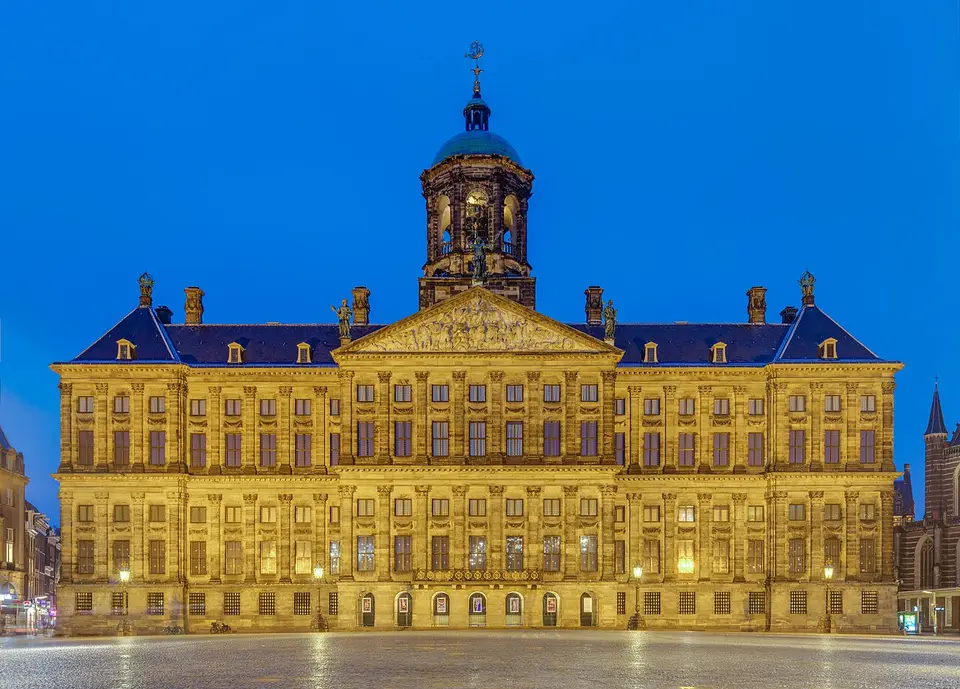
In practice most of what a capital usually has is in The Hague. The king lives at Huis ten Bosch Palace and works at Noordeinde Palace, both there. The States General, the cabinet, the Supreme Court and the Council of State sit there, and so do most foreign embassies. Amsterdam has the ceremony: the inauguration, royal weddings, and a palace used for state visits and official receptions.
A republic without a capital
The split is older than the kingdom. Until 1795 the Netherlands was a republic, a federation of seven provinces that each ran their own affairs, and it had no official capital. Its shared bodies still needed somewhere to meet. In 1588 they settled in The Hague, long the seat of the counts of Holland. Amsterdam grew into the largest and most powerful city of the country, but it was the stronghold of the party that opposed the princes of Orange, and more than once it clashed with them.
A French king moves in
The change came from outside. In 1806 Napoleon’s brother Louis Bonaparte became king of Holland. He held court first in The Hague and then in Utrecht. On 20 April 1808 he made his entry into Amsterdam, which he had named his capital, and took the town hall on the Dam as his palace. For two years Amsterdam was both capital and seat of government, the only time it has been both. In 1810 Louis stepped down and the country was annexed by France.
1814: the title stays, the government goes
When French rule ended in 1813, the son of the last stadholder came back from exile as sovereign prince, and the government returned to The Hague. Amsterdam kept the title. The first constitution, of 1814, had the prince sworn in “in the city of Amsterdam, as the capital”, and on 30 March 1814 he was, in the Nieuwe Kerk. It is described as a conciliatory gesture towards the country’s most prominent city.
The wording did not last. In 1815 the southern provinces, today’s Belgium, were joined to the kingdom, and the new constitution had the ceremony held by turns in Amsterdam and in a city of the south. William was inaugurated a second time, as king, in Brussels. After Belgium broke away in 1830 his successors were all sworn in at Amsterdam, but the word “capital” did not return to the constitution until 1983.
See it on the Dam
Stand on Dam Square and face the Royal Palace. It was built as the town hall and served as one for 150 years. The balcony in the middle of the front is the one Louis Bonaparte had made, so that a king could show himself to his people. Beside the palace is the Nieuwe Kerk. Seven times since 1814 a new head of state has been sworn in there, most recently King Willem-Alexander on 30 April 2013. The governing, then as now, was done in The Hague.
Where to see it
Walking through Amsterdam? Point your phone at whatever you’re standing in front of, and I’ll tell you its story.
Open LookstorySee how it worksKeep reading
Sources
- Government of the Netherlands: The Constitution of the Kingdom of the Netherlands 2018
- Overheid.nl: Grondwet, artikel 32
- Royal House of the Netherlands: Palaces
- Royal House of the Netherlands: Royal Palace Amsterdam
- Royal House of the Netherlands: Kingdom of the Netherlands
- Royal Palace Amsterdam: Town Hall becomes Royal Palace
- De Nieuwe Kerk Amsterdam: The Royal Church
- Eerste Kamer der Staten-Generaal: interview with Dorine Hermans on the inauguration
- Parlement.com: De Grondwet van 1814
- Wikipedia: Capital of the Netherlands
- Wikipedia (Dutch): Hoofdstad van Nederland
- Wikipedia: The Hague
- Wikipedia: Royal Palace of Amsterdam
- Wikipedia: Nieuwe Kerk, Amsterdam
- Wikipedia (Dutch): Nieuwe Kerk (Amsterdam)