The short answer
Because each of them holds a carillon: a set of at least 23 tuned bronze bells, played from a keyboard or by a machine that marks the time with a short tune. The instrument comes from the Low Countries, and the brothers François and Pieter Hemony, who cast the first tuned carillon in 1644, later had their foundry in Amsterdam.
An instrument at the top of a tower
The music that falls on you from a tower in Amsterdam is not a recording. It comes from a carillon, an instrument of at least 23 bells. The bells are cast in bronze, hung so that they do not swing, and tuned so that they sound well together. Clappers strike them, and the clappers are connected to a keyboard of wooden batons played with the hands, and to pedals played with the feet.
A carillon can also play by itself. An automatic system announces the time and plays simple tunes through the day, which is what you hear most often.
It was invented in this part of the world
The carillon began in the Low Countries in the 16th century. The modern one dates from 1644, when Jacob van Eyck and two bell founders, the brothers François and Pieter Hemony, cast the first carillon whose bells were truly in tune: 19 bells for a tower in Zutphen. Over the next 36 years the Hemony brothers made 51 carillons.
The brothers who came to Amsterdam
The first carillon Amsterdam bought was a small one by the Hemonys, made in 1651 for the tower of the exchange. In 1655 the city invited François Hemony to settle here as its founder of cannon and bells, on favourable terms, and in 1657 he came with his family. In his Amsterdam foundry he cast twenty carillons. Pieter joined him in 1664, and together they made four more, among them the one for the town hall on the Dam, which is now the Royal Palace.
Their work is still spread over the centre. The Zuiderkerk has a carillon by the brothers, installed in 1656. François made carillons for the Oude Kerk and for the Westerkerk. And the bells of the exchange ended up in the Munttoren, where Pieter added new ones in 1668.
The tower that plays all night
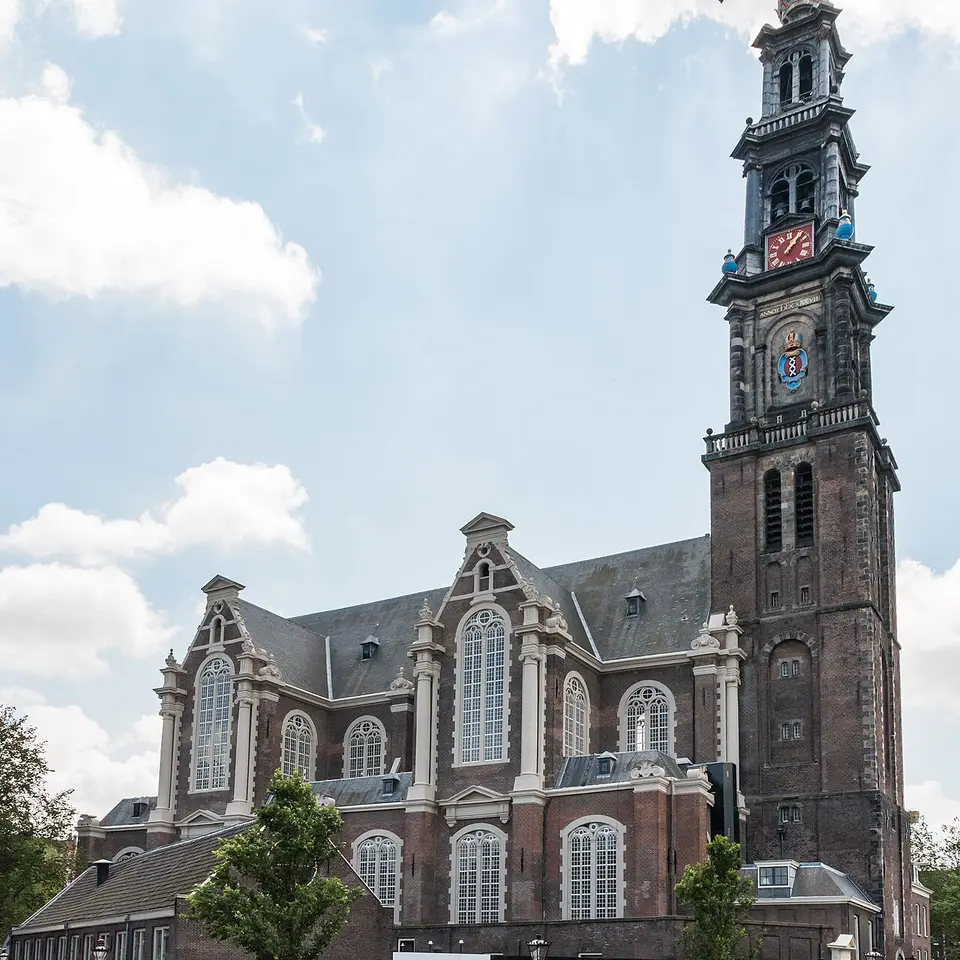
The carillon of the Westerkerk has 51 bells, and the 14 largest were cast by François Hemony in 1658. The drum that plays them by itself was made in 1659, and it still chimes every quarter of an hour. This is the only carillon in the city that plays through all twenty-four hours, at the request of the people of the Jordaan.
Anne Frank, in hiding a few doors away, wrote about this tower often in her diary. She described the sound of its bells as a comfort.
When to stand and listen
Go to the Westerkerk on a Tuesday at noon. The city carillonneur plays for an hour then, by hand. Look up while you listen: the bells hang just above the clock faces.
On any other day, wait at the foot of the Munttoren until the quarter. A mechanism makes its bells play a short melody every fifteen minutes.
Where to see it
0 of 5 heard
Walking through Amsterdam? Point your phone at whatever you’re standing in front of, and I’ll tell you its story.
Open LookstorySee how it works