What is a hofje? Amsterdam’s hidden almshouse courtyards
A hofje is a courtyard ringed by small houses, founded by a wealthy benefactor or a church so that poor old people, most often women, could live there free. Amsterdam still has many of them, nineteen in the Jordaan alone at a count in 2017. People still live in them, so they can be visited only quietly, and only when the gate is open.
What a hofje is
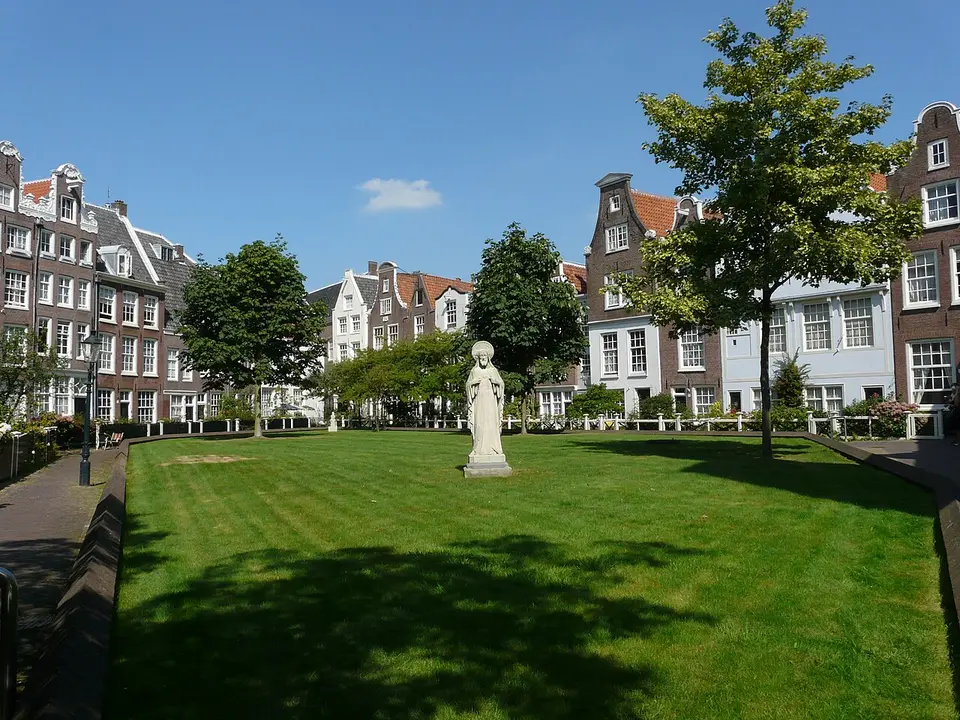
From the street you see a door or a gateway like any other. Behind it is a courtyard, now usually a garden, with a ring of small houses round it. In earlier times the yard held what the houses shared: the privies and a place to wash.
A hofje was a private charity. It was run by a board of well-off men and women, the regents, who chose the residents and met in a room in the gatehouse. The houses were free, and living in one was a favour that came with rules. Residents were expected to go to church, visitors had to leave by ten in the evening, and the gate was then locked.
Why they were built
Until the state old-age pension arrived in the 1950s, the Netherlands had no pension for everyone. An old person without money depended on family, on the church, or on the rich. Founding a hofje was one way the rich answered.
The founders were often people without children who wanted their money to do some good after their death. A hofje also carried their name on, and many believed that charity would count in their favour in heaven. Most hofjes were for women living alone, because it was thought that a woman could keep her own household and a man could not. Old men went to an old men’s home, where everything was done for them.
The Begijnhof: the famous one, and a different kind
The best-known courtyard in Amsterdam is the Begijnhof, first recorded in 1346, and it is not an almshouse. It belonged to the beguines, Catholic women who lived as a community without becoming nuns. They were not objects of charity: a beguine kept her own property. The layout of the later hofjes, small houses round a closed court, is thought to have been borrowed from beguinages like this one.
Three to know
The Sint Andrieshofje, on the Egelantiersgracht, is the oldest hofje still standing in the Jordaan. It dates from the 1610s: the national register of monuments gives 1617 for the three wings round its courtyard.
The Karthuizerhof, properly the Huiszittenweduwenhof, is the big one. It was built in 1650 to a design by the city architect Daniël Stalpaert, with four wings round a wide court and two pumps under little domed roofs. It had 104 small dwellings, for widows and for unmarried older women. Its name comes from the Carthusian monastery that stood on the site.
The Deutzenhofje, on the Prinsengracht, dates from 1695. It was founded from the estate of Agneta Deutz for old servants and poor relations of her family. The stone in its front says that she shows her love and her faith here, “a comfort to the poor, an example to the rich”.
The same need was met on a far larger scale by the Amstelhof on the Amstel, built in the early 1680s as a home for old women and used to house the elderly until 2007.
Visiting one
These are homes. Many hofjes are still lived in, and visitors are asked to keep their voices down. The Begijnhof is closed in the evening.
Beyond the Begijnhof, the city’s visitor guide, I amsterdam, points people to the Karthuizerhof, the Rozenhofje and the Suyckerhofje. Being let in is a favour and can be withdrawn at any time. If a gate is shut, or a notice asks you to stay out, take that as the answer.
Where to see it
- Begijnhof The Begijnhof is an enclosed courtyard of houses in the centre of Amsterdam, founded in the 14th century for the beguines, a community of unmarried Catholic women.
- Amstelhof The Amstelhof is a very long brick building on the Amstel, built in the early 1680s as a home for old women and used to house the elderly until 2007.
Walking through Amsterdam? Lookstory tells you the story of whatever you’re standing in front of. Point your phone at it.
Open LookstoryKeep reading
Sources
- Rijksmonumentenregister, monument 978 (St. Andrieshofje)
- Rijksmonumentenregister, monument 2194 (Huiszittenweduwenhof)
- Rijksmonumentenregister, monument 4431 (Deutzenhofje)
- I amsterdam: Beauty is in the details
- I amsterdam: 10 dingen om te doen in de Jordaan
- Wikipedia (Dutch): Hofje
- Wikipedia: Hofje
- Wikipedia (Dutch): Jordaan (Amsterdam)
- Wikipedia (Dutch): Huiszittenweduwenhof
- Wikipedia (Dutch): Deutzenhofje