The short answer
By the city’s own figures Amsterdam has more bicycles than people: over 900,000 in 2017. It helps that the land is flat and the city small, but the real reason is a choice. Cycling was in steep decline until the 1970s, when protests over road deaths changed policy. In 1978 the city’s traffic plan gave priority to cycling and took road space from cars to do it.
More bicycles than people
The city’s statisticians put the number of bicycles in Amsterdam at more than 900,000 in 2017, when four out of five residents aged twelve or over owned one. At the start of 2019 the city had about 863,000 residents. That is more than one bicycle for every person, babies included.
They are ridden, too. In 2022 one in three journeys made by people who live here was by bicycle. At the end of the last century it was less than a quarter. Cars are scarcer than you might expect: early in 2023 there were 0.4 private cars for every household, the lowest figure of any municipality in the Netherlands.
Flat, small and nearly lost to the car
Geography helps. The city is flat and small, so most trips are short. Cycling here is old, too. The first cycle paths in Amsterdam were laid in 1925, in the Van Woustraat, the Rijnstraat and on the Amsteldijk. In 1959 the Dutch cycled about 1,500 kilometres a head, a peak that has not been matched since.
Then came the car, and roads were rebuilt to suit it. Between 1964 and 1974 cycling in the Netherlands fell sharply, and in the mid-1970s people rode about 700 kilometres a year, less than half the old figure. In 1967 an American traffic expert, David Jokinen, proposed filling in the Singelgracht for a six-lane motorway and pulling down two whole districts, De Pijp and the Kinkerbuurt. His plan was buried in criticism and very little of it was built.
What changed in the 1970s
Road deaths in the Netherlands reached their peak in 1972, at more than 3,200 in one year, and many of the dead were children. A campaign called Stop de Kindermoord, “stop the child murder”, was founded in March 1973. A cyclists’ union followed in October 1975. Together with the oil shortage of 1973 and 1974, the protests turned government policy round.
Amsterdam’s traffic plan of 1978 gave priority to cycling, above all to cycle paths set apart from the road, and took space from motor traffic to make them. From 1977 the distance the Dutch cycled began to climb again. What you see in the streets today goes back to those choices.
Where to see it
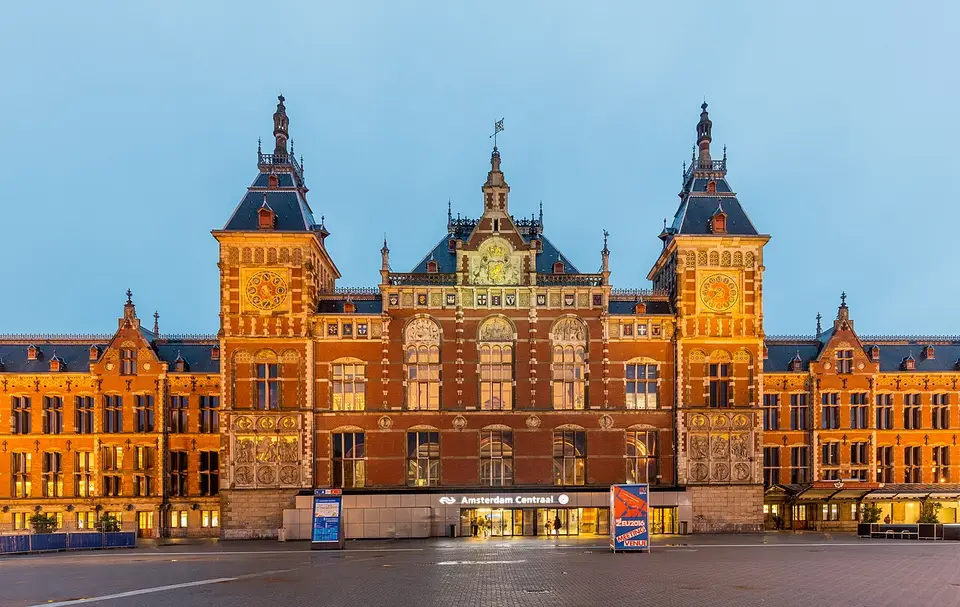
Start at Amsterdam Centraal. Under the water in front of the station lies a garage for 7,000 bicycles. It opened on 26 January 2023 and was then the largest in the city. Moving walkways take you down to it. A second, for 4,000, opened a month later on the other side of the station, built in the water of the IJ.
At the Rijksmuseum, stand in the passage under the building. The museum itself says a route through it was required in the original commission, so that the building would be a gateway between the old town and the new districts to the south. Cars have been kept out since 1931. When the museum was rebuilt between 2003 and 2013 the passage was shut, and there was a long argument over whether bicycles should come back. The cyclists’ union and a committee called Red de Onderdoorgang, “save the underpass”, pressed for it. In May 2013 the bicycles returned.
Then go on to the Vondelpark, where the argument is older still. In the 1880s and 1890s the park’s managers tried to curb cyclists with special paths, limited hours and fines for anyone going faster than a horse’s trot. In 1893 cycling was allowed after much debate, and then only in the morning.
Where to see it
- Amsterdam Centraal Amsterdam Centraal is the city’s main railway station, opened in 1889 and designed by Pierre Cuypers, the architect of the Rijksmuseum.
- Rijksmuseum The Rijksmuseum is the national museum of the Netherlands, home of Rembrandt’s Night Watch.
- Vondelpark The Vondelpark is Amsterdam’s best-known park: 47 hectares of lawns, ponds and winding paths, opened in 1865 and laid out by the garden architects Jan David Zocher and his son Louis Paul.
Walking through Amsterdam? Point your phone at whatever you’re standing in front of, and I’ll tell you its story.
Open LookstorySee how it worksKeep reading
Sources
- City of Amsterdam: De Staat van de Stad Amsterdam X (2019)
- City of Amsterdam: De Staat van de Stad Amsterdam X, chapter on mobility (2019)
- City of Amsterdam, Onderzoek en Statistiek: Verkeer in cijfers (2024)
- Rijksmuseum: 10 things to know about Cuypers’ museum building
- Wikipedia: Cycling in Amsterdam
- Wikipedia: Cycling in the Netherlands
- Wikipedia: History of cycling infrastructure
- Wikipedia: Road transport in the Netherlands
- Wikipedia: Jokinen Plan
- Wikipedia (Dutch): Plan Jokinen
- Wikipedia (Dutch): Geschiedenis van het fietsen in Nederland
- Wikipedia (Dutch): Stichting Kinderen Voorrang
- Wikipedia (Dutch): Fietsersbond (Nederland)
- Wikipedia (Dutch): Fietsenstalling Stationsplein (Amsterdam)
- Wikipedia (Dutch): Station Amsterdam Centraal
- Wikipedia (Dutch): Passage Rijksmuseum
- Wikipedia: Vondelpark
- Wikipedia (Dutch): Vondelpark
- BNNVARA Kassa (ANP): Conflict over fietspassage Rijksmuseum (2013)
- BNNVARA Kassa (ANP): Fietstunnel Rijksmuseum gaat goeddeels open (2013)