Is Amsterdam below sea level?
Partly. The old centre of Amsterdam lies about a metre above sea level, on ground that has been raised over the centuries, while drained lakes in the newer districts, such as the Watergraafsmeer, lie about five metres below it. Heights in the Netherlands are measured from NAP, the Normaal Amsterdams Peil, a zero level first fixed in Amsterdam in 1684.
The honest answer
It depends where you stand. The inner city lies about a metre above sea level. The Dam is higher still: the benchmark buried ninety centimetres under its paving stands at about 1.4 metres above the zero level.
Walk outwards and the ground drops. The Watergraafsmeer, in the east of the city, is the bed of a lake that was drained in 1629, and it lies about five metres below sea level. The Bijlmermeer and the Buikslotermeer are drained lakes too, and they also lie below it.
You will often read that Amsterdam lies two metres below sea level, or that its airport lies four metres below. The first is a single figure for a very uneven city. The second is true of Schiphol, but Schiphol stands on the floor of another drained lake in the neighbouring municipality of Haarlemmermeer.
Why the old city is the high part
The medieval town grew up along a dike and a dam, and its people went on raising the ground. Mud dug out of the canals was used to raise the land beside them. You can see how much was added at the Begijnhof. The courtyard has kept its medieval level, and you step down about a metre to enter it.
Low ground is kept dry by draining and pumping, and that has a price. The Vondelpark was laid out on peat meadow. It is drained to keep it dry, the peat shrinks as it dries, and the park has sunk below the streets around it.
Even the harbour water is below zero. The level of the IJ, the water behind Centraal Station, is fixed by a national decree of 1992 at forty centimetres below NAP.
What NAP is
NAP stands for Normaal Amsterdams Peil, the normal Amsterdam level. Every height in the Netherlands is measured from it, and zero NAP is roughly the average level of the North Sea.
It began with a flood. After Amsterdam was flooded in 1675, the mayor Johannes Hudde had the high-water level of the IJ measured every day for a year, from 1683 to 1684. The average became the city’s zero. In 1684 Hudde had eight marble stones set into the sluices of the city, each with a groove showing the height the sea dikes had to reach: nine feet five inches above that zero, which is 2.67 metres.
In 1818 King William I made the Amsterdam level the standard for the whole country. The word “normal” was added later in the 19th century, when the heights were measured again more precisely. Prussia adopted the level in the 1870s, and the European height system is based on it.
Rijkswaterstaat, the national water authority, maintains it through about 35,000 marks, most of them small metal bolts set in houses, bridges and viaducts. Almost anywhere in the country there is one within a kilometre.
Where to see it
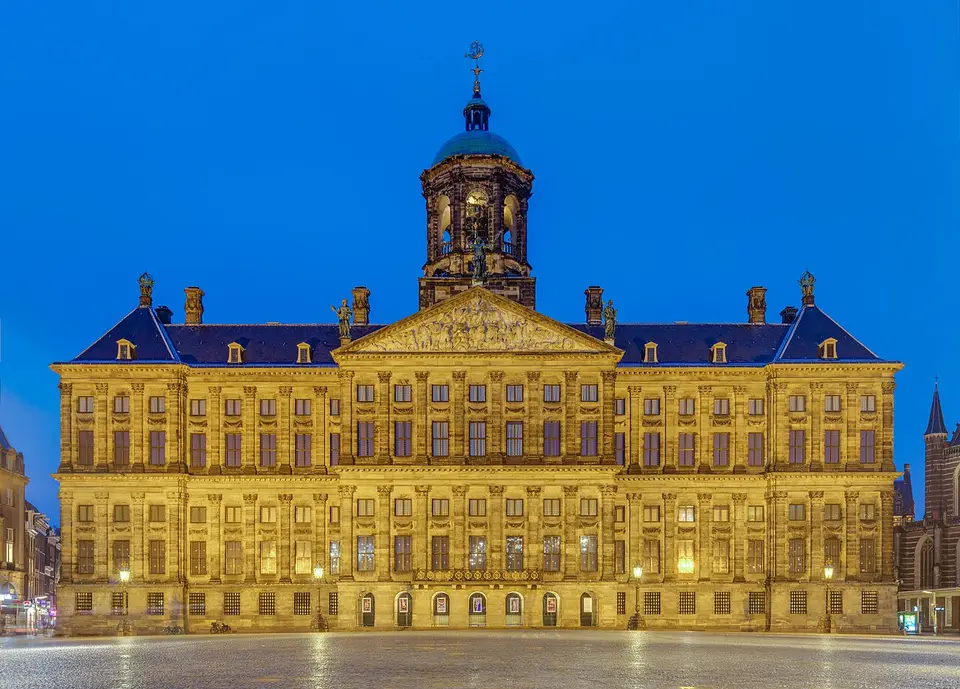
The mark that Rijkswaterstaat calls the original zero point is in the middle of the Dam, hidden under a stone in the paving in front of the palace. Beneath it is a bronze bolt on top of a pile 22 metres long, which became the country’s reference point in 1953. You can walk over it without noticing.
The one made to be looked at is in the Stopera, the city hall and opera house on the Amstel. A monument to NAP was opened there on 18 May 1988, with a second pile carrying a bronze bolt at exactly zero. It is ceremonial and is not used for measuring. When this page was last checked, in October 2026, the visitor centre beside it was listed as closed on its own website.
The oldest marks are Hudde’s stones. Only one of the eight is still in its original place, in the Eenhoornsluis, the lock on the Korte Prinsengracht at the Haarlemmerdijk. Another went missing in the 1950s, was found again during the building of the metro, and since 2014 can be seen on the north side of the Nieuwe Brug, on the Damrak.
Where to see it
- Royal Palace The Royal Palace on Dam Square was built between 1648 and 1665 as Amsterdam’s town hall, designed by Jacob van Campen.
- Begijnhof The Begijnhof is an enclosed courtyard of houses in the centre of Amsterdam, founded in the 14th century for the beguines, a community of unmarried Catholic women.
- Vondelpark The Vondelpark is Amsterdam’s best-known park: 47 hectares of lawns, ponds and winding paths, opened in 1865 and laid out by the garden architects Jan David Zocher and his son Louis Paul.
- Amsterdam Centraal Amsterdam Centraal is the city’s main railway station, opened in 1889 and designed by Pierre Cuypers, the architect of the Rijksmuseum.
Walking through Amsterdam? Lookstory tells you the story of whatever you’re standing in front of. Point your phone at it.
Open LookstoryKeep reading
Sources
- Rijkswaterstaat: Normaal Amsterdams Peil (NAP)
- Rijkswaterstaat: Geschiedenis NAP
- Stichting Normaal Amsterdams Peil: NAP history
- Stichting Normaal Amsterdams Peil: the NAP monument and visitor centre
- Peilbesluit boezem Noordzeekanaal/Amsterdam-Rijnkanaal (1992)
- Wikipedia: Amsterdam Ordnance Datum
- Wikipedia (Dutch): Normaal Amsterdams Peil
- Wikipedia: Watergraafsmeer
- Wikipedia (Dutch): Amsterdam