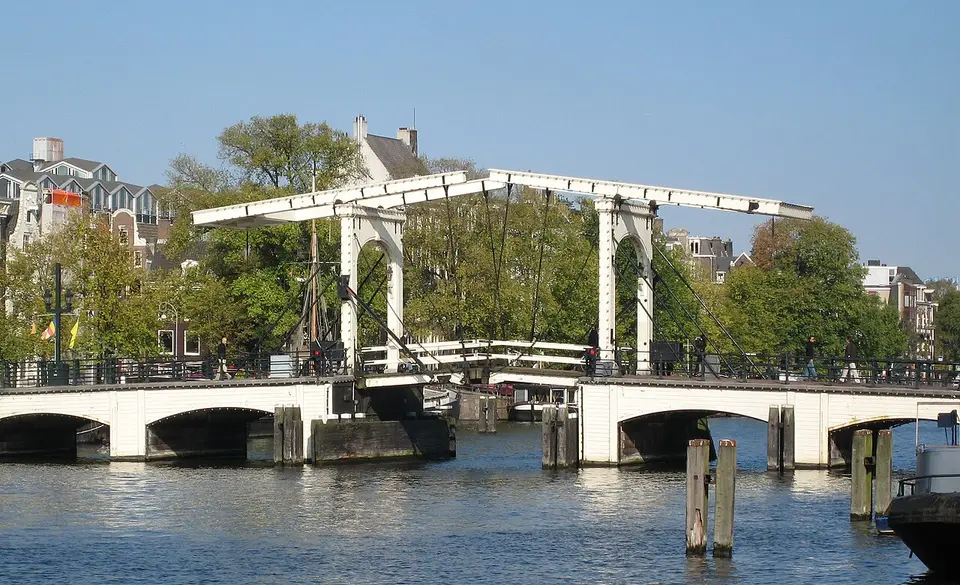
The short answer
Amsterdam’s canals are between two and four metres deep on average, according to the Museum of the Canals. On the bottom lie mud and rubbish, including the 12,000 to 15,000 bicycles that Waternet says it lifts out every year. The water is far cleaner than it used to be, but the canals are not official swimming water, and ice thick enough to skate on has become rare.
Two to four metres, depending on where
There is no single depth. The Museum of the Canals gives an average of between two and four metres, varying from place to place, with some spots a little deeper where the bottom is dredged more often.
Left alone, a canal gets shallower. Mud, plant remains and rubbish settle on the bottom, so the canals have to be dredged regularly to keep their depth. The regional water board says its waterways are measured, and dredged when they are no longer deep enough, which comes round about every seven to fifteen years.
What lies on the bottom
Bicycles, for a start. Waternet, which keeps the canals clean, says that every year it lifts 12,000 to 15,000 of them off the bottom, together with more than 700 boats, shopping trolleys and car tyres. In a piece written in 2024 it gave a year’s haul as 12,000 bicycles, between 40,000 and 60,000 kilos of plastic and 7,000 dead animals, most of them ducks.
The fishing is done every day, with a grab. Waternet points out that a car tyre caught against a lock gate can stop the gate closing at high water.
How the water is kept fresh
In the Golden Age the tide did the work: the water in the canals was refreshed twice a day, on the ebb and on the flood. As the city grew, the Amstel and the canals became badly polluted, and in 1673 the Amstelsluizen were built across the river to flush them better. The design was by Johannes Hudde, a mathematician who later became mayor.
In 1872 new locks shut the IJ off from the sea, and the tide was gone. From 1879 a steam pumping station at Zeeburg did the flushing. Until 2010 water from the IJmeer was still pumped through the canals a few times a week. That is no longer needed, because the waste that once went into the canals now goes into the sewer: the inner city was connected in 1935, the canal ring from 1973 and the houseboats from 2010. Today the canals are flushed only in special cases, such as after very heavy rain, when the sewers can overflow into them.
Swimming and skating
Waternet says the canal water is cleaner than ever, and now and then someone dives in to cool off. But the canals and the Amstel are not official swimming water. The dangers it names are boats, because a swimmer is hard to see, and things lying unseen under the surface, bicycle wrecks among them. Its advice is not to jump from bridges, and to stay out for three days after a hard shower. Once a year there is an organised race, the Amsterdam City Swim. Thousands of people took part in the first one, in 2012.
Ice is rarer. When it starts to form, Waternet closes locks to still the water, and boats are banned from some canals, the Keizersgracht among them, so that people can skate there. A sprint race on the Keizersgracht is held only when the ice is 15 centimetres thick. That happened in 1991, 1996, 1997 and 2012. When the city’s statisticians wrote about it in January 2025, the last time Amsterdammers had skated on the canals was 2021.
Where to look
From the Magere Brug, walk upstream along the Amstel, away from the centre. Just beyond the Prinsengracht, close to Theater Carré, a row of lock islands with small buildings on them crosses the river. These are the Amstelsluizen of 1673. The gates normally stand open.
Then find the Montelbaanstoren on the Oudeschans. From 1878 until 2006 the tower housed the Stadswaterkantoor, the city’s water office, and the department that managed the city’s water worked from here.
Where to see it
Walking through Amsterdam? Point your phone at whatever you’re standing in front of, and I’ll tell you its story.
Open LookstorySee how it worksKeep reading
Sources
- Museum of the Canals: Frequently asked questions
- Waternet: De Amsterdamse grachten: van riool naar zwemwater (2024)
- Waternet: Varende drone Emily
- Waternet: Zwemwater
- Waterschap Amstel, Gooi en Vecht: Amsterdamse grachten
- Waterschap Amstel, Gooi en Vecht: Gemaal Zeeburg
- Waterschap Amstel, Gooi en Vecht: Baggeren
- Rijksmonumentenregister, monument 518510 (Amstelsluizen)
- City of Amsterdam, Onderzoek en Statistiek: IJs om op te schaatsen, autorijden en ontsnappen uit de gevangenis (2025)
- Wikipedia: Magere Brug
- Wikipedia (Dutch): Amsterdamse grachten
- Wikipedia (Dutch): Amstelsluizen
- Wikipedia (Dutch): Gemaal Zeeburg
- Wikipedia (Dutch): Keizersgracht (Amsterdam)
- Wikipedia (Dutch): Keizersrace
- Wikipedia (Dutch): Montelbaanstoren