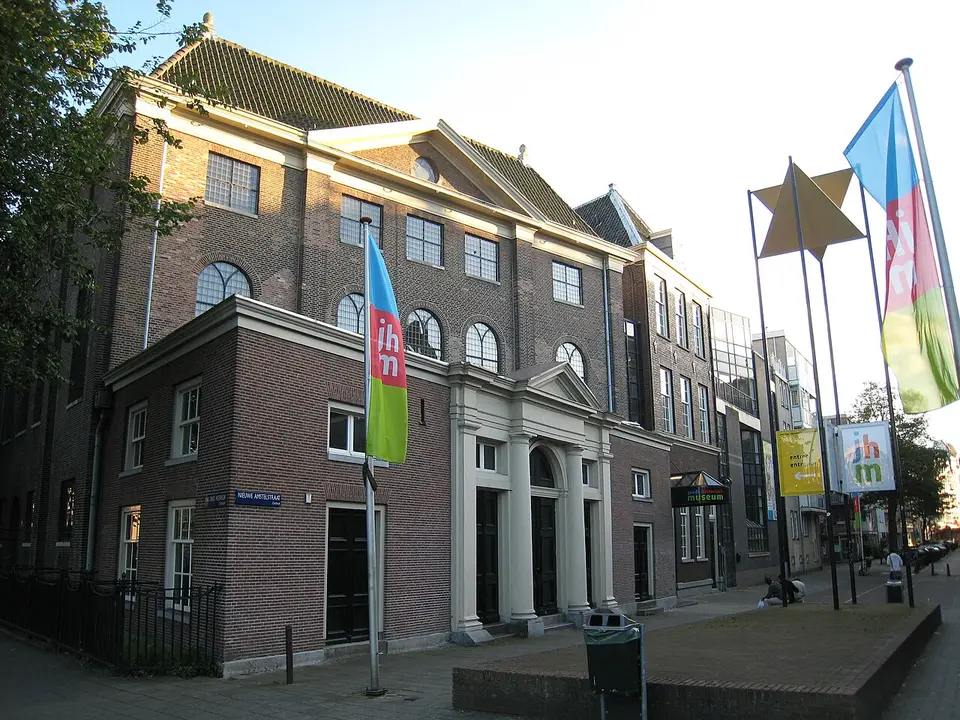
Jewish Museum
The Jewish Museum is housed in four former synagogues of Amsterdam’s Ashkenazi Jews, built side by side on the Jonas Daniël Meijerplein between 1671 and 1752. They were plundered during the German occupation and did not return to use as synagogues. The museum opened in them in 1987.
Before you hear it, a guess
Two great synagogues face each other across this square. Which one opened first?
This museum is four synagogues. Amsterdam’s Ashkenazi Jews built them side by side over eighty years, because the congregation kept outgrowing the last one.
What stands in front of you is not one building. It is four synagogues, built side by side between 1671 and 1752 and joined into one museum.
They were built by the Ashkenazi Jews of Amsterdam, families who had come from Germany and eastern Europe. The Great Synagogue came first, in 1671, four years before the Portuguese Synagogue across the square. It was soon too small. In the 1680s a second was built beside it, upstairs, over a kosher meat hall. A third followed in 1700. The fourth, the New Synagogue with the dome, opened in 1752. It is the largest, with seats for nearly a thousand people.
For more than two and a half centuries this corner was the centre of Ashkenazi religious life in Amsterdam. In 1753 Sara Rintel gave the Great Synagogue a silver lamp for the festival of Hanukkah, more than a metre high. That lamp still stands in its place.
In the early 20th century many Jewish families moved to newer districts, and the synagogues grew quieter. Then came the German occupation. Most of the people who prayed here were deported and murdered. The last service in the Great Synagogue was held in September 1943. The empty buildings were plundered, and in the last, hungry winter of the war the galleries were torn out for firewood.
They did not become synagogues again. The city bought the complex in 1954 and began repairs. The Jewish Museum, which had itself been shut by the occupiers and had lost most of its collection, opened here on 3 May 1987. The alley between the synagogues was roofed with glass and steel and became the way in. The new parts were made plainly modern on purpose, to mark the break. Look for that seam between the old brick walls. On either side of it are rooms where people prayed for more than 270 years. Inside, the museum tells of Jewish life here, then and now.
What to look for
The words over the door
On the square side, find the old main door of the New Synagogue. Above it are lines of Hebrew. The upper one holds the year the building was opened, and the one below reads: this is the gate of the Eternal, may the righteous enter here.
The dome
Look up at the roof of the New Synagogue. Above the stone balustrade and its carved crest rises the small dome that lets daylight into the hall.
The glass between the brick
Between the Great Synagogue and the New Synagogue ran an alley. It is now roofed with glass and steel, and that is where the four buildings were joined.
The oldest of the four
The tall brick building on the corner of the Nieuwe Amstelstraat is the Great Synagogue of 1671. The low porch with columns in front of it was added in 1822 and 1823.
Key facts
- Great Synagogue
- Opened in 1671
- Obbene Sjoel
- 1680s, built upstairs over a kosher meat hall
- Dritt Sjoel
- 1700
- New Synagogue
- Opened on 25 March 1752; the largest of the four
- Last service
- September 1943, in the Great Synagogue
- Museum opened here
- 3 May 1987
- Address
- Nieuwe Amstelstraat 1, Amsterdam Directions
Close by
The bigger picture
In Amsterdam? Lookstory tells you the story of whatever you’re standing in front of. Point your phone at it.
Open LookstorySources
The dates, names and figures on this page were checked against published references. These are the records for this place. The story is Lookstory’s own telling of them. Last updated October 2026.
- Rijksmonumentenregister, monument 265 (Great Synagogue)
- Rijksmonumentenregister, monument 2041 (New Synagogue)
- Jewish Cultural Quarter: Nu het Joods Museum, ooit het Hoogduitse Synagogencomplex
- Jewish Cultural Quarter: De Nieuwe Synagoge
- Jewish Cultural Quarter: Geschiedenis Joods Museum
- Jewish Cultural Quarter: Geschiedenis van de Joden in Amsterdam
- Jewish Cultural Quarter: Jewish Museum
- Wikidata Q702726
- Wikipedia: Joods Historisch Museum
- Wikipedia (Dutch): Grote Synagoge (Amsterdam)
- Wikipedia (Dutch): Obbene Sjoel
- Wikipedia (Dutch): Joods Museum (Nederland)
- Wikipedia: History of the Jews in Amsterdam
- Photograph: S Sepp, CC BY-SA 3.0