Van Gogh Museum
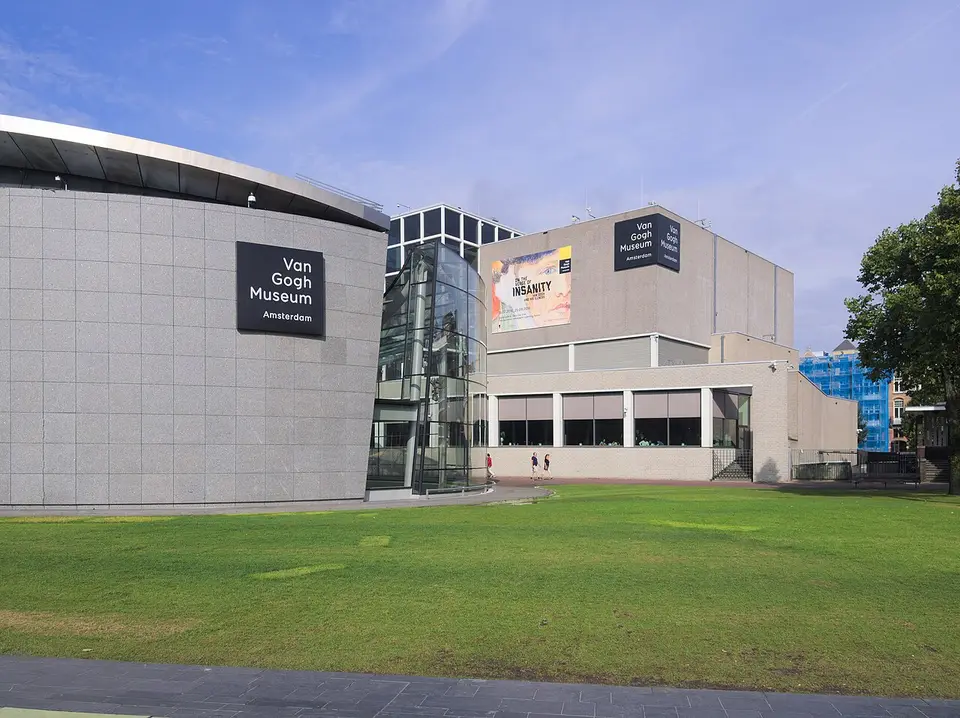
The Van Gogh Museum holds the largest collection of Vincent van Gogh’s paintings in the world. It stands on the Museumplein in two buildings: a main block designed by Gerrit Rietveld, opened in 1973, and an oval exhibition wing by Kisho Kurokawa, opened in 1999.
Before you hear it, a guess
Vincent’s brother Theo died only six months after him. Who did the unsold work pass to then?
Vincent van Gogh hardly sold a painting while he lived. That is why this museum exists: the pictures nobody bought stayed in his family, and the family kept them together.
When Vincent van Gogh died in 1890, his unsold work went to his brother Theo. Theo died only six months later, and it all passed to Theo’s widow, Jo van Gogh-Bonger. She sold some pictures to make the painter known, organised exhibitions, and kept the rest. In 1925 the collection went to her son, who was also called Vincent. For many years he lent it to the Stedelijk Museum next door.
The family worried that one day it would be scattered. In 1962 they reached an agreement with the Dutch state. The whole collection, more than two hundred paintings and about five hundred drawings, with Vincent’s letters, went into a foundation. In return the state undertook to build a museum for it and to keep it open to the public.
The architect was Gerrit Rietveld, a leading member of De Stijl, the group of Dutch artists and architects of the 1920s. He liked geometric shapes and light, open rooms. He drew the building in 1963 and 1964 and died that year, with only a sketch design finished. His partners worked it out, building started in 1969, and the museum opened on 2 June 1973.
The second building, the oval one, is by the Japanese architect Kisho Kurokawa and opened in 1999. It was made possible by donors in Japan. Where Rietveld had drawn a cube, Kurokawa chose an ellipse, and he sank half of it into the ground of the square.
The glass hall between the two came last. It opened in September 2015, and it moved the way in from the street behind to the square in front.
What to look for
Cube and oval
Stand back on the grass and compare the two buildings: Rietveld’s straight-sided block of 1973 and Kurokawa’s ellipse of 1999.
Glass holding up glass
In the entrance hall even the structure is glass. The fins that carry the roof are glass, the longest of them twelve metres, and so are the columns.
The sunken wing
Kurokawa’s wing is half sunk into the ground of the Museumplein, and it is joined to the main building below ground.
Key facts
- Opened
- 2 June 1973
- Main building
- Gerrit Rietveld, designed 1963–1964
- Exhibition wing
- Kisho Kurokawa, opened 1999
- Glass entrance hall
- Opened 5 September 2015
- Collection
- More than 200 paintings and about 500 drawings by Van Gogh
- Address
- Museumplein 6, Amsterdam Directions
Close by
The bigger picture
In Amsterdam? Lookstory tells you the story of whatever you’re standing in front of. Point your phone at it.
Open LookstorySources
The dates, names and figures on this page were checked against published references. These are the records for this place. The story is Lookstory’s own telling of them. Last updated October 2026.