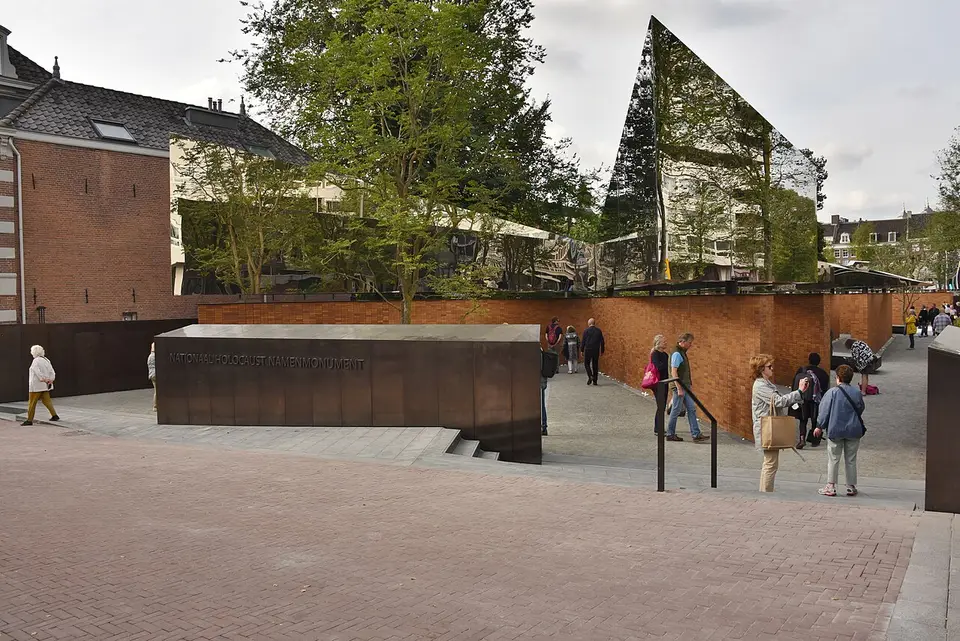
National Holocaust Names Memorial
The National Holocaust Names Memorial is a memorial of brick walls on the Weesperstraat, designed by Daniel Libeskind and unveiled on 19 September 2021. Each brick carries the name of one of the more than 102,000 Jews, Sinti and Roma from the Netherlands who were murdered in the Holocaust and have no grave.
Before you hear it, a guess
How are the brick walls of the memorial laid out?
There are more than 102,000 engraved bricks in these walls, and each one carries a name. They are the names of people who were taken from the Netherlands and murdered, and who have no grave.
Before the war this street was the middle of Jewish Amsterdam. The Weesperstraat was a crowded street of homes and shops, and almost everyone who lived on it was Jewish. After 1945 it stood deserted and neglected. The houses were pulled down and a wide traffic road was built. A strip of green was left open beside it, and that strip is where the memorial stands.
About 140,000 Jews lived in the Netherlands in 1940. About 102,000 of them did not survive the war. They were deported and murdered in camps such as Auschwitz and Sobibor, or died of hunger, exhaustion and forced labour. The memorial is for those who have no grave. It also names 220 Sinti and Roma who were persecuted and killed in the same years.
The idea came from the Dutch Auschwitz Committee and its chairman, Jacques Grishaver. There was no place in the country where every victim was named, and families had no grave to visit. The architect Daniel Libeskind, himself the son of Holocaust survivors, presented this design in December 2016. Building began in 2019. On 19 September 2021 the king unveiled the memorial together with Grishaver.
The walls are laid out as four Hebrew letters, which together mean “in memory of”. On top of them, following the same letters, lie four shapes of mirrored steel. Libeskind left a narrow gap between the brick and the steel, so that the letters seem to float. The gap stands for the break in the history of the country.
The names run in alphabetical order. Each brick gives a name, a date of birth and the age at which that person died. Some of the ages are those of small children. People come here to find one brick among them all, and to touch it.
What to look for
One brick
Read a single brick: a name, a date of birth, an age. The bricks are placed in alphabetical order of surname, so you can look for a name.
The gap under the steel
Look where the mirrored steel meets the brick. A narrow gap has been left between them, so that the steel letters seem to float above the names.
The wall without names
At the Nieuwe Keizersgracht end is a wall of a thousand blank bricks. It remembers victims who are still unknown, and leaves room for names found later.
Key facts
- Unveiled
- 19 September 2021, by King Willem-Alexander and Jacques Grishaver
- Designer
- Daniel Libeskind
- Names
- More than 102,000 Jews and 220 Sinti and Roma
- On each brick
- A name, a date of birth and the age at death
- Initiative
- Dutch Auschwitz Committee
- Address
- Weesperstraat, between Nieuwe Herengracht and Nieuwe Keizersgracht, Amsterdam Directions
Close by
The bigger picture
In Amsterdam? Lookstory tells you the story of whatever you’re standing in front of. Point your phone at it.
Open LookstorySources
The dates, names and figures on this page were checked against published references. These are the records for this place. The story is Lookstory’s own telling of them. Last updated October 2026.
- Holocaust Namenmonument: the design
- Holocaust Namenmonument: the Weesperstraat site
- Holocaust Namenmonument: questions about the memorial
- Wikidata Q66023853
- Wikipedia: National Holocaust Names Memorial (Amsterdam)
- Wikipedia (Dutch): Holocaust Namenmonument
- Studio Libeskind: Dutch Holocaust Memorial of Names
- Photograph: Christian Michelides, CC BY-SA 4.0