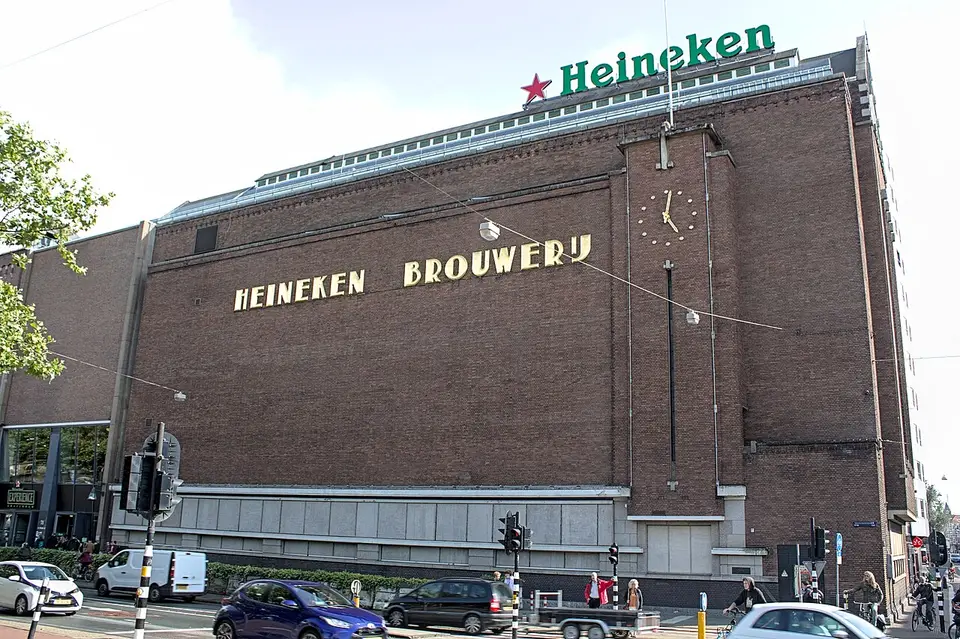
Heineken Brewery
The Heineken Brewery is the former brewery on the Stadhouderskade where the company made its beer from the late 1860s until 1988. The brick buildings that stand today were built between 1911 and 1934 and are a national monument. The company now uses them as a visitor attraction, the Heineken Experience.
Before you hear it, a guess
The big corner building of this brewery has almost no windows. Why?
The gold letters on this wall have a gap in the middle. An S hung there until the 1960s: the wall used to say Heineken’s Brouwerij, and when the letter came down the rest stayed where it was.
Look up at the gold letters on the big brick wall: HEINEKEN BROUWERIJ. The space between the two words is too wide. The wall first read Heineken’s Brouwerij, Heineken’s brewery. The S was taken down in the 1960s, and the other letters stayed where they were.
The brewery is older than this wall. In 1864 Gerard Heineken, who was 22, bought a centuries-old brewery in the middle of the city called De Hooiberg, the Haystack. It could not keep up with the times. So in 1867 he had a new one built here, driven by steam, just outside the Singelgracht, the canal that runs along this street. That was then the edge of Amsterdam.
Nothing of his building is left. The brewery grew year after year until it filled the whole block, and in the 1930s the first part was pulled down to make room. The oldest piece still standing is the brewhouse in the middle of the row, built between 1911 and 1913. A band of tiles across its front still gives the company’s old name: Heineken’s Bierbrouwerij Maatschappij.
The block on the corner, with the gold letters and the clock, was built in the 1930s. Its architect, Bert Ouëndag, died before it was finished, and his son Willem completed it. It has almost no windows, and that is deliberate. Behind this wall the beer fermented and matured in rooms that had to stay dark and at a steady temperature. The windows are on the roof. Up there the hot brew was left to cool, with the windows open.
Brewing stopped here in 1988. Most of what stood behind the front was demolished, and homes and a square took its place. The front along the canal was kept, and since 2006 it has been a national monument. Inside, the company now receives visitors. Outside, the wall still says brewery, with room for one more letter.
“Outside, the wall still says brewery, with room for one more letter.”
What to look for
The missing S
Read the gold letters on the corner building, then look at the space between the two words. It is wider than a space should be. An S hung there until the 1960s, when the wall still said Heineken’s Brouwerij.
The old name in tiles
Walk left along the quay to the brewhouse of 1911–1913, the building with the arched windows. A band of tiles runs across the full width of its front, with the old company name, Heineken’s Bierbrouwerij Maatschappij, and pictures of hop cones.
Windows on the roof
Step back across the street and look at the very top of the corner building. The long row of small windows lit the room where the brew was cooled. There were 37 of them on each side, made to open.
The haystack
Left of the brewhouse stands the malt silo of 1925. Between its ground-floor windows are three stone reliefs by the sculptor Lambertus Zijl. The middle one shows a haystack, for De Hooiberg, the brewery Gerard Heineken bought. The other two show barley and hops, and a wooden tub with a brewer’s tools.
Key facts
- First brewery here
- 1867, designed by Isaac Gosschalk; pulled down in the 1930s
- Brewhouse
- 1911–1913
- Malt silo
- 1925, Bert Ouëndag
- Corner building
- 1933–1934, Bert and Willem Ouëndag
- Brewing ended
- 1988
- National monument since
- 17 July 2006
- Address
- Stadhouderskade 78, Amsterdam Directions
Close by
In Amsterdam? Lookstory tells you the story of whatever you’re standing in front of. Point your phone at it.
Open LookstorySources
The dates, names and figures on this page were checked against published references. These are the records for this place. The story is Lookstory’s own telling of them. Last updated October 2026.
- Rijksmonumentenregister, complex 527808 (Heineken Brouwerij)
- Rijksmonumentenregister, monument 527809 (brewhouse)
- Rijksmonumentenregister, monument 527810 (silo)
- Rijksmonumentenregister, monument 527811 (corner building)
- Heineken Collection Foundation: Heineken miniatures
- Heineken Collection Foundation: Gerard Heineken, man of the world
- The HEINEKEN Company: Our heritage
- Wikidata Q2158153
- Wikipedia (Dutch): Heineken Brouwerij (Amsterdam)
- Wikipedia (Dutch): Stadhouderskade 78-79
- Wikipedia (Dutch): Stadhouderskade (Amsterdam)
- Wikipedia: Heineken Experience
- Photograph: Alexander Migl, CC BY-SA 4.0