Stedelijk Museum
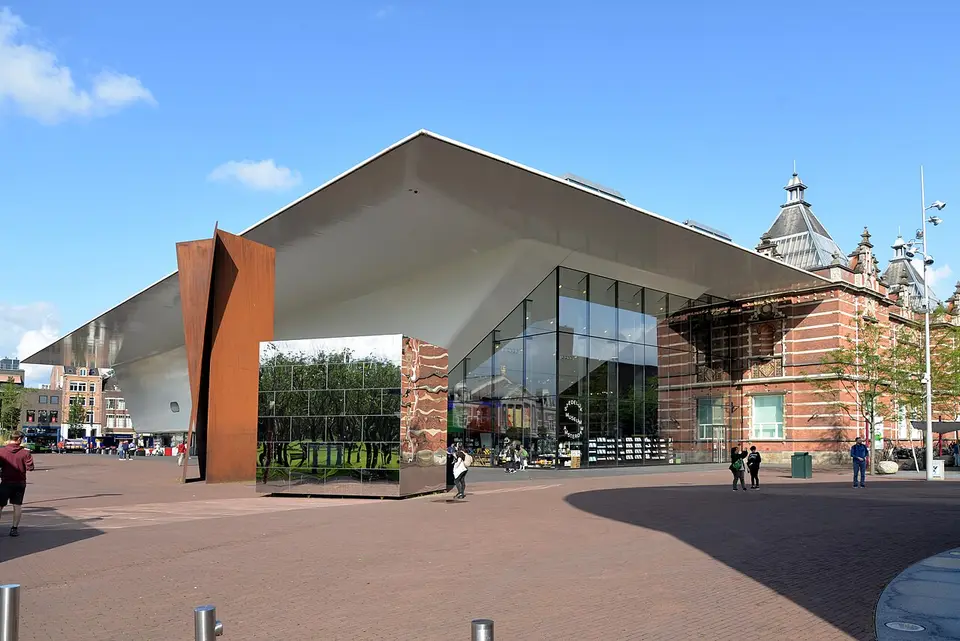
The Stedelijk Museum is Amsterdam’s museum of modern and contemporary art and design. It stands on the Museumplein in two parts: a red-brick building by A.W. Weissman, opened in 1895, and a white wing by Benthem Crouwel Architects, opened in 2012, that Amsterdammers call the bathtub.
Before you hear it, a guess
The new wing is nicknamed the bathtub. What is its smooth white skin made with?
Amsterdam’s museum of modern art has turned its back on its own front door. The brick entrance of 1895 faces the street. Since 2012 you go in from the square, under a white bathtub.
This museum has two fronts, and they do not look related. On the Paulus Potterstraat it is red brick striped with pale stone, with a stepped gable and a small clock tower. On the Museumplein it is a smooth white tub, raised off the ground above walls of glass.
The brick came first. A.W. Weissman, the city architect, designed it, and the years of building, 1892 and 1894, are carved on the street front. It opened in 1895, paid for in good part with money from a rich widow, Sophia Lopez Suasso, and from a family of bankers. It was not yet a museum of modern art. Beside paintings it showed militia banners, dolls, an eighteenth-century kitchen and an old pharmacy. The statues in the niches are painters and master builders of the 16th and 17th centuries.
Modern art took over slowly, and it changed the rooms. In 1938 Willem Sandberg, a curator who later became director, had the red and yellow brick walls inside painted white, so that the art would stand out. White became the colour of the house.
In 2003 the fire brigade had the worn-out building closed. The architects Benthem Crouwel won the job of renewing it. They left Weissman’s building almost whole, lifted part of the new wing into the air and sank the rest underground. They also moved the entrance from the street to the square. The museum reopened in September 2012, and the nickname was waiting: the bathtub.
Look at the tub. Its skin is 271 panels of a material made with a synthetic fibre that is also used in ships, aircraft and tennis rackets. And it is white for a reason. Mels Crouwel, the architect, said that everything was painted in Sandberg’s colour. What Sandberg did to the rooms inside, the bathtub wears on the outside.
“What Sandberg did to the rooms inside, the bathtub wears on the outside.”
What to look for
Two years in stone
On the Paulus Potterstraat, look up at the middle of the brick front. The coat of arms of Amsterdam is cut in stone there, and in the band under the two windows are the years 1892 and 1894.
The men in the niches
Along the same front, statues stand in niches: painters and master builders of the 16th and 17th centuries. At the left corner is Hendrick de Keyser, at the right corner Jacob van Campen.
The empty medallions
Above the upper windows of the brick building are round medallions with nothing in them. Weissman meant to fill them, in time, with portraits of the artists of his own day.
Under the canopy
On the square, stand under the white roof that juts out from the tub. The ground floor beneath it is walled in glass, and the museum’s offices are above your head.
Key facts
- Opened
- 14 September 1895
- Old building
- A.W. Weissman, city architect; built between 1892 and 1894
- New wing
- Benthem Crouwel Architects; designed from 2004, opened 23 September 2012
- Skin of the bathtub
- 271 panels of a composite made with Twaron, a synthetic fibre
- First benefactors
- Sophia Adriana Lopez Suasso-de Bruyn and the Van Eeghen family
- National monument since
- 29 October 1996
- Address
- Museumplein 10, Amsterdam Directions
Close by
The bigger picture
In Amsterdam? Lookstory tells you the story of whatever you’re standing in front of. Point your phone at it.
Open LookstorySources
The dates, names and figures on this page were checked against published references. These are the records for this place. The story is Lookstory’s own telling of them. Last updated October 2026.
- Rijksmonumentenregister, monument 505840
- Stedelijk Museum Amsterdam: Gebouw
- Stedelijk Museum Amsterdam: Geschiedenis
- Stedelijk Museum Amsterdam: History
- Wikidata Q924335
- Wikipedia (Dutch): Adriaan Willem Weissman
- Wikipedia: Stedelijk Museum Amsterdam
- Wikipedia (Dutch): Stedelijk Museum Amsterdam
- Benthem Crouwel Architects: Stedelijk Museum Amsterdam
- Photograph: Calips, CC BY-SA 3.0