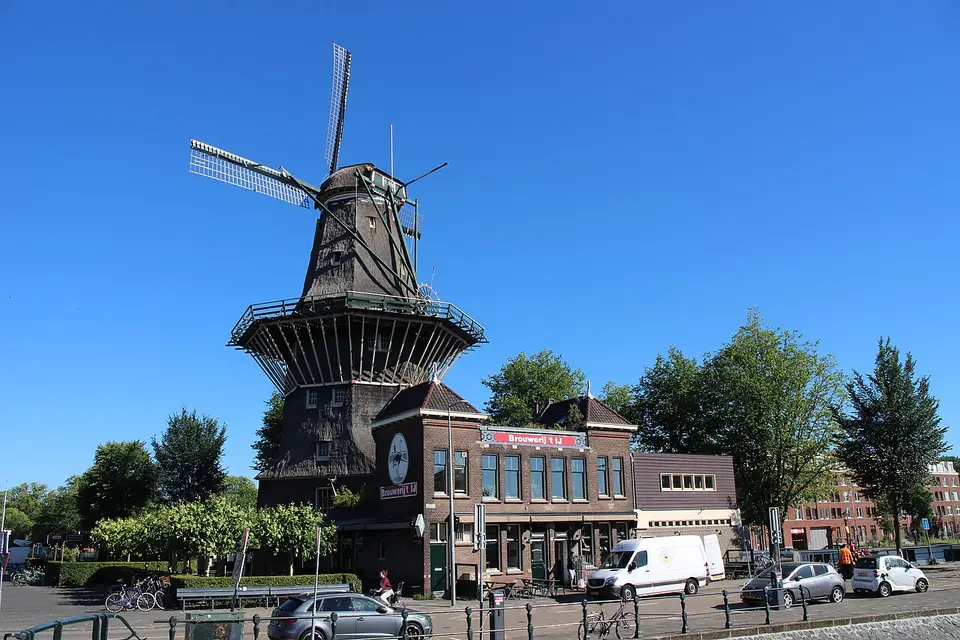
De Gooyer
De Gooyer is a wooden corn mill on the Funenkade, beside the Nieuwe Vaart. It once stood on a bastion of the city wall and was moved here in 1814, onto the stone base of a water mill. It no longer grinds, and Brouwerij ’t IJ is next door.
Before you hear it, a guess
Why was this windmill moved here in 1814?
In 1814 a new army barracks took this mill’s wind. So the city paid to move it here, and set it on the stone base of a water mill that had just been pulled down.
Look up at the wooden gallery that runs round the mill. That is the stage, 17.8 metres up. From it the miller set the sails and turned the cap into the wind. A city mill must be tall to catch a clear wind. Stadsherstel, which owns it, calls it the tallest wooden mill in the Netherlands, and its sails measure 26.6 metres from tip to tip.
A mill called De Gooyer stood outside the city walls long before this one. It was destroyed in 1572, in the Eighty Years’ War. Its name is explained in three ways. The man who rebuilt it was called De Gooijer. In 1603 half of it was sold to two brothers from Gooiland. And some say it was tall enough to look out over the Gooi. Later it moved to the Oosterbeer, a bastion of the city wall, where mills stood beside the cannon. Around 1725 the old mill was replaced by the eight-sided mill you see.
In 1814 the owner went to the city. A new barracks had gone up beside the bastion, and it took the mill’s wind. The city paid to move the mill here, onto the square brick base of a water mill pulled down in 1812. The base was built 3.5 metres higher.
The city bought the mill in 1928 for 3,200 guilders. In the Second World War, when there was no power, it worked as a corn mill. On 13 November 1972 a storm set the sails turning by themselves. The miller could not stop them, the shaft at the top broke, and the sails fell into the Nieuwe Vaart. A new shaft was cast at the Stork works nearby, and in 1976 the mill turned again.
“On 13 November 1972 a storm set the sails turning by themselves.”
The building at its foot is not part of the mill. It was the city’s bathhouse, from 1911, and Brouwerij ’t IJ has brewed there since 1985. The mill does nothing for the brewery, though it is on the labels.
What to look for
The stage
The wooden gallery halfway up is where the miller walked round to set the sails and turn the top of the mill into the wind.
Brick below, wood above
Look at where the dark brick base meets the wooden body. The base is older than the mill’s time here: it belonged to a water mill.
The sails
These are sails of the old Dutch kind, put back in 1976 after the storm. When the mill works, the miller fixes cloth to them from the stage.
The neighbour
The brick building at the foot of the mill was the city’s bathhouse, from 1911. They look like one building, but they never were.
Key facts
- Moved here
- 1814, onto the base of a water mill pulled down in 1812
- Kind of mill
- Corn mill with a stage, eight-sided and thatched
- Span of the sails
- 26.6 metres
- Owner
- Stadsherstel Amsterdam, since 2018
- Monument
- Rijksmonument 1107
- Address
- Funenkade 5, Amsterdam Directions
In Amsterdam? Lookstory tells you the story of whatever you’re standing in front of. Point your phone at it.
Open LookstoryFive questions a day, from wherever you areSources
The dates, names and figures on this page were checked against published references. These are the records for this place. The story is Lookstory’s own telling of them. Last updated October 2026.