Huis Bartolotti
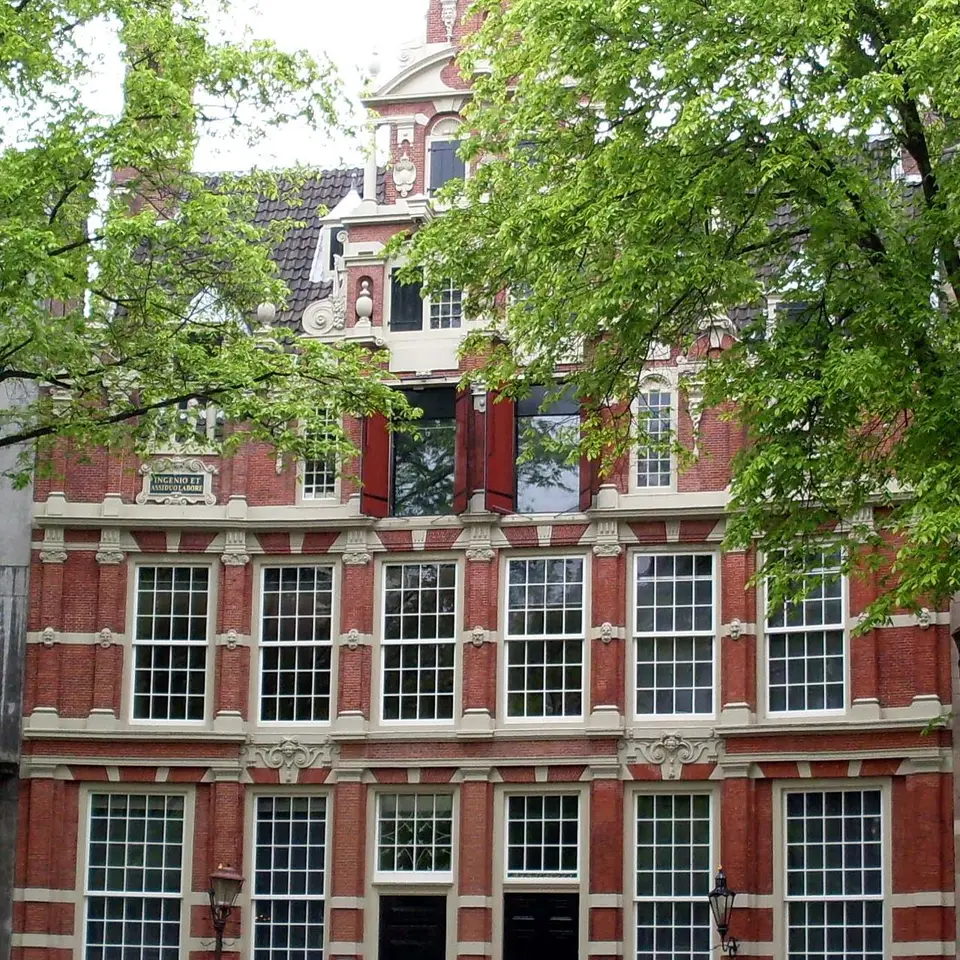
Huis Bartolotti is a wide canal house of about 1617 on the Herengracht, built for one of the richest men in Amsterdam. Its richly decorated front is attributed to Hendrick de Keyser, and it bends to follow the curve of the canal.
Before you hear it, a guess
How did the builder of this house come by the name Bartolotti?
The man who built this house wrote on its front how he had become rich: by ingenuity and hard work. Much of it he had inherited from an uncle.
Start with the name, because it came with the money. The man who had this house built in about 1617 was Willem van den Heuvel, one of the richest people in Amsterdam. He had inherited a great deal from an uncle by marriage who had no children: Giovanni Battista Bartolotti, a merchant from Bologna. The will had a condition. The heir had to call himself Bartolotti.
Now look at how he explained his wealth. On the front are two framed panels with words in Latin. On the left: Ingenio et assiduo labore, by ingenuity and hard work. On the right: Religione et probitate, by religion and honesty. The inheritance is not mentioned.
“The inheritance is not mentioned.”
The front is in the manner of Hendrick de Keyser, and the design is attributed to him; the building of it is put down to his son Pieter. It is covered in decoration: pilasters, bands of stone, masks, vases and scrolls, under a stepped gable. The balustrades beside the gable are a trick. Together with the pilasters there, they suggest another storey, so the house looks taller than it is.
It also bends. The Herengracht curves here, because the old city moat went round a bastion, and the house follows the curve with two kinks. The outermost window on each side is set at an angle.
Only three houses of this early kind, a house with a side house, survive in Amsterdam. One of the others is the Huis met de Hoofden. The society named after De Keyser acquired number 170 in 1924 and number 172 in 1971. The top of the gable, simplified early in the 19th century, was rebuilt, and the year of that work was put on it.
What to look for
The motto
High on the left, a small framed panel reads INGENIO ET ASSIDUO LABORE: by ingenuity and hard work.
The bend
Look along the front from one side. The outermost window on each side stands at an angle to the others, because the house follows the curve of the canal.
The false storey
Find the stone balustrades on either side of the gable. They make the house look a floor taller than it is.
Key facts
- Built
- About 1617, for Willem van den Heuvel
- Design
- Attributed to Hendrick de Keyser
- The mottoes
- Ingenio et assiduo labore; Religione et probitate
- Owner
- Hendrick de Keyser Monumenten, since 1924 and 1971
- Address
- Herengracht 170–172, Amsterdam Directions
- Going inside
- Opening times and tickets are on its own site. Official site
Close by
In Amsterdam? Lookstory tells you the story of whatever you’re standing in front of. Point your phone at it.
Open LookstoryFive questions a day, from wherever you areSources
The dates, names and figures on this page were checked against published references. These are the records for this place. The story is Lookstory’s own telling of them. Last updated October 2026.