Hortus Botanicus
The Hortus Botanicus is Amsterdam’s botanic garden, one of the oldest in the world. The city founded it in 1638 as a garden of medicinal herbs, and it has stood on this plot in the Plantage since 1682. Its palm house dates from 1912 and its large three-climate glasshouse from 1993.
Before you hear it, a guess
The city founded this garden in 1638. What was it for?
Coffee came through this garden. Plants raised under glass here in the early 1700s were given to the king of France, and by the garden’s own tradition the coffee of South America descends from them.
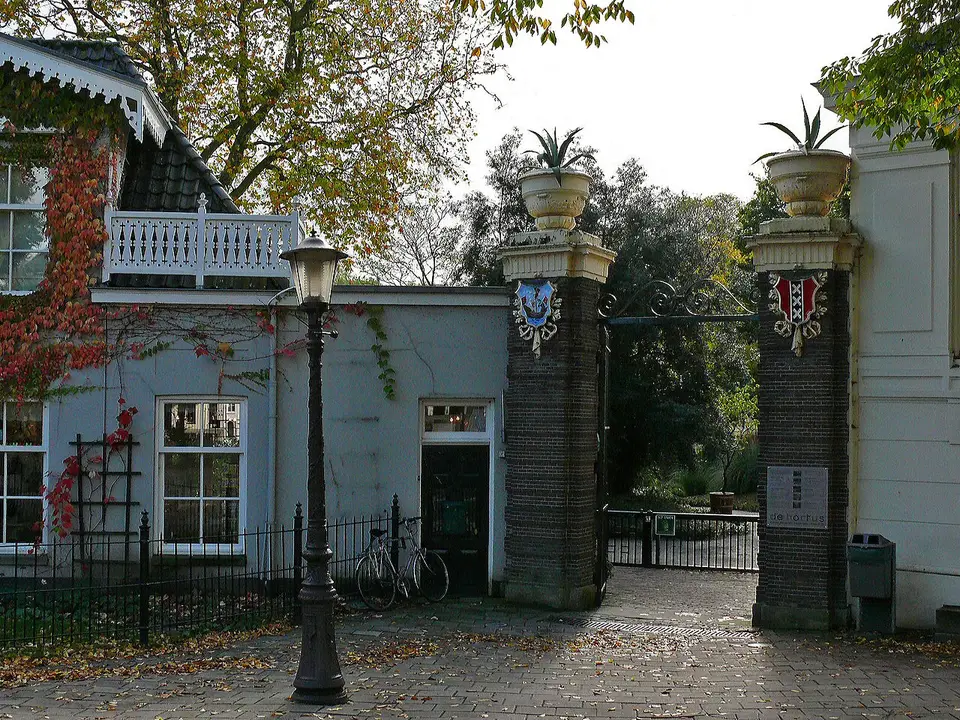
Start at the gate. Two brick pillars stand either side of it, each with a vase on top and a shield on its face: the old arms of Amsterdam and the new. The gate dates from the early 1700s. The garden behind it is older.
The city founded it in 1638 as a garden of medicinal herbs. Plants were the medicines of the day. Doctors and apothecaries came to study them, and apothecaries sat their exams in the garden. In 1682 the city council gave it this plot in the Plantage, and it has not moved since.
Then the ships came in. The Dutch East India Company brought plants home from the Cape, the geranium among them. In 1706 came coffee, grown by the Company at Batavia, now Jakarta. It did well under glass here. A few years later some young plants went to the king of France as a gift. The French took their offspring to their colonies in the Americas, and from there coffee reached Brazil. By the garden’s own tradition, the coffee of South America goes back to a plant grown on this spot.
“By the garden’s own tradition, the coffee of South America goes back to a plant grown on this spot.”
One of its oldest plants lives in the palm house, the brick and glass building with the round roof. It is a cycad from South Africa, a palm-like plant in a tub, and it came to the Netherlands more than three hundred years ago. The palm house itself went up in 1912, to keep the garden’s famous professor, Hugo de Vries, from leaving for America.
In 1986 the university that owned the garden let it go, and it nearly closed. Neighbours and students founded a society of friends and saved it. The huge modern glasshouse followed in 1993, with a jungle, a desert and a piece of South Africa under one roof. From the bridge over the canal you can see it without a ticket: a jungle in a glass box, in a garden that began with herbs for apothecaries.
What to look for
Two coats of arms
Look at the two brick pillars of the gate, below the vases. One shield shows a ship and the other three crosses: the old arms of Amsterdam and the new.
The glass jungle
Go to the Hortusbrug, the bridge over the Nieuwe Herengracht. The huge glasshouse behind the trees is the three-climate house of 1993.
The eight-sided seed house
At the corner of the Plantage Middenlaan and the Plantage Parklaan, behind an iron fence, stands a small eight-sided building with a glass dome on top. Its base is 17th-century, and in 1877 it became the garden’s seed house.
The round roof
From the Plantage Parklaan, look for a round roof of iron and glass with a small lantern and a weathervane on top. That is the palm house of 1912.
Key facts
- Founded
- 1638, by the city, as a garden of medicinal herbs
- On this site since
- 1682
- Entrance gate
- Early 18th century
- Palm house
- 1912, on the initiative of the botanist Hugo de Vries
- Three-climate glasshouse
- 1993
- Eastern Cape giant cycad
- More than 300 years old; bought in 1850 from the collection of King William II
- Address
- Plantage Middenlaan 2a, Amsterdam Directions
Close by
In Amsterdam? Lookstory tells you the story of whatever you’re standing in front of. Point your phone at it.
Open LookstorySources
The dates, names and figures on this page were checked against published references. These are the records for this place. The story is Lookstory’s own telling of them. Last updated October 2026.
- Rijksmonumentenregister, complex 518271 (Hortus Botanicus)
- Rijksmonumentenregister, monument 4110 (entrance gate)
- Rijksmonumentenregister, monument 495304 (palm and fern house)
- Rijksmonumentenregister, monument 518276 (seed house)
- Hortus Botanicus Amsterdam: Snippendaaltuin
- Hortus Botanicus Amsterdam: Palmenkas
- Hortus Botanicus Amsterdam: Cycadeeën
- Hortus Botanicus Amsterdam: De Klimatenkas
- Hortus Botanicus Amsterdam: Plantkundige pionier, Hugo de Vries
- Hortus Botanicus Amsterdam: Plant zoekt dak, the palm house roof
- Hortus Botanicus Amsterdam: Places to enjoy nature in Amsterdam
- Hortus Botanicus Amsterdam: Crown jewels (archived 2019)
- Hortus Botanicus Amsterdam: Coffee (archived 2016)
- Hortus Botanicus Amsterdam: 375 years (archived 2014)
- Hortus Botanicus Amsterdam: Eastern Cape giant cycad (archived 2014)
- Hortus Botanicus Amsterdam: South African plants (archived 2014)
- Hortus Botanicus Amsterdam: History of the Friends (archived 2014)
- Wikidata Q1576733
- Wikipedia: Hortus Botanicus (Amsterdam)
- Wikipedia (Dutch): Hortus Botanicus Amsterdam
- Photograph: Fons Heijnsbroek, CC0